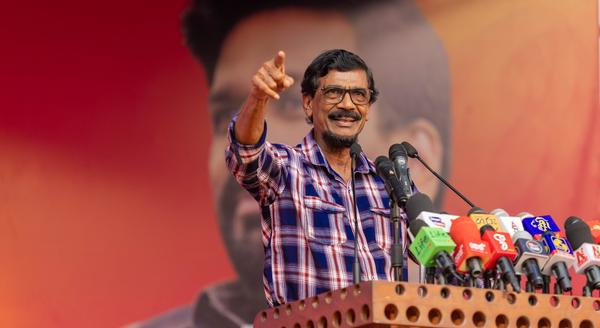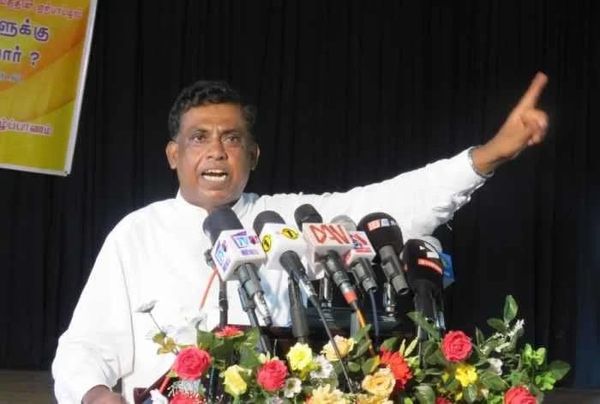
JAFFNA — When former parliamentarian M.K. Sivajilingam stood before reporters recently, his voice unsteady as he appealed for financial assistance to treat kidney failure, the moment resonated far beyond a routine public plea. It triggered a deeper reckoning within sections of the Tamil community — including both those aligned with his Tamil nationalist politics and those who are not.
A veteran of Sri Lanka's turbulent Tamil political landscape and the current chairman of the Valvettithurai Urban Council, the hometown of LTTE leader Velupillai Prabhakaran, Sivajilingam revealed that doctors had warned his condition was critical and that a kidney transplant and related treatment could cost nearly seven million rupees. Having already spent close to 1.9 million rupees, he now faces mounting medical expenses with limited personal means.
What has particularly captured public attention is not merely the appeal itself, but the disclosure that after decades in public life, including two terms in Parliament and service in the Northern Provincial Council, Sivajilingam says he owns no house, land, or vehicle.
In a political culture frequently criticised for patronage networks and personal enrichment, his circumstances have been viewed by many as a rare reflection of personal austerity.
"Seventy lakh rupees is barely a fraction of what some Tamil politicians may receive for helping secure a bar licence," one Tamil political activist, who requested anonymity, told Jaffna Monitor.
Social media platforms have since been flooded with messages recalling Sivajilingam's years of activism, his uncompromising Tamil nationalist positions, and his presence during some of the most politically sensitive phases of post-war Tamil politics.
Public response has also been swift. Small donations from ordinary citizens have been accompanied by larger contributions from organised groups. The France Tamil Traders’ Association, through the Yarl Traders’ Association, donated 2.5 million rupees toward his treatment. Members of the Nallur Pradeshiya Sabha also pledged to contribute their monthly allowances toward his medical expenses in a rare display of cross-party solidarity.
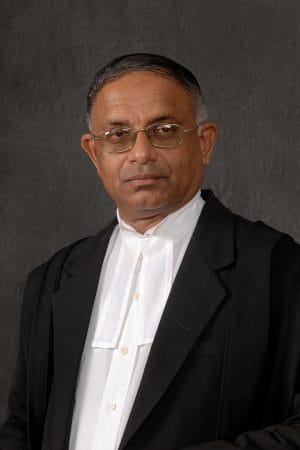
President’s Counsel K.V. Thavarasa, a veteran Tamil nationalist figure and former senior ITAK office-bearer in Colombo, donated one million rupees through the Gowri Shankari Thavarasa Memorial Trust.
Fisheries Minister Ramalingam Chandrasekar also visited Sivajilingam personally. The government has not publicly indicated whether any official financial assistance would be extended, and Chandrasekar's office did not respond to a request for comment.
Survival, Loyalty, and Confrontation
A member of the Tamil Eelam Liberation Organisation (TELO), Sivajilingam narrowly survived the bloody internecine violence of the 1980s, during which the LTTE decimated much of the TELO leadership and cadre.
Yet in the years that followed, Sivajilingam emerged as one of the most outspoken public defenders of the very organisation that had tried to destroy his own. He described Prabhakaran openly as the leader of the Tamil nation, took personal responsibility for the care of Prabhakaran's mother, Parvathy Amma, after the military defeat of the LTTE in 2009, in which Prabhakaran's entire immediate family was killed, and made himself visible at a time when most chose silence.
It was a posture that brought him repeatedly into confrontation with the Sri Lankan state, and more than once to the edge of serious personal danger.
Tamil political circles have long recounted an exchange between Sivajilingam and investigators after he cut a cake commemorating Prabhakaran's birthday years after the end of the war.
"Why did you cut a cake?" investigators reportedly asked. "Was it because he is your relative?"
"Yes, he is a relative," Sivajilingam replied. "But that is not why I cut the cake."
"Then why did you cut the cake?"
"Because he is the leader of the Tamil nation."
When investigators challenged the basis for that description, Sivajilingam was characteristically direct: "Ranil Wickremesinghe signed the peace agreement with Prabhakaran, not with Sivajilingam."
Accounts from journalists and activists further illustrate the texture of that defiance. When Parvathy Amma died in 2011, soldiers at Valvettithurai Hospital allegedly attempted to inspect photographs taken of her body. Sivajilingam intervened, demanding to know why troops needed to scrutinise images of a deceased woman, and accusing the military of fearing "not only the son, but even the mother."
Supporters also credit him with sustaining remembrance practices in the Tamil homeland during years when such events faced heavy restrictions under the governments of Mahinda and Gotabaya Rajapaksa. Nallur Pradeshiya Sabha member Parthipan Varatharajan wrote in a Facebook post that the banana trunks Sivajilingam carried to remembrance events during years of intense military surveillance helped lay the foundation for the emotionally charged commemorations seen in the Tamil homeland today. Many regard him as one of the principal architects of post-war remembrance politics in the north.
Ninety-One Votes in Kurunegala
Transitioning into mainstream politics through the LTTE-backed Tamil National Alliance, Sivajilingam was elected to Parliament in 2001 and again in 2004. In 2010, barely a year after the end of the civil war, he entered the presidential race against the powerful incumbent Mahinda Rajapaksa, polling 9,662 votes — a result some critics argued helped Rajapaksa consolidate Sinhala nationalist support by lending the contest an ethnic dimension it might otherwise have lacked.
Considered by many something of an eccentric figure in Tamil politics, Sivajilingam long resisted easy categorisation. To his supporters, his confrontational gestures were acts of principled defiance in an environment that often punished dissent. To his detractors, they were provocations that at times appeared to serve the interests of his political opponents more than his own cause.
That tension was perhaps nowhere more visible than in his 2015 parliamentary campaign.
Following Rajapaksa's defeat in that year's presidential election, Sivajilingam announced he would contest a parliamentary seat in Kurunegala, a predominantly Sinhalese district, as a protest against Rajapaksa and against President Maithripala Sirisena for allowing the former president to return to electoral politics. He received 91 votes.
Rajapaksa's allies moved quickly to exploit the candidacy, framing it as a confrontation between a Sinhalese-Buddhist former president and a man they described publicly as a relative of Prabhakaran, standing in the Sinhalese heartland. The framing helped Rajapaksa's campaign in the district. Some Tamil political figures accused Sivajilingam of having handed his opponents a gift, whether intentionally or not.
Sivajilingam did not appear troubled by the controversy. For him, the provocation appeared to have been the point.
Today, the man who carried banana trunks through military checkpoints, contested elections he could not win, and cut a birthday cake for a dead leader while soldiers and investigators watched, is asking the public to help pay his hospital bills.
For many Tamils, the appeal has become something more than a medical plea. It is a reminder of what became of a generation that gave its life to a cause shaped by war — and of what, in the end, that war left behind.
Those wishing to contribute toward Sivajilingam’s medical treatment may do so through the following bank account, the details of which were provided by him during the press conference:
Name: M.K. Sivajilingam
Bank: Bank of Ceylon, Bambalapitiya Branch
Account Number: 774688
Account Type: Savings Account