

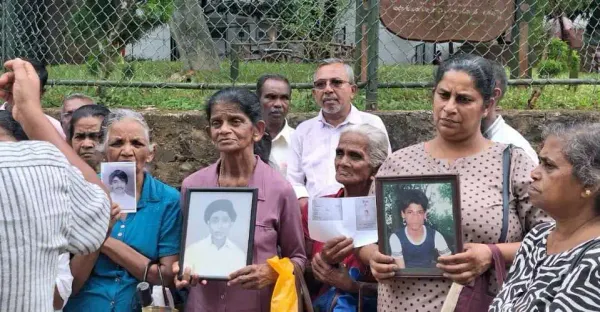
Relatives of young people who disappeared during the state’s crackdown on a Marxist uprising in the late 1980s asked the High Court in Matale on Wednesday to revive a judicial inquiry into a mass grave of 155 bodies. The grave was found on the grounds of the town’s main hospital in 2012, and the case has been dormant since 2015.
The application was filed by the attorneys Himali Kularatne and Lakmal Sooriyagoda on behalf of the Families of the Disappeared, an organisation of relatives of people forcibly disappeared in Sri Lanka at different periods. Among the petitioners are 15 mothers whose family members disappeared during the uprising led by the Janatha Vimukthi Peramuna, or JVP, in the south of the country.
Britto Fernando, the group’s president, said the families were seeking the resumption of the proceedings previously held at the Matale Magistrate’s Court. The attorneys are expected to file written submissions on Jan. 13.
The case reached the High Court after the lower court declined to hear it. In June, the families petitioned the Matale Magistrate’s Court. They asked it to resume the earlier proceedings, investigate whether any of the disappeared are still alive, and build a DNA database to identify the remains. In July, Harshana Dhanushka Ratnayake, the Magistrate and District Judge of Matale, ruled that the court could not reopen a decision made by an earlier judge. On the Attorney General’s advice, he directed the families to a higher court.
A grave in the centre of town
On Nov. 26, 2012, labourers digging on the grounds of the Matale District General Hospital to build a biogas unit struck human remains. The skeletons lay about 1.45 metres below the surface, and heavy earth-moving machinery damaged some of them. By February 2013, investigators had exhumed 155.
None of the dead has been identified. Families, rights groups and the JVP itself have long held that the grave contains Sinhalese youths seized by the security forces during the 1987 to 1990 insurrection. Matale, a Sinhala-majority district in the central hills, was one of the uprising’s strongholds. A 2023 letter from United Nations experts to the Sri Lankan government said state commissions had documented 1,041 cases of enforced disappearance in the district. More than 700 of them took place between May 1989 and January 1990.
Former detainees and rights groups have linked the grave to a school nearby. They say a unit of the army’s Gajaba Regiment ran a detention and torture centre at Vijaya Vidyalaya, also known as Vijaya College, in 1989 and 1990. Residents said at the time that the school is about 100 metres from the hospital. In 2013, a hospital employee said soldiers had been stationed in two of the hospital’s wards during that period. He said no illegal activity took place there.
One mother, Kamalawathi, said in interviews published in 2013 that soldiers took her two sons, aged 18 and 17, from their home in Ukuwela on Dec. 13, 1989. She said they were held at an army camp near Vijaya Vidyalaya. She also said she was turned away at the gate when she went to plead for their release with the district’s military coordinating officer, Lt. Col. Gotabaya Rajapaksa, who later became president of Sri Lanka.
Evidence of torture and a disputed date
The forensic findings were among the most severe recorded at any mass grave in Sri Lanka. Dr. Ajith Jayasena, the consultant judicial medical officer, documented decapitation, dismemberment, skulls cut with saws, and toes that had been nailed. Raj Somadeva, a professor of archaeology at the University of Kelaniya, identified a metal noose on one skeleton’s leg as an adjustable device of the kind used in a hangman’s knot. Professor Somadeva now leads the court-ordered excavation of the Chemmani mass grave in Jaffna. Based in part on a plastic fragment and a bottle found in the Matale grave, he estimated that the burials took place between 1986 and 1990.
In 2013, President Mahinda Rajapaksa appointed a three-member Presidential Commission of Inquiry, chaired by S.I. Imam, a retired Supreme Court justice. Gotabaya Rajapaksa, the president’s younger brother, was then defence secretary. The commission sent bone samples to Beta Analytic, a laboratory in Miami, which found seven of eight samples suitable for testing. Douglas Ubelaker, an American forensic anthropologist, interpreted the results and concluded that the skeletons dated from before 1950.
Professor Somadeva argued that the grave had flooded twice after it was opened, contaminating the samples. The commission found his accounts inconsistent and rejected that argument. It accepted that the victims had been severely tortured and murdered, but said it could not establish who they were, who killed them or why. Forty-seven witnesses told the commission that relatives had disappeared during the insurrection, often taken by men in military or police uniforms. None could link a missing relative to the grave.
The commission submitted its report to the president’s secretary on April 29, 2015. Dr. Jayasena and Professor Somadeva, who had supervised the excavation, later said they rejected its conclusions entirely. The magistrate’s court stayed the case the same year.
Allegations against a former president
Mr. Rajapaksa served as military coordinating officer for Matale from 1989 until January 1990, by which time the uprising had been crushed. He was elected president in 2019 and resigned in 2022 after mass protests over an economic crisis.
In June 2023, four groups published a report accusing Mr. Rajapaksa of obstructing investigations into the grave. They were the International Truth and Justice Project, the Center for Human Rights and Development, Journalists for Democracy in Sri Lanka and the Families of the Disappeared. The report said that after the grave was found, he ordered the destruction of all police records older than five years at police stations in the Central Province, including Matale. Mr. Rajapaksa has not been charged in connection with the grave.
The JVP in government
The case is politically sensitive for the government. The JVP now leads the governing National People’s Power coalition, and some of the dead may have been its own members. After the grave was found, the JVP called for a special court to investigate it and began gathering details of members who had gone missing in Matale between 1987 and 1990. In April 2025, Gamagedara Dissanayake, a deputy minister from the party, told Parliament that 20 torture chambers had operated in Matale District.
In July 2025, Dr. J. Thatparan, executive director of the Office on Missing Persons, said the office hoped to intervene in the Matale case and in Sooriyakanda, another grave linked to the counterinsurgency against the JVP. The government has not publicly said whether it supports the families’ application.
The remains are in the custody of the Judicial Medical Officer. Mr. Fernando said last year that the government had shown no interest in the case so far, and that if this government did not pursue it, no one would.