

THAIYIDDY, Sri Lanka —
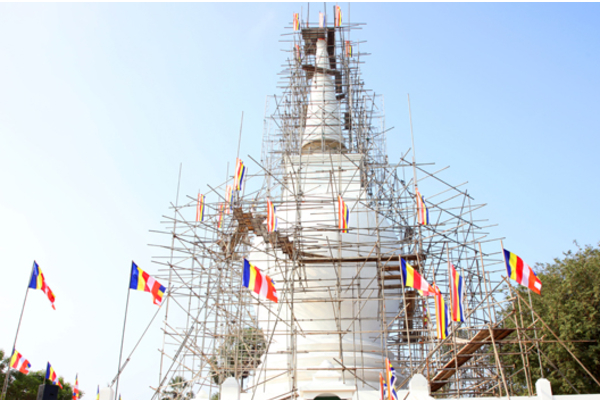
For more than three decades, Sarujan Sukumari and many others were unable to set foot on their family lands. Seized by the military and designated a High Security Zone, the area remained inaccessible even after the war ended in 2009. Years later, as the country settled into an uneasy peace, a Buddhist temple rose on what had once been their ancestral property.
Recently, she and other landowners sat in a government conference room in Jaffna as a cabinet minister and senior survey officials explained that the state intended to measure their land as a step toward returning it.
Ms. Sukumari said she and others agreed to the survey, but remained wary.
“We agreed only after being assured that this is not for acquisition, but to return the lands to the people,” she said, speaking to reporters outside the Jaffna District Secretariat. “We have strong suspicions that surveying the land could be a hidden attempt to acquire it.”
The meeting, attended by the Minister of Fisheries, senior administrative officials and representatives of the Survey Department, was the latest development in a prolonged dispute over land in Thaiyiddy, a small village near Kankesanthurai on Sri Lanka’s northern tip, where a Buddhist temple was constructed on private land with the involvement of the military.
A Temple, a High-Security Zone and a Disappeared Boundary
The dispute centers on a prominent new Buddhist complex — the Tissa Raja Maha Vihara — that has expanded substantially in the years since the war ended. Local residents and civil society groups say the new structures were built on privately owned Tamil land that was absorbed into a military High Security Zone during the conflict and later repurposed, without the knowledge or consent of the original owners.
Supporters of the temple say it represents the restoration of an ancient Buddhist site, citing references in historical chronicles. Some Sinhala-Buddhist narratives point to the Mahavamsa, a 5th-century chronicle of Sri Lanka, which describes King Devanampiya Tissa — who ruled in the 3rd century B.C. and is regarded as the first Sri Lankan ruler to formally embrace Buddhism — as having established monasteries in different parts of the island following the religion’s introduction.
“It has been 36 years since we left our lands,” said Bhaskaran, another landowner who attended Saturday’s meeting and, like many in the area. “Identifying the exact boundaries is a major challenge.”
Promises Made, Suspicions Unresolved
The Saturday meeting was convened, officials said, to address those practical difficulties. The survey, they maintained, was a technical step — a way to map plots and establish legal boundaries before returning them to their original owners. They gave explicit assurances that the exercise was not a prelude to acquisition.
Government officials said the lands could be released to residents within two weeks of completing the survey — a timeline that, if met, would allow families to return before Vesak, the most important Buddhist festival in Sri Lanka, which commemorates the birth, enlightenment and death of the Buddha and falls in early May.
But suspicion ran alongside cautious hope. Residents noted a disparity they found troubling: they were asked to furnish documents proving their ownership of the land, while those connected to the temple were not subjected to equivalent scrutiny.
“Authorities requested documents from residents while not requiring similar proof from those linked to the temple,” Ms. Sukumari said. Officials did not directly respond to that characterization.
Where War’s End Did Not Mean Return
Sixteen years after the end of Sri Lanka’s civil war, the question of land remains unresolved across the Tamil-majority North and East. In Jaffna district alone, officials acknowledge that more than 2,600 acres of privately owned land remain under the control of the military and other security forces.
Activists and local residents have also alleged that entire villages near the Palaly military headquarters, within areas designated as High Security Zones, were completely cleared and demolished in the years after the war, with homes, temples and churches removed, erasing visible traces of what had once been Tamil settlements and making it difficult for former residents to return or substantiate land claims.