

After Delays, Sri Lankan Government Releases Funds for Chemmani Mass Grave Investigation

After Delays, Sri Lankan Government Releases Funds for Chemmani Mass Grave Investigation


Share this post

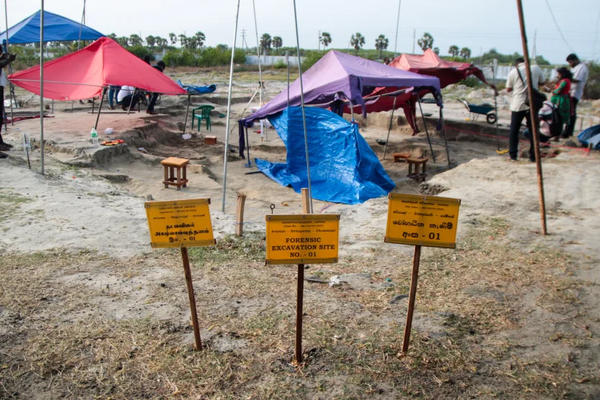
JAFFNA, Sri Lanka — The Sri Lankan government has allocated 21 million rupees for the third phase of excavations at the Chemmani mass grave site, officials said.

The release of funds follows repeated postponements caused by a lack of financial approval and adverse weather conditions that left the site waterlogged. The case is scheduled to be taken up again at the Jaffna Magistrate’s Court on April 21, when authorities are expected to indicate when excavation work will resume.

Chemmani, a village on the outskirts of Jaffna, has long been associated with allegations of enforced disappearances and extrajudicial killings during the final years of the civil war in the north.

The site first drew widespread attention in 1998, when a Sri Lankan Army soldier, testifying in a murder case, told a court that hundreds of bodies of detainees who had disappeared in the mid-1990s had been buried in the area. His account aligned with longstanding claims by families and human rights groups that large numbers of civilians went missing during military operations to retake the Jaffna peninsula in 1995 and 1996.

Court-ordered excavations in 1999 uncovered human remains, but the investigation did not lead to comprehensive identification of victims or prosecutions of senior officials, leaving many questions unresolved.

Interest in the site resurfaced in February 2025, when construction work at a nearby Hindu cremation ground uncovered skeletal remains, prompting a renewed, court-supervised excavation. Since then, investigators have identified around 240 sets of remains, including those believed to be of children and infants, making Chemmani one of the largest officially documented mass grave sites in Sri Lanka .

Despite the renewed effort, progress has been uneven. Excavations have been halted multiple times, including in recent months amid delays in the release of funds, drawing criticism from lawyers representing victims’ families and from rights groups, who say such interruptions risk compromising both evidence and public confidence.

The site is currently secured as a crime scene, with forensic work continuing under judicial oversight. The Human Rights Commission of Sri Lanka has previously noted broader administrative delays in the disbursement of funds for such investigations, while international organizations have called for greater transparency and independent monitoring.


Share this post

Be the first to know

Join our community and get notified about upcoming stories

Subscribing...
You've been subscribed!
Something went wrong
Deepthi Attygalle, Pioneer of Sri Lankan Anaesthesia, Dies at 86
Deepthi Attygalle

Deepthi Attygalle, Pioneer of Sri Lankan Anaesthesia, Dies at 86

Deepthi Attygalle, the Sri Lankan anaesthesiologist whose work on magnesium sulphate became an important reference point in the treatment of severe tetanus, died on June 1, 2026. She was 86. For much of the twentieth century, severe tetanus was managed by heavily sedating patients and supporting them on mechanical ventilators for weeks at a time, a regimen that consumed intensive-care resources often unavailable in many developing countries. At the General Hospital in Colombo, Dr. Attygalle and


Jaffna Monitor

Jaffna Monitor

A Former Tiger's Death in France Raises Questions About Unhealed Wounds

A Former Tiger's Death in France Raises Questions About Unhealed Wounds

By M.R. Narayan Swamy The killing of a former Tamil Tiger in Paris by the police has brought to the fore psychological issues that still affect a huge mass of ex-combatants who mostly lead broken lives after fighting one of the world’s bloodiest insurgencies, which at one point almost broke up Sri Lanka. A large but mostly undocumented army of former guerrillas of the Liberation Tigers of Tamil Eelam (LTTE) now eke out a low-key existence in Sri Lanka, India, and several countries in the West,


M.R. Narayan Swamy

M.R. Narayan Swamy

The Jaffna Bar Association's Letter the Government Did Not Want Written

The Jaffna Bar Association's Letter the Government Did Not Want Written

By Aruliniyan Mahalingam JAFFNA, Sri Lanka — The letter ran to a few hundred words, but its message to the President of Sri Lanka was unambiguous: lawyers in Jaffna, the country's Tamil heartland, believed that the executive branch had reached into the judiciary and moved a judge who had displeased it. That document — an appeal from the Jaffna Bar Association to President Anura Kumara Dissanayake over the abrupt transfer of High Court Judge A.G. Alexraja — was precisely the kind of accusation


Aruliniyan Mahalingam

Aruliniyan Mahalingam

Mano Ganesan Seeks Inquiry Into Whether Government Diverted Election Funds Without Parliamentary Approval

Mano Ganesan Seeks Inquiry Into Whether Government Diverted Election Funds Without Parliamentary Approval

COLOMBO, Sri Lanka — Mano Ganesan, leader of the Democratic People’s Front and a member of Sri Lanka’s opposition, has asked Parliament’s chief financial oversight committee to investigate whether funds allocated for long-delayed Provincial Council elections were diverted to post-cyclone reconstruction efforts without legislative approval. In a letter sent Monday to Dr. Harsha de Silva, chairman of Parliament’s Committee on Public Finance (COPF), Mr. Ganesan requested an inquiry into remarks at


Our Reporter

Our Reporter