

Air Force Denies Radar Plan at Trincomalee Temple Site

Air Force Denies Radar Plan at Trincomalee Temple Site


Share this post

COLOMBO, Sri Lanka — The Sri Lanka Air Force has denied that it plans to install a radar system within the Fort Frederick precinct in Trincomalee, rejecting concerns raised by trustees of the Thirukoneswaram Temple, who had urged the public to oppose what they called a fresh encroachment on sacred land.

Air Force officials, speaking to Jaffna Monitor on condition of anonymity in line with service protocols, said no proposal had been advanced to place radar equipment within the temple grounds or on land claimed by the trustees. They added that the Air Force was not pursuing any installation that would affect the shrine or its immediate surroundings.

The denial follows remarks by a member of the temple’s Board of Trustees, Mr. Jeyasankar, who called on the public on Friday to resist what he said was a planned radar installation. He added that successive security deployments over the years had reduced the extent of land under temple control.

“If land is now allocated for the Air Force as well, we will be left asking what remains of our land,” Mr. Jeyasankar said.

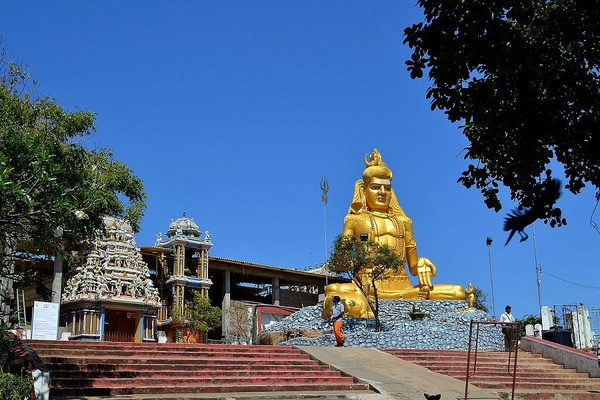
Perched on a rocky promontory overlooking the Indian Ocean, the temple is among Sri Lanka’s most prominent Hindu shrines and is revered as one of the Pancha Ishwarams — the island’s five ancient abodes of Lord Shiva. It draws thousands of devotees from across Sri Lanka and India and remains central to the religious and cultural life of the region.

Mr. Jeyasankar said the temple’s holdings extend to about 247 acres, citing a copper plate grant from the British colonial period as evidence of longstanding land rights. He said earlier security installations had progressively reduced those holdings, citing the closure of a traditional tank at the temple’s entrance, the establishment of a nearby police headquarters, and the construction of a naval facility on Swami Rock, locally known as Nandi Malai.

He questioned why the temple precinct would be considered for such an installation when other locations in the region, including China Bay, could accommodate radar infrastructure without affecting a place of worship.

“There is a need to understand the intention behind choosing this location,” he said.

Air Force officials said reports suggesting otherwise were inaccurate and risked creating unnecessary concern. They said no formal request had been made for land within the Fort Frederick area and that any official position would be communicated through the service’s media directorate if required.

Trincomalee, home to one of the world’s deepest natural harbors, has long hosted a significant military presence, with facilities operated by the army, navy, police and air force across the district. Civil society groups and religious organizations have, over the years, raised concerns about access restrictions and the impact of security infrastructure on historically and religiously significant sites in the area.

It could not be independently established how temple trustees came to believe that a radar installation was planned within the precinct. Officials have not publicly detailed any installation plans in the wider area.


Share this post

Be the first to know

Join our community and get notified about upcoming stories

Subscribing...
You've been subscribed!
Something went wrong
Sri Lankan Parliament Suspended After Chaotic Protest Over Judiciary Debate

Sri Lankan Parliament Suspended After Chaotic Protest Over Judiciary Debate

COLOMBO, Sri Lanka — Sri Lanka’s Parliament descended into disorder on Tuesday when opposition lawmakers protested the government’s refusal to allow an urgent debate on persistent judicial vacancies and a contentious proposal to extend the retirement age of senior judges, prompting the Speaker to suspend proceedings for 10 minutes. The confrontation began after opposition legislators, led by Ajith P. Perera of the Samagi Jana Balawegaya, pressed for immediate discussion of long-unfilled positio


Our Reporter

Our Reporter

U.S. Embassy Announces Transfer of 10 Helicopters to Sri Lanka Air Force
President Anura Kumara Dissanayake attends the induction of TH-57 Sea Ranger helicopters to the Sri Lanka Air Force alongside senior U.S. and Sri Lankan defense officials at Ratmalana Air Force Base on June 23, 2026.

U.S. Embassy Announces Transfer of 10 Helicopters to Sri Lanka Air Force

RATMALANA, Sri Lanka — The United States has transferred 10 TH-57 Sea Ranger (Bell 206) helicopters to the Sri Lanka Air Force, according to a press release issued by the U.S. Embassy in Colombo on Tuesday. The handover took place at Ratmalana Air Force Base in the presence of President Anura Kumara Dissanayake, U.S. Pacific Air Forces Commander General Kevin Schneider, and U.S. Assistant Secretary of State Paul Kapur, the embassy said. According to the U.S. Embassy, the helicopters were trans


Our Reporter

Our Reporter

Ex-Militants in Europe Question Maulana’s Easter Bombings Claims

Ex-Militants in Europe Question Maulana’s Easter Bombings Claims

By M.R. Narayan Swamy When Sivanesathurai Chandrakanthan alias Pillaiyaan was first told that his former aide Azad Maulana was planning to stir up some trouble from Europe, the former’s instant reaction was: “Really? What could it be about?” Pillaiyaan, a former chief minister of Sri Lanka’s Eastern Province, could only recall the mountain of difficulties Mohammed Hanzeer Mohammed Mihilar, alias Maulana, had been in due to his own family problems. The Amparai-born Maulana had apparently


M.R. Narayan Swamy

M.R. Narayan Swamy

The Padmanabha Massacre: The Killing That Foretold a Movement's Isolation

The Padmanabha Massacre: The Killing That Foretold a Movement's Isolation

By M.R. Narayan Swamy When EPRLF leader K. Pathmanabha was gunned down with 12 party colleagues (and two Indians) in Chennai in 1990, it was a clear signal that the LTTE was set to take individual terrorism to a new level even as it waged an armed struggle in Sri Lanka. Most unfortunately, the red flag was mostly ignored by the Indian state, Tamil Nadu politicians, and the larger Sri Lankan Tamil society. Most people in the Indian establishment and among Tamil Nadu leaders viewed the cold-bloo


M.R. Narayan Swamy

M.R. Narayan Swamy