

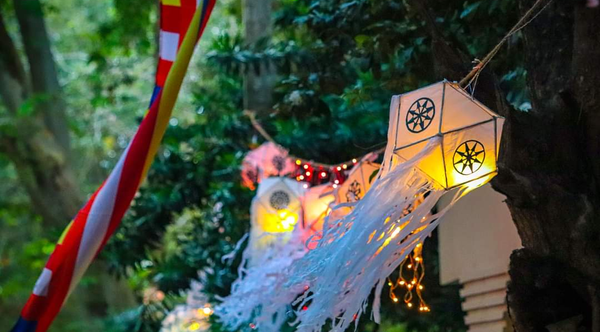
JAFFNA, Sri Lanka — When a few Vesak lanterns erected by Sinhala Buddhist students at the University of Jaffna were vandalized this week, the damage itself was limited. What followed was more unusual: student leaders, university representatives, and even Tamil nationalist politicians quickly united to condemn the act and reject attempts to turn it into an ethnic controversy.
The lanterns, displayed as part of Vesak celebrations at the university’s Faculty of Management Studies and Commerce, were damaged on Sunday night. Photographs of the vandalized decorations soon circulated on social media, where some Sinhala nationalist commentators portrayed the incident as evidence of anti-Buddhist hostility in Sri Lanka’s Tamil-majority Northern Province.
Student representatives at the university offered a sharply different account.
In a statement issued on June 2, the Faculty of Management Studies and Commerce Students’ Union said the Vesak celebration had been organized with the approval and support of the union itself and had received active cooperation from Tamil students.
“The event, which included the display of Vesak lanterns, was conducted with the approval and support of the Students’ Union,” the statement said. “Tamil students actively extended their cooperation and assistance in facilitating the event and ensuring its successful implementation.”
The union said every effort had been made to ensure that Sinhala Buddhist students could freely celebrate one of the most important occasions in the Buddhist calendar.
While strongly condemning the destruction of the lanterns, the union stressed that responsibility should rest solely with those directly involved and not be extended to the wider student population.
“We strongly condemn this act of vandalism and firmly believe that those directly responsible should be identified and subjected to the appropriate disciplinary action,” the statement said.
The union also rejected attempts to portray the incident as reflective of the attitudes of Tamil students generally.
“Such allegations are unfair, misleading, and do not reflect the reality of the situation,” it said.
A separate statement issued by the University of Jaffna Students’ Union echoed those sentiments, condemning the vandalism, affirming the right of all students to practice and celebrate their religious beliefs, and calling for a fair investigation into the incident.
The response was subsequently endorsed by Gajendrakumar Ponnambalam, leader of the Tamil National People’s Front, a politician often associated with hard-line Tamil nationalist positions.
“I wish to fully associate myself and my party with the sentiments of the statement issued by the Management Studies and Commerce Students’ Union,” Mr. Ponnambalam said in a statement.
“All students have the right and the freedom to enjoy their religious and cultural beliefs,” he added. “As such, the Sinhala Buddhist students and others who celebrate Vesak and similar Buddhist occasions have that unfettered right.”
Mr. Ponnambalam called for a full investigation and said those responsible should be dealt with appropriately. The Tamil National People’s Front, he said, condemned the vandalism “unreservedly.”
The convergence of views was notable in a country where even relatively minor incidents have at times been interpreted through the lens of ethnic politics.
Few institutions in Sri Lanka carry the weight of the country’s ethnic history more visibly than the University of Jaffna. Located in the cultural and political heartland of the Tamil community, the university has long been regarded as a barometer of relations between the country’s ethnic groups.
Those relations have occasionally come under strain. In 2016, clashes erupted during a freshers’ event over cultural performances, leaving several students injured and prompting the temporary closure of the university.
The institution itself bears the imprint of Sri Lanka’s civil war. Following the anti-Tamil violence of 1983 and the escalation of the conflict, Sinhala students largely disappeared from the campus. Their numbers began to grow again only after a government-backed reintegration program was introduced in 2011, two years after the war ended.
Several political observers who spoke to Jaffna Monitor said the significance of the episode lay less in the destruction of a few lanterns than in the response that followed. Statements issued by student unions and political leaders differed in emphasis but were remarkably consistent in substance: the vandalism should be condemned, those responsible should be identified, and blame should not be assigned to an entire community.
For many observers, that consensus may have prevented a local act of vandalism from becoming a wider ethnic controversy.
By Monday, the damaged lanterns had become a secondary issue. The more consequential question was whether a small act of vandalism would be allowed to define relations between communities that share the same campus. Judging by the response from students and political leaders alike, there was little appetite for allowing that to happen.