

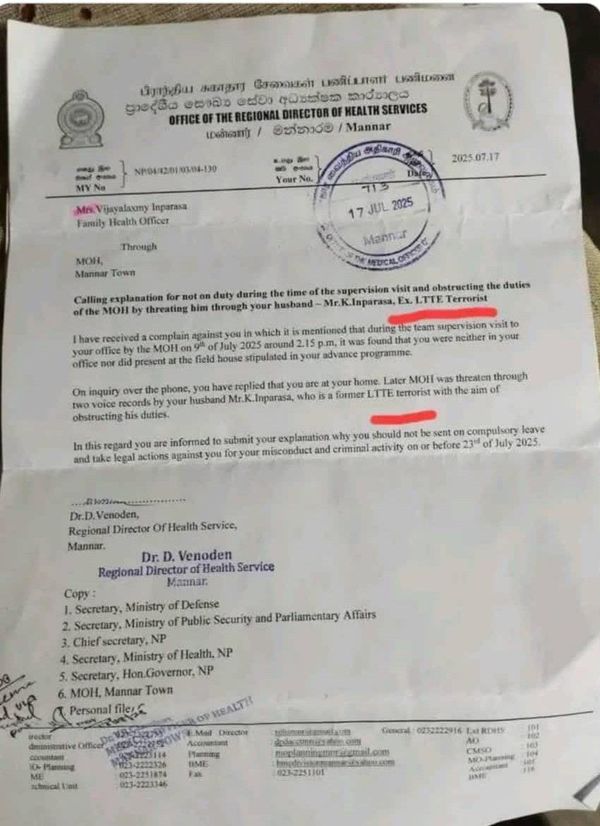
A letter in English — riddled with grammatical mistakes — issued by the Office of the Regional Director of Health Services (RDHS) in Mannar, has ignited strong reactions across sections of the Tamil community after it referred to a former LTTE member as a “terrorist.”
The official letter, signed by Dr. D. Venoden, Regional Director of Health Services, Mannar, was addressed to a Family Health Officer, calling for an explanation regarding her absence during a supervisory visit and for alleged obstruction of duties. The document described her husband, identified as Mr. K. Inparasa, as an “Ex. LTTE Terrorist” (sic), alleging that he had threatened the Medical Officer of Health (MOH) during the incident.


While the letter was ostensibly a disciplinary communication, the explicit use of the word “terrorist” to describe an ex-LTTE cadre — decades after the war — has provoked criticism from various Tamil circles. Critics argue that such terminology reflects an ongoing political and institutional mindset that stigmatises former combatants who, in the Tamil nationalist narrative, are often regarded as having fought for the community’s rights and self-determination.
“This is an extreme display of state loyalty,” one Tamil political commentator remarked, echoing a widely circulating sentiment. “Dr. Venoden has officially labelled the Liberation Tigers of Tamil Eelam, who fought for Tamil liberation, as terrorists. This will naturally cause deep hurt among sections of our people.”
Credible sources told Jaffna Monitor that the dispute between Dr. Venoden and Inparasa is far from new. Inparasa, a former LTTE intelligence wing member who operated under Trincomalee intelligence chief Kalayan and was known by his LTTE name, ‘Kamal’, surrendered to the military during the final phase of the war and completed government rehabilitation.
Following his release, he formed a small political group called the Rehabilitated Tamil Liberation Tigers Party and became the sole voice in Sri Lanka publicly claiming that LTTE leader Velupillai Prabhakaran was still alive. He also attempted to lend legitimacy to a Swiss-based woman, Thuvaraga, who falsely posed as Prabhakaran’s daughter. Sources allege that he regularly receives financial support from sections of the LTTE diaspora who continue to promote the narrative that Prabhakaran is alive.
The long-running friction between Inparasa and Dr. Venoden reportedly stems from Inparasa’s gathering of documents and other material alleging that the RDHS misused official funds and vehicles for personal purposes. Credible sources suggest there is some merit to these claims. These findings, they say, were intended to politically and administratively trouble Dr. Venoden — a move that has reportedly infuriated the health official.
The controversy arose when Inparasa’s wife — employed as a health assistant — was found at home during official duty hours, allegedly prompting Dr. Venoden to initiate disciplinary action.
The recent letter’s language, however — specifically referring to Inparasa as an “Ex. LTTE Terrorist” (sic) — may have been a calculated choice, according to a Mannar hospital source who spoke to Jaffna Monitor. The terminology went well beyond routine procedural matters, reigniting the broader and sensitive debate over how state officials should refer to former LTTE members in official documents.
Observers note that while Dr. Venoden’s choice of words has inflamed community sentiment and risks deepening mistrust in a post-war setting, Inparasa’s own past actions — including his controversial political stances and personal targeting of the RDHS — have contributed to an atmosphere of hostility and retaliation.
As of now, there has been no official response from Dr. Venoden to the criticism, and the Ministry of Health has not commented on whether the terminology in the letter aligns with departmental guidelines.
Grammar Check: 7 Mistakes in One Short Letter

At Jaffna Monitor, we sometimes admit to being more interested in the grammar than the politics. The July 17 letter from the Mannar RDHS is short — just under 250 words — but it still manages to contain seven clear grammatical mistakes. Here’s the breakdown:
1.“Complain” instead of “Complaint”
“Complain” is a verb (e.g., I complain about the noise). Here, the noun “complaint” is needed because it refers to a formal report.
2.“Did present” instead of “Was present”
“Did present” usually means giving a presentation. The intended meaning is about being physically there, so it should be “was present.”
3.“Threaten” instead of “Threatened”
The letter describes a past incident, so it should be in the past tense — “threatened.”
4.“Ex. LTTE Terrorist”
The period after “Ex” is wrong. Correct usage is “Ex-LTTE terrorist” or “Former LTTE terrorist.” Also, “terrorist” should be lowercase here.
5.“Two voice records”
This is clumsy. “Two voice recordings” is the proper term in English.
6.“Take legal actions”
In this context, “legal action” is an uncountable noun, so it should be singular unless talking about multiple separate legal steps.
7.Missing articles and punctuation
Missing “a” or “the” in key places, plus absent commas, make sentences awkward and harder to read.
In short, the letter was meant as a formal warning — but it has ended up a formal joke because of its grammar mistakes.