
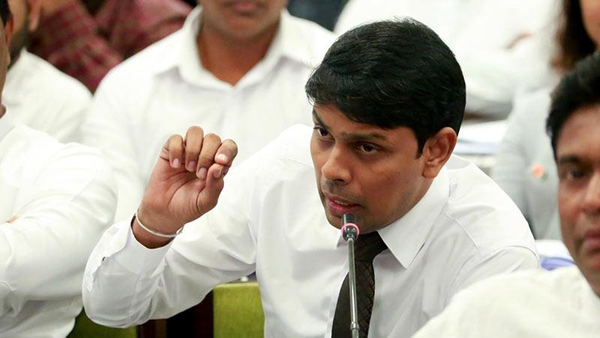
COLOMBO, Sri Lanka — A heated confrontation in Sri Lanka’s Parliament on Friday over an arrest warrant issued against Jaffna District independent MP Ramanathan Archchuna exposed a broader constitutional question: What happens when a Member of Parliament is required to appear before court on the same day Parliament is sitting?
Opposition lawmakers argued that the warrant infringed upon parliamentary privilege and interfered with an elected legislator’s constitutional duties. Government members countered that Members of Parliament remain subject to the ordinary processes of the courts.
The legal position, however, is more nuanced than the political exchanges suggested..
The warrant
The Colombo Fort Magistrate’s Court issued an arrest warrant for Archchuna after he failed to appear in a criminal case in which he is accused of obstructing Fort Police officers in the discharge of their duties. According to court proceedings, his sureties were also absent when the case was called.
Several hours later, Archchuna was attending Parliament, where lawmakers were debating a no-confidence motion against Justice and National Integration Minister Harshana Nanayakkara.
Interrupting the debate, Archchuna raised a question of parliamentary privilege.
He told the House that although he was attending Parliament, an arrest warrant had been issued against him for failing to appear before the court.
The intervention immediately triggered a constitutional debate.
Opposition Leader Sajith Premadasa argued that an elected Member of Parliament has both the right and the duty to attend parliamentary sittings and that no institution should obstruct a legislator from carrying out those responsibilities.
Samagi Jana Balawegaya MP Harsha de Silva similarly argued that issuing an arrest warrant against a member attending Parliament raised a question of parliamentary privilege requiring the attention of the Speaker.
Deputy Speaker Rizvie Salih declined to make a ruling, saying the matter fell within the jurisdiction of the courts.
Instead, he asked Archchuna whether the court had been informed that he would be attending Parliament.
Archchuna replied that his lawyers had appeared before the magistrate while he himself attended the parliamentary sitting.
Government members rejected the opposition’s interpretation.
Deputy Minister of Public Security and Parliamentary Affairs Sunil Watagala said defendants in both civil and criminal proceedings are required to appear before the court, and that the parliamentary office does not exempt a person from complying with judicial process.
Urban Development Minister Anura Karunathilaka said Parliament had heard only one side of the dispute and could not determine whether the warrant had been properly issued without knowing what had transpired before the magistrate.
What does the law actually say?
The Constitution does not give Members of Parliament a general immunity from court proceedings.
Article 67 provides that the powers, privileges, and immunities of Parliament and its members are those established by law, principally through the Parliament (Powers and Privileges) Act.
The provision most frequently cited in disputes of this nature is Section 5 of that Act.
Section 5 protects a Member of Parliament from arrest, detention, or molestation “in respect of any debt or matter which may be the subject of civil proceeding” while travelling to Parliament, attending a sitting or returning from one. The section is headed “Freedom from arrest in civil proceedings.”
Legal practitioners familiar with parliamentary law told Jaffna Monitor that the section is confined to civil proceedings and does not create a comparable protection in criminal cases.
Because the proceedings against Archchuna arise from a criminal charge, they said, Section 5 does not exempt him from complying with a court summons or from appearing in person.
They also noted that while Section 7 extends to Sri Lankan Members of Parliament the privileges traditionally enjoyed by the House of Commons, nothing in the Act creates a general immunity from criminal proceedings.
When Parliament and court sit on the same day
The law does not establish an automatic rule giving parliamentary sittings priority over court proceedings.
Lawyers familiar with parliamentary practice told Jaffna Monitor that where a Member of Parliament is unable to attend court because Parliament is sitting, the accepted practice is to notify the court through counsel and seek either an adjournment or an exemption from personal appearance.
Whether such a request should be granted is entirely a matter for the presiding judge.
If the court accepts the explanation, it may excuse the appearance or postpone the hearing. If it is not satisfied, it may proceed under the ordinary law, including issuing an arrest warrant where the legal requirements are met.
That makes one exchange in Parliament particularly significant.
Deputy Speaker Salih specifically asked Archchuna whether the magistrate had been informed that he would be attending Parliament.
Archchuna replied that his lawyers had appeared before the court while he attended the parliamentary sitting.
Legal experts who spoke to Jaffna Monitor said the legality of the warrant cannot be assessed solely from the parliamentary debate. They said the decisive question is whether the magistrate was informed in advance of Archchuna's parliamentary attendance and, if so, whether the explanation placed before the court was legally sufficient to excuse his absence.
The precise reasons recorded by the magistrate for issuing the warrant were not immediately available to Jaffna Monitor. Until those reasons are known, it is not possible to determine whether the court rejected an explanation that was presented or whether no legally sufficient explanation was placed before the court, the experts said.
Separate constitutional roles
Legal practitioners who spoke to Jaffna Monitor said Parliament and the judiciary exercise distinct constitutional functions and that neither institution can assume the powers of the other.
They said Parliament may determine whether one of its own privileges has been infringed during parliamentary proceedings, but it has no authority to suspend, cancel, or invalidate an order issued by a court. Likewise, they said, the lawfulness of an arrest warrant is a judicial question that may be challenged only through the courts.
For that reason, the experts said, Friday's dispute ultimately turns not on the fact that Parliament was sitting when the warrant was issued, but on whether the magistrate had before the court a legally sufficient explanation for Archchuna's absence and, after considering that explanation, had lawful grounds to issue the warrant.
The magistrate's reasons for issuing the warrant were not immediately available to Jaffna Monitor. Until those reasons are known, the experts said, it is not possible to determine whether the court rejected an explanation that was placed before it or whether no legally sufficient explanation was presented.