

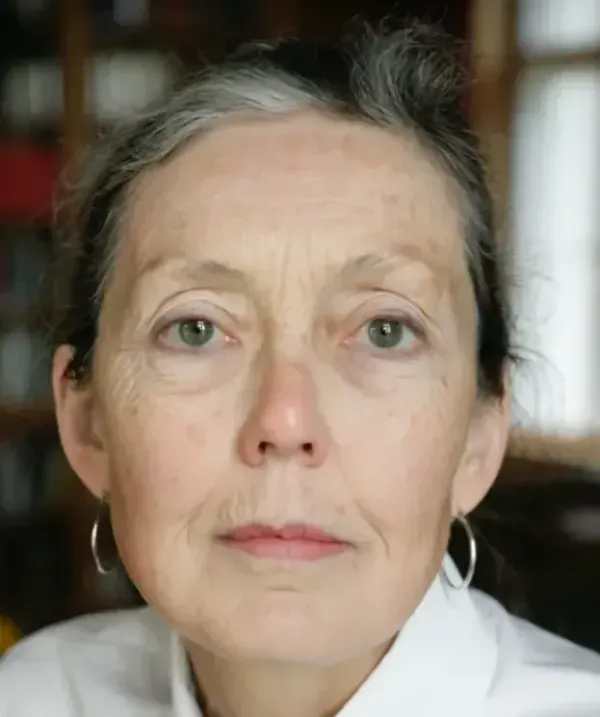
STOCKHOLM: Anne Carson, the Canadian poet, essayist and translator whose books fold ancient Greek literature into verse novels, essays, performance pieces and comics, won the Nobel Prize in Literature on Thursday.
The Swedish Academy cited Ms. Carson "for her bold and inventive oeuvre that, in playful dialogue with the classical tradition, has created new forms for contemporary literature." The prize, awarded for a writer's entire body of work, carries 12 million Swedish kronor, about $1.2 million (roughly 397 million Sri Lankan rupees), and will be presented in Stockholm on Dec. 10.
Ingrid Carlberg, the academy's permanent secretary, told reporters that she had reached Ms. Carson by phone shortly before the announcement. The call was short. Ms. Carlberg said Ms. Carson was in Iceland, "where she is listening to the wind."
"She was taken by surprise but very happy," Ms. Carlberg said. "I could hear that in her voice."
Her American editor had less luck. Declan Spring of New Directions said that when he called to congratulate her, he got a message that her phone was switched off. He described her as shy.
Ms. Carson, 76, is the third Canadian-born writer to win the prize, after Saul Bellow in 1976 and Alice Munro in 2013, and the first poet to win since Louise Glück in 2020. She had been a favorite with critics and bookmakers for years. This year, the betting markets narrowed to two women, Ms. Carson and the Chinese avant-garde writer Can Xue. Since 2018, the academy has alternated between male and female laureates, partly in response to criticism that the prize had gone overwhelmingly to men. Last year's award went to the Hungarian novelist László Krasznahorkai.
Anders Olsson, who chairs the academy's Nobel committee for literature, said Ms. Carson had "broken away from lyrical poetry bound to the narrative self and inspired new forms of contemporary literature."
"This method of writing leads to playful and ironic works that move not only between classical and modern poetry but also between different genres and art forms," he said.
Ms. Carson was born in Toronto in 1950. Her father was a banker, and the family moved several times around Canada for his work. She was drawn to ancient Greek in high school and later studied classics at the University of Toronto. She taught at the University of Calgary and McGill University as her writing career began, and later at Cornell, Princeton, New York University and the University of Michigan. She lives in Michigan and has held Icelandic citizenship since 2022.
Her first book, "Eros the Bittersweet" (1986), was a book-length essay on erotic love in Greek poetry, drawn from her doctoral work on Sappho. The Nobel committee cited it along with "The Glass Essay" (1995), a long poem about the end of a love affair that moves between the poet's own grief and the life of Emily Brontë.
Her best-known book, "Autobiography of Red" (1998), takes the surviving fragments of an ancient poem by Stesichorus about Geryon, a red, winged monster killed by Herakles, and turns them into a novel in verse about a troubled teenage boy and a love affair that wrecks him. She returned to the characters in "Red Doc >" (2013), which follows them on a road trip. "The Beauty of the Husband" (2001), about a failing marriage, made her the first woman to win Britain's T.S. Eliot Prize.
One of her earliest champions was Michael Ondaatje, the Sri Lankan-born Canadian novelist best known for "The English Patient." In the late 1990s, when Ms. Carson was still little read in her own country, Mr. Ondaatje called her "the most exciting poet writing in English today." The line appeared on the cover of "Autobiography of Red," and publishers and critics have repeated it for more than two decades. When she won the T.S. Eliot Prize, The Times of London introduced her to its readers as the poet Mr. Ondaatje had praised.
She has translated 10 Greek tragedies, often in deliberately contemporary language. Her version of Sophocles' "Elektra," starring Brie Larson, was staged in London last year. In "Norma Jeane Baker of Troy" (2019), a performance piece, she paired Helen of Troy with Marilyn Monroe. "The Trojan Women: A Comic" (2021), made with the artist Rosanna Bruno, retells Euripides as a graphic novel.
The committee also pointed to "Wrong Norma" (2024), a collection that was nominated for the National Book Award. Its pieces range from her father to snow to Roget's Thesaurus. Ms. Carson says nothing connects them, which is why she called them wrong.
She has kept her private life out of public view. Her books seldom carry an author photograph, and some have no biography at all. In an essay for the London Review of Books in August 2024, she disclosed that she has Parkinson's disease. She wrote that her handwriting, which once filled shelves of notebooks, had "disintegrated," and that she had taken up boxing classes to help manage the symptoms.
Her earlier honors include a MacArthur fellowship and Spain's Princess of Asturias Award. She has twice won the Griffin Poetry Prize, one of the world's richest awards for a single collection of poetry, which was founded in Toronto in 2000 with Mr. Ondaatje among its original trustees. She took its first Canadian prize in 2001, for "Men in the Off Hours," and in 2014 became its first two-time winner, with "Red Doc >."
She has also worked with musicians and choreographers, including Laurie Anderson, Lou Reed and the Merce Cunningham Dance Company.
"Her collaborations with visual artists and choreographers and with opera and theatre directors demonstrate the freedom with which she relates to literary expectations and rule systems," Mr. Olsson said. "It is this that lies behind the outstanding importance her work since the 1990s has had for the international art and literature scene."