
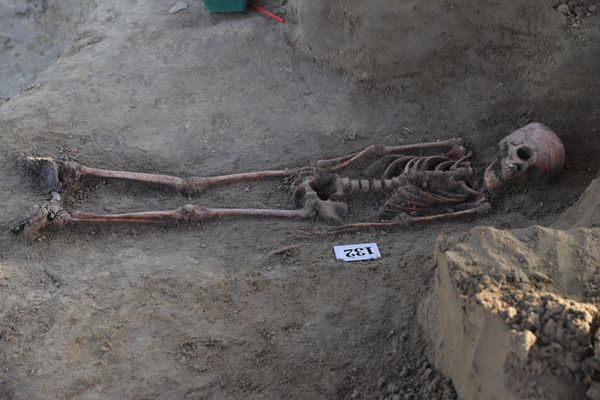
JAFFNA, Sri Lanka — Excavations at the Chemmani mass grave end on Wednesday with 582 sets of human remains identified, among them those of children, and no decision on whether digging will resume before a court date in October.
Wednesday is the 56th and final day authorised by the court for the third phase of the excavation, and the 110th day of digging at the site on the outskirts of Jaffna since work began in May last year. Whether a fourth phase goes ahead rests on a hearing set for Oct. 14, when the Jaffna Magistrate’s Court is due to take up reports on the excavation, including findings from a ground-penetrating radar survey and an account of the evidence recovered so far.
Ten more sets of remains, one of them a child’s, were identified on Tuesday, taking the total to 582. Eight sets were exhumed during the day, bringing the number fully recovered to 573 and leaving nine identified sets still in the ground as the phase closes.
Investigators also recovered three further items of evidentiary value on Tuesday: an amulet of the kind traditionally tied around the waist, coins, and fragments of iron objects. That takes the number of items recovered from the site to 169.
Remains have continued to emerge at a steady rate through the final week of the authorised period, with no sign in the recent days’ work that the site is exhausted. Test pits dug at random points around the excavation to establish whether burials extend beyond the area under investigation have themselves yielded remains, including a headless skeleton with its hands bound across its chest.
Chemmani is now the largest mass grave uncovered in Sri Lanka, having surpassed the Mannar Sathosa site. Investigators have found infants and young children buried alongside adults, in clusters and stacked one above another, together with clothing, feeding bottles, toys and beads.
The identification of the dead has not begun. The remains establish neither who the dead were, nor when they died, nor how they came to be buried at the site. Those questions require forensic work that has yet to start.
The site has been associated with disappearances in Jaffna since 1998, when Somaratne Rajapakse, a soldier convicted in the rape and murder of the schoolgirl Krishanthi Kumaraswamy, alleged that hundreds of bodies of disappeared Tamils lay buried at Chemmani. An internationally observed excavation the following year recovered 15 bodies, two of them identified as men who disappeared in 1996.
The current investigation began after construction work near a Hindu cremation ground uncovered skeletal remains in February 2025. The Jaffna Magistrate’s Court ordered a forensic excavation, which started in May 2025 and ran for 54 days across two phases before funding was exhausted in September. Work resumed in April this year, after the government allocated 21 million rupees for a third phase.
Relatives of the disappeared have pressed for international involvement in the investigation. When ambassadors from the European Union, France, Germany, Italy and the Netherlands visited the site in July, families staged a protest and handed over a memorandum calling for an international inquiry. Their fear is that Chemmani will end where Mannar did: excavations near the Sacred Heart Church in 2018 recovered 346 skeletons, 29 of them children, and produced no identifications and no prosecutions.
The close of the third phase leaves the dig idle for almost two months while the court considers whether it continues.