

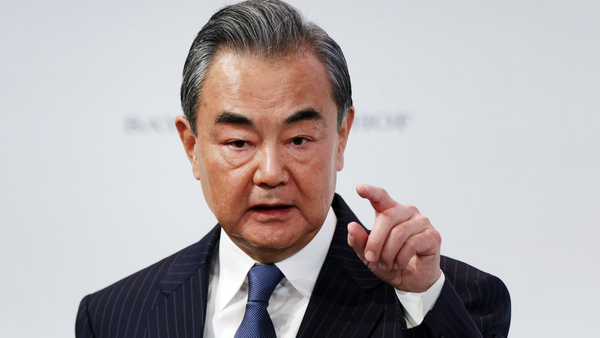
UNITED NATIONS — China's Foreign Minister Wang Yi called on the United Nations Security Council to reassert its authority over international security matters and urged member states to stop bypassing the body through unilateral military action and sanctions — remarks widely read as a pointed critique of the United States conduct in global affairs.
Speaking at a high-level Security Council meeting on the theme "Upholding the Purposes and Principles of the U.N. Charter and Strengthening the U.N.-Centred International System," Wang argued that the current disorder in international affairs stems not from any deficiency in the U.N. Charter but from member states' failure to observe it.
"The root cause of the chaos in today's world is not that the Charter's spirit is outdated," Wang said, "but that the international order and the basic norms governing international relations, both set out in the Charter, are not being effectively upheld and observed."
On Sovereignty and the Use of Force
Without naming the United States directly, Wang called any unilateral military action that bypasses the Security Council "unacceptable," and said sanctions imposed beyond the Council's explicit resolutions "lack legitimacy." He called on all states — and "major countries in particular" — to lead by example in following the rule of law and to avoid what he described as double standards, exceptionalism, and selective application of international norms.
Wang also invoked the post-World War II international settlement, calling on states to "uphold the victorious outcomes of World War II" and oppose any glorification of the history of aggression — a phrase that carries resonance in the context of ongoing tensions over Japan's wartime record and Russia's conduct in Ukraine.
On the Security Council
Wang urged the five permanent members of the Security Council to increase communication and coordination on major proposals, seek common ground, and reduce confrontation. Membership of the Council, he said, carried responsibilities rather than privileges, and members should "rise above narrow national interests" and use international public goods responsibly.
He also called for reforms to the Council's Rules of Procedure to ensure proposals are objective and inclusive, and warned against "forcing through contentious proposals." U.N. peacekeeping operations, he added, should be assessed for their value and effectiveness and reformed where necessary.
On Development and Economic Governance
Wang said development must remain at the centre of the international agenda, describing implementation of the Sustainable Development Goals as "woefully behind schedule." He called on the U.N. to coordinate global actions, mobilise resources, and pressure developed countries to deliver on financing pledges.
He called explicitly for opposition to protectionism, the securitising of economic and trade issues, technology blockades, decoupling, and the severing of supply chains — language in direct tension with Washington's export controls on semiconductors and advanced technology, and its restrictions on Chinese firms.
Wang further called for increased representation of developing countries at the International Monetary Fund and the World Bank, and expressed support for stronger U.N. dialogue with BRICS, the G20, the New Development Bank, and the Asian Infrastructure Investment Bank.
On AI, Outer Space, and Emerging Domains
On artificial intelligence, Wang called for the prompt establishment of institutional guardrails with the U.N. at the centre, citing moral and security risks posed by AI development. He announced that China is preparing to launch a World Artificial Intelligence Cooperation Organization.
He also called for comprehensive governance frameworks for outer space, the polar regions, and cyberspace, warning against allowing new frontiers to become "lawless domains of zero-sum competition."
On U.N. Reform and Financing
Wang said the U.N.'s role should be enhanced, not weakened, and criticised member states that "willfully withdraw from treaties and organizations" or establish alternatives to the multilateral system — another implicit reference to U.S. withdrawals from multilateral bodies and agreements under recent administrations.
He backed early delivery of what he called the U.N. 80 Initiative, calling for streamlining of overlapping U.N. bodies and mandates, better integration of resources, and a culture of efficiency. He urged member states to fulfil their financial obligations to the U.N., noting that China is the second largest contributor to the U.N. budget.
On Ukraine and Hotspot Conflicts
Wang reiterated China's position on the Ukraine conflict, saying Beijing had initiated a "Group of Friends for Peace" at the U.N. platform and continued to contribute wisdom and effort to maintaining world peace. China has refused to condemn Russia's invasion of Ukraine, and has presented itself as a neutral mediator — a characterisation contested by Western governments.
He expressed support for the U.N. playing a bigger role in political settlements of hotspot issues, and called for an integrated mediation model encompassing the U.N., regional organisations, stakeholders, and specialised agencies.
On Climate
Wang called for expedited climate action and the establishment of regular audit and accountability mechanisms to track whether financial and technology assistance commitments have been fulfilled.
On China's Record at the U.N.
The session fell on the 55th anniversary of the restoration of the People's Republic of China's seat in the United Nations, a milestone Wang invoked to frame China as a long-standing and responsible pillar of the multilateral system.
He cited China's record of U.N. peacekeeping contributions, its Global Development Initiative — which he said had mobilised more than $23 billion in funds, supported over 1,800 cooperation projects, delivered more than 10,000 capacity-building programmes, and trained over 200,000 professionals — and its offer to assist the Democratic Republic of Congo and Uganda with a current Ebola outbreak. He noted that Chinese medical teams were already deployed in Africa fighting the disease alongside African health workers.
Wang also cited China's establishment of the China-U.N. Peace and Development Fund, the Global Development and South-South Cooperation Fund, the International Organization for Mediation, and the World Data Organization, and said Beijing was actively bidding to host the secretariat of the agreement on biodiversity beyond national jurisdiction, known as BBNJ.
He closed by framing China's forthcoming 15th Five-Year Plan as a new point of departure from which Beijing would continue to pursue "greater unity under the banner of multilateralism" and push for a more just and equitable global governance system.
The meeting was attended by U.N. Secretary General António Guterres, who briefed the Council before Wang's remarks.