

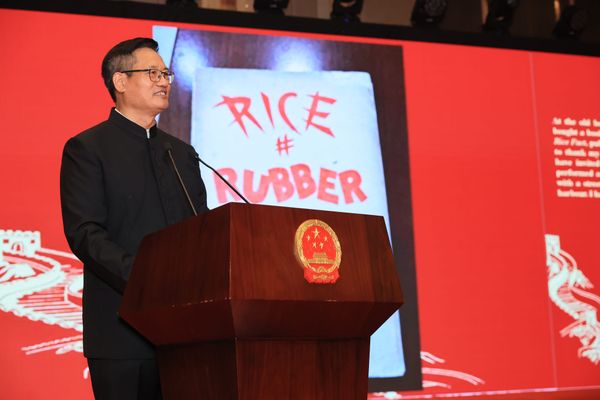
COLOMBO: China's new ambassador to Sri Lanka, Wei Huaxiang, said on Wednesday that the 1952 Rubber-Rice Pact was "a valuable historical legacy for China and Sri Lanka" and should guide relations between the two countries as they prepare to mark 70 years of diplomatic ties next year.
"China stands ready to work with Sri Lanka to continue carrying forward the spirit of independence, self-reliance, solidarity and mutual assistance enshrined in the Rubber-Rice Pact," Mr. Wei said at a reception at the Shangri-La hotel in Colombo to mark the 77th anniversary of the founding of the People's Republic of China.
Under the pact, Ceylon, as Sri Lanka was then known, traded rubber to China in exchange for rice during the Korean War, despite a Western embargo on Beijing. Next year also marks the pact's 75th anniversary. Mr. Wei said China was ready to work with Sri Lanka to "eliminate interference and meet challenges together."
It was Mr. Wei's first major public address since taking up the post. He arrived in Colombo on Aug. 11, succeeding Qi Zhenhong, who served as ambassador for nearly six years, and presented his credentials to President Anura Kumara Dissanayake on Aug. 25.
Mr. Wei opened with greetings in Sinhala, Tamil and Arabic. He told guests he had bought a 1953 book on the Rubber-Rice Pact at a secondhand book market in Colombo and had sung with a street performer at the fishing harbor in Galle. He said he had invited both the bookseller and the singer to the reception.
The ambassador also highlighted China’s economic performance, saying the economy grew 4.7 percent in the first half of the year. He said renewable energy now accounts for 61 percent of China’s installed power capacity and that the country exported more than two million new-energy vehicles during the same period.
Mr. Wei said Colombo Port City and Hambantota Port were "thriving." Hambantota was leased to a Chinese state-owned company for 99 years in 2017 after Sri Lanka had difficulty repaying the loans used to build it. Sri Lanka defaulted on its foreign debt in 2022, and China was among the creditors in the restructuring that followed.
He cited several examples of assistance between the two countries. He thanked the Sri Lanka Navy for joining the 2023 search for the Chinese fishing vessel Lu Peng Yuan Yu 028, which he said came from his hometown. He was born in Dongying, in Shandong Province. He also thanked Sri Lanka for providing emergency medical care in March to a crew member of the Chinese research vessel Shi Yan 6. The Sri Lanka Navy brought the crew member ashore for treatment at Galle General Hospital, and he was later moved to the National Hospital in Colombo.
Mr. Wei listed recent Chinese assistance, including relief after Cyclone Ditwah, a joint water research center and donated school uniform material that he said had reached more than 4.4 million students over four consecutive years. He said China's AI-based weather warning system, Mazu, "will be deployed" in Sri Lanka. The China Meteorological Administration said in April that it had already delivered a customized version of the system to Sri Lanka.
He noted that Sri Lanka hosted the Non-Aligned Movement summit in 1976 and said China was ready to work with Sri Lanka to "practise true multilateralism." He also listed President Xi Jinping's recent and upcoming travel, including a state visit to the United States and the APEC leaders' meeting in Shenzhen.
Anura Karunathilaka, the minister of ports and civil aviation, represented the Sri Lankan government at the reception. Mr. Karunathilaka, who was also appointed energy minister in April after his predecessor resigned amid allegations tied to a coal procurement scandal, announced that Sri Lanka would soon reopen its consulate general in Chengdu, in Sichuan Province, to strengthen engagement with southwestern China. He did not give a date.
Mr. Karunathilaka said Sri Lanka's One China policy "remains firmly embedded" in its foreign policy. He thanked China for its "longstanding solidarity with Sri Lanka on the international stage particularly on matters of vital importance to the country," without naming those matters. China has consistently voted against resolutions on Sri Lanka at the United Nations Human Rights Council relating to accountability for the civil war.
The minister called the Rubber-Rice Pact "a powerful symbol of our solidarity and mutually beneficial cooperation." He said China had lifted more than 800 million people out of poverty and described it as "a leading voice of the Global South." He said Sri Lanka was one of the first countries to recognize the People's Republic. Ceylon extended recognition in January 1950.
He recalled President Dissanayake's state visit to China in January 2025 and a visit to Beijing by Prime Minister Harini Amarasuriya in October 2025. He said Colombo Port City reflected Sri Lanka's efforts to attract foreign investment and that China's role as a partner remained important "as Sri Lanka continues its journey of recovery and growth."
Mr. Karunathilaka thanked China for its help after Cyclone Ditwah and for school uniforms that he said covered 4.4 million students this year, as well as a smart classroom project and scholarships. He said China ranked among the top five sources of tourists to Sri Lanka and that the two countries would continue to cooperate in trade, investment, energy, technology and tourism.
The ambassador closed with a toast to "the prosperity and strength of our great motherland." Mr. Karunathilaka proposed a toast to the health of President Xi and to friendship between the two countries.