

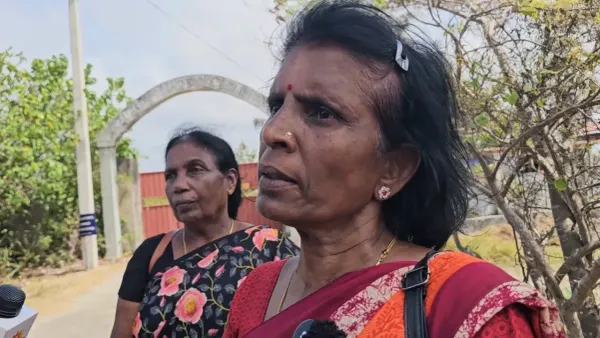
JAFFNA, Sri Lanka — The leader of an association representing families of people who disappeared during and after Sri Lanka’s civil war accused the government on Saturday of trying to steer relatives toward accepting death certificates and compensation instead of establishing what happened to their missing family members.
Yogarasa Kanagaranjini, president of the Association of Relatives of the Forcibly Disappeared in the North and East, said the government was using the Office on Missing Persons, or O.M.P., to summon relatives and offer them financial assistance.
“The government is working vigorously to provide death certificates and compensation,” Ms. Kanagaranjini said at a news conference at the Jaffna Press Club.
Ms. Kanagaranjini said families had rejected such offers at a recent O.M.P. meeting in Kopay, outside Jaffna.
“We do not want compensation. We do not want death certificates. We want our children,” she quoted mothers who attended the meeting as saying.
The Office on Missing Persons was established by the Sri Lankan government to trace people who disappeared during periods of conflict and political violence. But the institution has long faced distrust among some families in the predominantly Tamil north and east, many of whom have demanded international involvement in investigations into disappearances.
Ms. Kanagaranjini accused the current government of failing to address those demands despite seeking the support of affected communities during elections. She said families should not expect the government to deliver the justice they were seeking and argued that an international process was necessary.
“This struggle for truth and justice is a genuine struggle directed toward the international community,” she said. “It is a long journey.”
The families are preparing to hold an international conference on Aug. 30 at the Thanthai Chelva Auditorium in Jaffna, coinciding with the International Day of the Victims of Enforced Disappearances.
Ms. Kanagaranjini said foreign diplomats and others involved in human rights issues were being invited to the gathering, where relatives would describe their experiences and press their demand for international justice.
She also accused the government of opening O.M.P. offices in some districts and intensifying its engagement with relatives in the period leading up to the conference, characterizing those efforts as an attempt to weaken the families’ campaign.
Families of the disappeared have maintained protests and campaigns for years across Sri Lanka’s north and east, seeking information about relatives who vanished during the civil war and its aftermath. Among the cases they have repeatedly raised are those of people they say surrendered or were handed over to the security forces during the final stages of the war in 2009 and were never seen again.
Ms. Kanagaranjini described the final phase of the war as involving “genocide,” a characterization made by some Tamil groups and activists but disputed by successive Sri Lankan governments.
“What happened to those who were handed over must be revealed,” she said. “That is the justice we must receive.”