

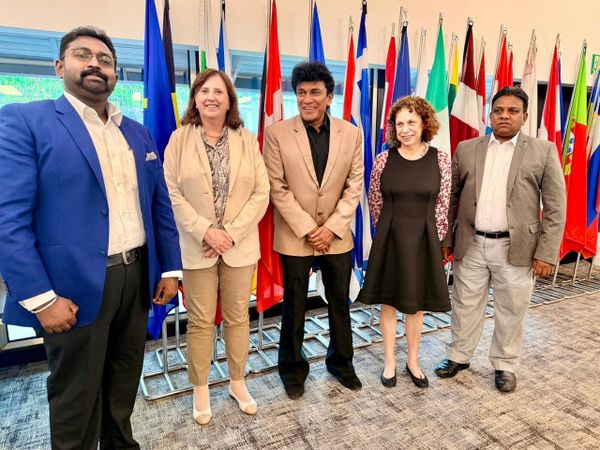
Representatives of Sri Lanka's historically marginalised plantation Tamil community have urged the European Union to ensure that the country's continued access to preferential trade benefits under the Generalised Scheme of Preferences Plus (GSP+) is tied to measurable progress on land rights, housing equity, and labour protections in estate regions.
The appeal came during a meeting in Colombo this week between leaders of the Tamil Progressive Alliance (TPA) and a visiting delegation from the European External Action Service (EEAS), as the EU continues its periodic monitoring of Sri Lanka's compliance with the 27 international conventions underpinning the GSP+ framework.
The TPA delegation was led by party leader and Member of Parliament Mano Ganesan, alongside Barath Arullsamy, Vice President for International Affairs of the Democratic People's Front and TPA Politburo member, and Prof. Vijayachandran, General Secretary of the Upcountry People's Front and a TPA Politburo member. The European delegation was led by Paola Pampaloni, Deputy Managing Director for Asia and the Pacific at the EEAS, and hosted by the EU's Ambassador to Sri Lanka, Carmen Moreno.
According to a statement issued by the TPA after the meeting, Ganesan argued that the credibility of the GSP+ framework depends not merely on Sri Lanka's formal ratification of international conventions, but on tangible improvements in the lived conditions of communities that remain excluded from full economic and social integration.
"Ratification alone cannot substitute for implementation," Ganesan told EU officials, according to the statement.
The Community Behind the Exports
The Malayaga Tamils — descendants of Indian-origin labourers brought to Sri Lanka's central highlands during British colonial rule to work on tea, rubber, and coffee plantations — form the backbone of the country's plantation economy. Tea and apparel, both major beneficiaries of duty-free access to European markets under GSP+, rely heavily on labour drawn from plantation regions.
The EU is Sri Lanka's second-largest export destination. In 2024, Sri Lankan exports to the bloc were valued at approximately €2.7 billion, with around 85 per cent of eligible goods entering under GSP+ preferences, according to EU figures.
Yet more than seven decades after independence, the Malayaga Tamil community continues to experience land insecurity, substandard housing, and development indicators that lag behind national averages. Most plantation families do not hold title to the land on which they live, and many still reside in colonial-era line rooms — shared barracks originally designed for indentured labour.
Post-Disaster Housing: A Two-Tier System?
A central concern raised during the meeting was the government's post-disaster housing policy following Cyclone Ditwah, which struck Sri Lanka in late November 2024 and caused damage to over 86,000 houses, according to the Disaster Management Centre — the worst housing destruction since the 2004 tsunami.
The TPA told EU officials that Malayaga families displaced by the cyclone, particularly in the worst-affected districts of Kandy, Badulla, Nuwara Eliya, Matale, and Kegalle, had been excluded from the government's national reconstruction framework, which provides up to LKR 5 million per unit for displaced families, and were instead being redirected to the Indian-assisted housing programme, which operates at a lower per-unit allocation.
The delegation argued that channelling plantation communities into a separate, lower-tier recovery structure risks entrenching what it described as “apartheid-like discrimination” — language the TPA has also used in subsequent meetings with the United Nations, and with British and French diplomatic missions in Colombo.
Ganesan has raised the same concern publicly on multiple occasions since the cyclone. In a December 2025 post on X, he said he could not identify "where the most marginalised plantation community fits into the relief matrix" announced by President Anura Kumara Dissanayake.
The Government of Sri Lanka has not publicly addressed the TPA’s specific allegation of a two-tier housing structure for plantation communities. Jaffna Monitor has reached out to the relevant government ministry responsible for plantation region development for comment. No response had been received at the time of publication.
"We Came to Seek Your Help"
Ganesan framed the appeal not as an attempt to internationalise domestic politics, but as an effort to hold the Sri Lankan state accountable for international commitments it has already undertaken.
“We came to seek your help,” he told EU officials.
He argued that successive governments — including the current administration led by President Dissanayake — have failed to implement the structural reforms necessary to secure land tenure, housing equality, and durable economic mobility for plantation communities.
“Unless structural changes are brought about, the Malayaga Tamil community will always remain marginalised,” Ganesan said.
The TPA also expressed concern over what it described as a lack of engagement from the government, noting that a request for a meeting with President Dissanayake to discuss issues affecting plantation Tamils had yet to receive a response.
EU Silent, but Watching
The European Union delegation has not issued a public statement regarding the discussions.
The meeting took place as the EU prepares for its next monitoring cycle. The most recent GSP+ monitoring mission visited Sri Lanka from 28 April to 7 May 2025, led by Charles Whiteley, Head of the South Asia Division of the EEAS, and Ambassador Moreno. That mission met government officials, civil society organisations, trade unions, and business associations across the country. Sri Lanka's continued eligibility for GSP+ preferences — worth an estimated $500 million annually to the country's exporters — depends on demonstrated compliance with the conventions underpinning the scheme.
The GSP+ framework requires not merely the ratification but the effective implementation of 27 international conventions spanning human rights, labour rights, environmental protection, and good governance. During the 2024–2025 monitoring period, the EU focused on nine priority areas, including labour standards and governance reform.
Beyond Tariffs
For plantation Tamil leaders, the issue extends beyond trade preferences. The TPA's argument is that secure land tenure and equal access to national housing frameworks would constitute concrete evidence of compliance with the governance and human rights standards embedded in GSP+ — and would signal meaningful progress toward the fuller democratic inclusion of a community that has been structurally marginalised since the colonial era.
The Indian Housing Project, a bilateral initiative between the Governments of India and Sri Lanka that has been the primary vehicle for plantation housing since 2010, has delivered tens of thousands of homes in the Northern, Eastern, and plantation provinces. But critics, including the TPA, argue that relying on a foreign-donor programme to house a segment of Sri Lanka's own citizenry — while other cyclone-affected communities receive support through the national reconstruction framework — raises questions about equal treatment under the state's own obligations.
In its statement, the TPA urged international partners, including the EU, to ensure that trade partnerships advance equitable national development rather than function solely as instruments of economic exchange.
"Addressing the long-standing marginalisation of the Malayaga Tamil community," the alliance said, "is central to strengthening democratic participation, reinforcing social stability, and safeguarding the credibility of Sri Lanka's international obligations."