

JAFFNA, Sri Lanka — Sri Lanka’s justice minister pledged Tuesday that the government would pursue the truth about the fate of people who disappeared during decades of conflict and political violence, telling a government-organized commemoration here that answers for the families of the missing were a matter of right, not politics.
“A family’s right to know what happened to its loved one is not a political demand,” said Harshana Nanayakkara, the minister of justice and national integration, at the event, held at the Jaffna District Secretariat ahead of the International Day of the Victims of Enforced Disappearances. “It is a fundamental human right. It is a matter of justice.”
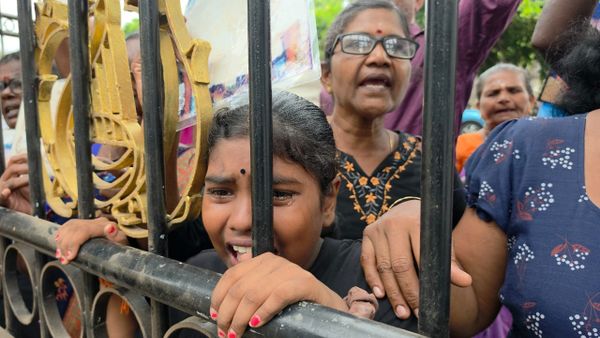
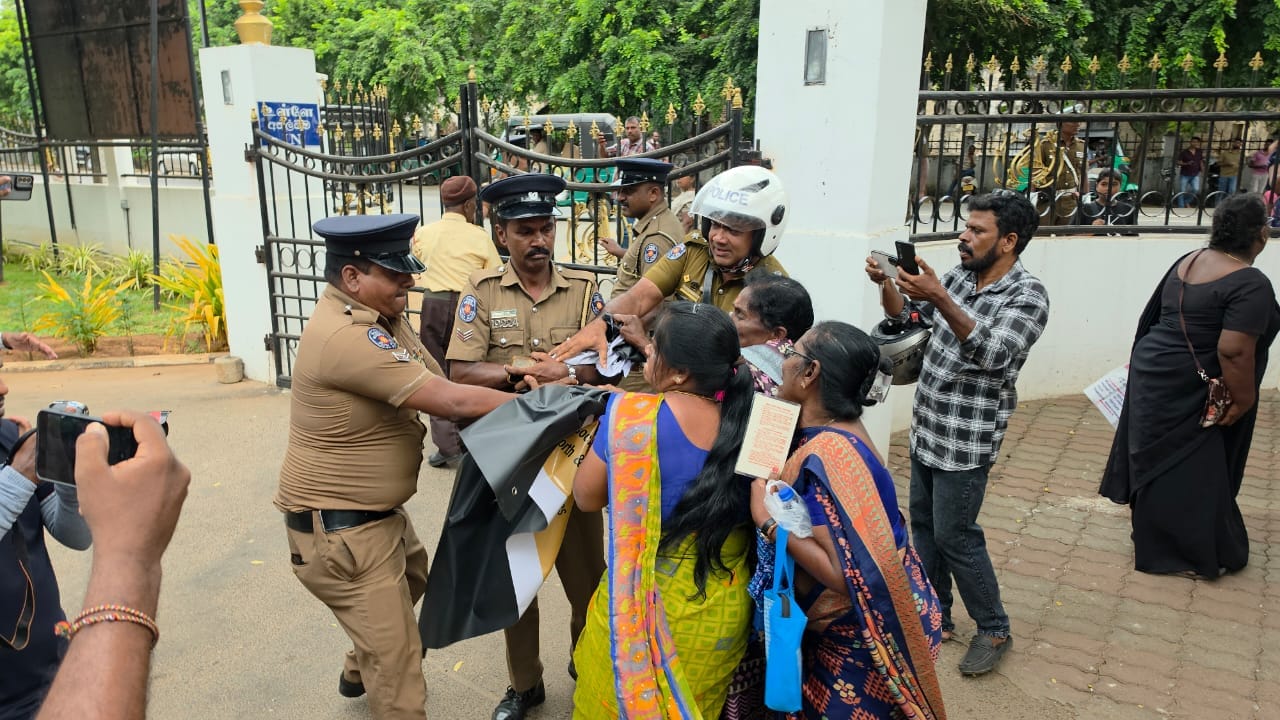
But the government’s message of reconciliation collided with a different reality just outside the building. A group of relatives of the disappeared gathered to protest the commemoration itself, and police pulled several of the women away from the site, even as ministers inside spoke of justice for the missing.
Families of the disappeared, particularly in the predominantly Tamil north and east, have spent years demanding to know what happened to relatives who vanished during and after the civil war. Many have refused compensation, death certificates and other forms of government assistance, arguing that such measures cannot substitute for establishing the fate of their relatives or holding those responsible to account.
Inside the commemoration, Mr. Nanayakkara acknowledged the history of unanswered questions. Before attending the event, he said, he had visited the homes of three families whose relatives had disappeared. An enforced disappearance, he said, does not leave only one person’s fate unknown — it condemns an entire family to prolonged uncertainty.
“A mother waits for an answer about her child,” he said. “A wife waits for an answer about her husband. A child waits for an answer about his or her father or mother.” However many years pass, he said, the question remains the same: “What really happened?”
Mr. Nanayakkara sought to frame enforced disappearances as a national problem rather than one confined to Sri Lanka’s Tamil population, noting that people from different ethnic and political backgrounds had disappeared during different periods of the country’s history. A just resolution, he said, was “the responsibility of Sri Lankan society as a whole.”
Sri Lanka has experienced large-scale disappearances during several periods of violence, including southern insurrections in the late 1980s and the 26-year civil war between government forces and the Liberation Tigers of Tamil Eelam. In the north and east, the fate of those who vanished during the war and its aftermath remains among the country’s most contentious unresolved issues.
Mr. Nanayakkara said the government would apply the law regardless of a person’s official position, political connections or influence if evidence implicated them.
“No one is above the law,” he said. “No matter how powerful a person may be, no matter how high an office that person holds, and regardless of that person’s political connections, everyone is equal before the law.”
The government’s promises are likely to be measured against the record of the Office on Missing Persons, the body that organized Tuesday’s event. Created to trace missing people and clarify their fate, the office has long faced skepticism from families, particularly in the north and east, for whom years of commissions, investigations and government pledges have yet to yield the answers they seek.
Mr. Nanayakkara said the current government had moved to strengthen the office, including filling vacancies on its governing board, adding representation from families of the missing, restarting stalled investigations and hiring 69 new employees.
According to figures he presented, the office had identified 16,966 complaints as suitable for investigation as of July 31. About 11,000 of those cases had been delayed for lack of funding, he said; the government allocated 375 million rupees in 2025 and formed 25 investigative teams to accelerate the work.
By the end of July, preliminary investigations into 3,000 of the outstanding cases had been completed, he said; the government aims to finish preliminary investigations into all complaints by the end of 2027.
Mahesh Katulanda, the office’s chairman, offered a broader measure of progress, saying more than 9,000 investigations had been completed nationwide out of roughly 19,000 complaints. In Jaffna District alone, he said, investigations had concluded in 1,940 of about 2,300 registered cases.
Mr. Nanayakkara said 1,594 cases examined in preliminary inquiries had been referred for further investigation. Authorities have also issued 2,719 Certificates of Absence, which allow families to resolve certain legal and administrative matters without formally declaring a missing relative dead, and 409 death certificates, he said. The government has established what he called final information regarding 31 missing people, details that were shared privately with their families rather than disclosed publicly. Another 5,427 people have been referred to the Office for Reparations for assistance.
That combination of investigation and material assistance is a source of unease for many families, who fear that compensation or administrative relief could become a substitute for truth and accountability. Nagalingam Vethanayahan, the governor of the Northern Province, addressed the concern directly, saying the search for justice and the provision of livelihood assistance should proceed together — and that relief should “never be used to bring the struggle for justice to an end.”
“The income earner of a family may have disappeared,” Mr. Vethanayahan said. “Therefore, alongside investigations to establish the truth, assistance should also be provided to rebuild the economic and social lives of those families. These two things are not contradictory.” He said truth, justice, relief, dignity and guarantees of non-recurrence were inseparable, adding that the government “will never withdraw from its responsibility to seek the truth.”
The government is considering a broader assistance package that would include psychosocial support, housing and welfare aid, educational opportunities, vocational training and help with self-employment. Mr. Nanayakkara cautioned that such measures should not be mistaken for an endpoint. “These are only milestones on the journey ahead,” he said. “We still have an enormous responsibility before us. We will not abandon that responsibility.”
The gathering also became a venue for the government to address its handling of mass graves, an issue that has taken on renewed urgency with the continuing excavation at Chemmani, on the outskirts of Jaffna. Mr. Nanayakkara said 57 million rupees had been provided so far for the excavation and related legal proceedings, and he promised further funding for later stages. “The search for truth must not stop because of financial constraints,” he said. “It is the responsibility of the state to preserve evidence, establish the truth and ensure justice for those who lost their lives.”
Investigations into mass graves, he said, should be evidence-based and conducted to scientific and forensic standards, including DNA testing where necessary. Mr. Vethanayahan echoed that view, saying evidence recovered from mass graves in the Northern and Eastern Provinces needed to be properly documented, professionally examined and subjected to judicial process. “These are not matters that should be used for political gain,” Mr. Nanayakkara said. “These are matters concerning human lives.”
Ramalingam Chandrasekar, the minister for fisheries, resettlement and community development, said the suffering endured by Tamil families in the north and east should be understood as part of the country’s shared grief, and that both compassion and justice were needed to heal those wounds.
The commemoration drew government officials, members of Parliament and relatives of the missing, alongside medical and social-service programs organized in conjunction with the event.
Mr. Nanayakkara acknowledged that no government could undo the past or, in many cases, bring back those who had vanished. But he said the state could still deliver what families have demanded for years. “We can establish the truth,” he said. “We can investigate. We can enforce the law. We can ensure justice.” He added: “This issue cannot be resolved in a single day. But that does not mean we can stop.”