

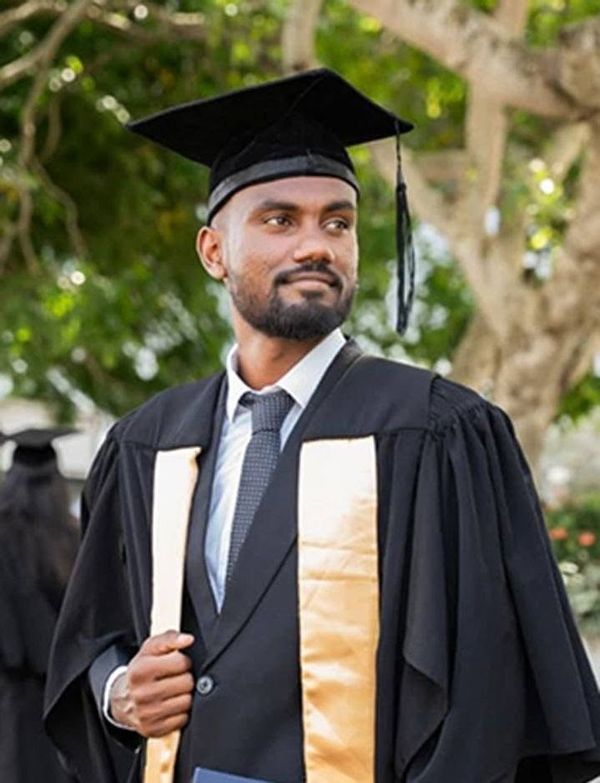
COLOMBO, Sri Lanka — Sivarasa Anojan, the Sri Lankan migrant worker facing execution in Saudi Arabia, told his family that he had been attacked with a sharp weapon in prison, according to a civil society activist working closely with his relatives. Sri Lanka’s government, citing information provided to its diplomats by Saudi prison authorities, said Wednesday that his injuries had been caused by another inmate’s fingernails.
Mr. Anojan, a Tamil from Natpiddimunai, near Kalmunai in Sri Lanka’s Eastern Province, was sentenced to death on Sept. 17 by a Saudi appeals court over a Facebook comment that a lower court had found insulting to the Prophet Muhammad. Sri Lanka has until Oct. 17 to challenge the sentence before Saudi Arabia’s Supreme Court.
Rajkumar Rajeevkanth, a civil society activist who has been assisting the family, said Mr. Anojan had called his relatives from prison and told them, crying, that he had been attacked with a sharp weapon and wounded in six places on his head.
“Anojan called us himself and said he had injuries in six places on his head,” Mr. Rajeevkanth said Wednesday. “He was crying as he told us that he had been attacked with a sharp weapon.”
Vijitha Herath, Sri Lanka’s foreign minister, gave Parliament a different account the same day. He said officials from the Sri Lankan Embassy had visited the prison in Dammam, where they met the superintendent and the prison doctor.
According to the explanation the diplomats received, an argument between Mr. Anojan and his cellmate escalated into a physical confrontation. The prison doctor attributed his injuries, including scratches on his face, to the other inmate’s fingernails. No knife or other weapon was used, Mr. Herath said.
The accounts differ not only over whether a weapon was involved but also in their descriptions of the injuries. Mr. Anojan’s family, through Mr. Rajeevkanth, described six wounds to his head, while the explanation conveyed by the government referred to scratches, including on his face.
Saudi authorities told the diplomats that Mr. Anojan’s life was not in danger and that he had been transferred to another cell, the minister said. He added that the government was arranging to provide the family with information and documents concerning his medical condition.
Neither the prison doctor’s findings nor any independent medical assessment has been made public. Jaffna Monitor could not independently determine how Mr. Anojan was injured, the extent of his injuries or whether a weapon was involved.
Mr. Rajeevkanth stood by the family’s account but said he did not intend to dispute the explanation provided by Saudi prison authorities, emphasizing that Mr. Anojan’s immediate safety was the priority.
“Anojan was attacked with a sharp weapon,” he said. “After that, prison authorities took steps to ensure his safety. We are not going to question further what they have told the government. Our primary objective is to ensure Anojan’s protection.”
On Wednesday, Mr. Rajeevkanth met the United Nations resident coordinator in Sri Lanka, Marc-André Franche, in Colombo to seek international attention to Mr. Anojan’s safety. He was accompanied by Mr. Anojan’s younger brother, who has been staying at Mr. Rajeevkanth’s home, and Gajendrakumar Ponnambalam, a member of Parliament from Jaffna District and the leader of the Tamil National People’s Front.
Mr. Rajeevkanth first made the assault allegation public on Monday, saying he had received information that fellow prisoners had attacked Mr. Anojan. He called on the Sri Lankan government, its embassy in Saudi Arabia and Saudi prison authorities to ensure that he received medical treatment and was protected from further harm.
At the time, Jaffna Monitor reported that the circumstances of the incident, the severity of the injuries and whether Saudi authorities had opened an investigation could not be independently established.
The dispute over Mr. Anojan’s treatment in prison comes as Sri Lanka races to challenge a death sentence arising from a social media argument that began thousands of miles away.
Mr. Anojan was working in Saudi Arabia when he joined online exchanges between Hindus and Muslims over a video showing a young Muslim man kicking a stray dog that had accompanied Hindu pilgrims on the annual Pada Yatra to Kataragama, a major religious pilgrimage in Sri Lanka.
The dog, which pilgrims called Subramani, had attracted public attention for traveling hundreds of kilometers with them. A comment Mr. Anojan posted during the exchanges became the basis of his prosecution in Saudi Arabia.
According to a judgment reviewed by Jaffna Monitor, the Criminal Court in Al-Ahsa convicted him on July 28 of publishing material through an information network in a manner harmful to religious values and public morals, and of insulting the Prophet Muhammad, which the court described as an offense under Shariah.
The court sentenced him to five years in prison and imposed a fine of three million Saudi riyals, approximately $800,000.
The family appealed in the hope of securing a reduced sentence. Instead, on Sept. 17, the appeals court sentenced him to death.
Documents previously reviewed by Jaffna Monitor showed that Sri Lanka’s Foreign Ministry helped arrange the appeal even though a legal opinion obtained by the embassy had described the chances of securing a reduced sentence as “extremely low.”
None of the documents reviewed recorded any warning to the family that the appeal could result in a harsher sentence. The ministry sent the family a copy of the appeal memorandum on Sept. 16, more than three weeks after it was filed and just one day before the appeals court delivered its ruling.
Mr. Rajeevkanth was among the first to make the death sentence public. He has said that Mr. Anojan called his relatives after the hearing to inform them of the decision.
Mr. Herath told Parliament on Wednesday that Sri Lankan and Saudi lawyers were working together on the challenge before Saudi Arabia’s Supreme Court and that a Sri Lankan legal delegation had traveled to the kingdom for consultations.
He said the government would pursue every available legal avenue while respecting Saudi judicial procedures and Shariah law.
Senior Saudi officials, he said, had indicated that they did not welcome outside interference while the case remained before the courts. Depending on the outcome of the judicial proceedings, Sri Lanka could consider further diplomatic measures, including a petition for royal clemency.
President Anura Kumara Dissanayake met Mr. Anojan’s parents last month and said his government would formally request clemency from the Saudi king.
Tamil and Muslim political leaders in Sri Lanka have urged Saudi Arabia to spare Mr. Anojan’s life. Mr. Rajeevkanth said the campaign had spread beyond Sri Lanka, but he expressed disappointment that some members of the Muslim community had criticized the effort.
“The entire country should speak with one voice on this matter,” he said.
As the deadline for challenging the death sentence approaches, Mr. Rajeevkanth said he remained focused on securing Mr. Anojan’s safety and had conveyed the information he received about the alleged prison assault to the United Nations.
“Everything I have written and said is true,” he said. “That is the one thing I can state with certainty.”