

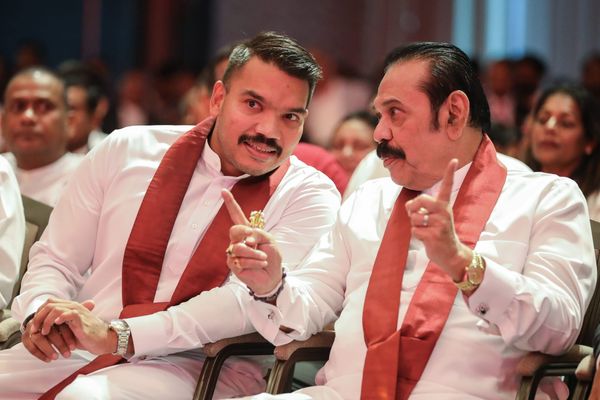
COLOMBO, Sri Lanka Fifty days after he was led from a Colombo courtroom onto a prison bus, Namal Rajapaksa, the son and political heir of Sri Lanka’s most powerful postwar leader, declared from remand custody this weekend that he would remain behind bars for 500 days if it would bring relief to the country’s struggling households.
His statement came alongside a letter from his father, former President Mahinda Rajapaksa, 80, written from a hospital in Colombo, that set out what the elder Mr. Rajapaksa described as the family’s code. Trust the judiciary alone, he told his son. If you return to power, do not go after your opponents. Children should not be punished for what their parents have done.
“Not taking revenge is the Rajapaksa way,” he wrote. “It is our tradition.”
Each of those principles was tested during Mahinda Rajapaksa’s decade as president, from 2005 to 2015, and again from 2019 to 2022, when the family returned to power and he served as prime minister under his younger brother, Gotabaya. Court rulings, prosecutors’ filings and the findings of police investigators document a government that turned the military, the police, Parliament and the country’s antiterrorism law against those who opposed it. It jailed the general who challenged it at the polls, removed a chief justice whose court ruled against it and imprisoned a Tamil journalist for his articles. During those years, critics of the government were beaten, killed or disappeared, and almost none of those cases has ended in a conviction.
The letter arrives as Namal Rajapaksa, 40, presents himself as the future of a dynasty that dominated Sri Lankan politics for most of two decades before the economic collapse of 2022 drove it from office. His party, the Sri Lanka Podujana Peramuna, says the prosecutions against him are an act of political vengeance by President Anura Kumara Dissanayake’s government. In effect, the father’s letter asks the public to judge the family by a standard of restraint that its own record makes it difficult to meet.
The Cases Against Him
Namal Rajapaksa, who leads the opposition in Parliament, was arrested on Sept. 4 by the Commission to Investigate Allegations of Bribery or Corruption after nearly five hours of questioning. Investigators accuse him of receiving kickbacks from the purchase of Airbus aircraft for the national carrier, SriLankan Airlines, a deal his father approved as president in 2013.
He was later named a suspect in a second case, which alleges that he was paid 70 million rupees in three installments in return for helping the Indian developer Krrish obtain the state-owned Transworks Square property in Colombo Fort and the approvals the project needed. He has said the money was sponsorship for an international rugby tournament held in Colombo in 2014.
On Friday, the Colombo chief magistrate, Asanga S. Bodaragama, rejected his bail application in the Krrish case and extended his remand to Nov. 6. Under the Anti-Corruption Act, the magistrate said the bribery commissioner’s certificate meant bail could be granted only in special circumstances, and the defense had not established any. In the Airbus case, he is remanded until Oct. 27. He has not been indicted in either case and denies wrongdoing.
The Statement From Prison
In his statement, Namal Rajapaksa said he had used his time in custody to reflect on his life, and accused the government of using his family to divert attention from the country’s economic hardship.
He listed the conditions under which a longer imprisonment would be worthwhile: electricity tariffs cut by two-thirds, fuel sold at import cost, salaries raised every six months, bank loans without interest or collateral, Toyota Vitz cars priced at about 1.2 million rupees, cheaper rice and no taxes on health care, education or essential goods. He did not explain how any of it would be financed.
Sri Lanka defaulted on its foreign debt in April 2022, under a government led by his uncle Gotabaya Rajapaksa as president and his father as prime minister. Namal Rajapaksa had served in that cabinet as minister of youth and sports until earlier that month.
He also wrote about Kavantissa, one of the country’s best-known wild tuskers, which died on Oct. 16 after weeks of treatment for a gunshot wound. He said the head of state bore a particular duty to protect the country’s religious heritage and natural resources, and that he expected to be acquitted.
“You may be able to imprison me,” he wrote, “but you cannot imprison the hopes and aspirations of the people who stand with us.”
The Letter
According to political sources, the former president’s secretary drafted the letter, and D. V. Chanaka, a member of Parliament from the family’s party, delivered it to Namal Rajapaksa when he was brought to Parliament.
The elder Mr. Rajapaksa recalled that when his son sought permission to enter politics in 2010, he told him to “come prepared to go to prison and to endure hardship.” He wrote that a government had once jailed him on a baseless allegation, before Namal was born, and that his only faith then had been in the courts. “Whatever anyone may say,” he wrote, “you too must place your faith in the judiciary alone.”
He said he and his wife, Shiranthi, were being treated at Nawaloka Hospital, where Namal was born, and that their younger sons, Yoshitha and Rohitha, were caring for them. One case against Yoshitha, he wrote, arose only because he had joined the navy. He said the children of people now in government were among the thousands of young people his administration had hired. “Whenever you hold power, do not go after them,” he wrote. “Children are not to blame for what their parents do.”
He closed by saying that Sri Lankans would not condemn the family for what he called liberating the country from war.
‘Place Your Faith in the Judiciary’
The sharpest confrontation between the Rajapaksa government and the courts began in September 2012, when the Supreme Court, led by Chief Justice Shirani Bandaranayake, ruled that a bill creating the Divi Neguma development agency could not proceed without the consent of the provincial councils. The agency was a project of the president’s brother Basil Rajapaksa, then the economic development minister.
President Rajapaksa asked to meet the chief justice and two members of the Judicial Service Commission, the body that oversees the lower courts. The commission refused, citing its independence. On Sept. 28, its secretary, Manjula Tillekaratne, issued a public statement saying its members and their families feared for their safety. Nine days later, four men stopped him in Mount Lavinia, a Colombo suburb, and beat him with the butt of a pistol. Lower court judges across the country stayed away from work for two days in protest. No one was charged.
The government then moved against the chief justice herself. Shortly before an impeachment motion was filed, the anti-corruption commission indicted her husband, Pradeep Kariyawasam, over a share transaction at the state savings bank he had chaired. The motion carried the signatures of 117 government lawmakers.
In January 2013, the Supreme Court ruled that the parliamentary committee that had found her guilty of misconduct had no legal authority to try a judge, and the Court of Appeal quashed the committee’s findings. Parliament voted 155 to 49 to impeach her anyway. On Jan. 13, President Rajapaksa removed her and swore in Mohan Peiris, a former attorney general then serving as the cabinet’s legal adviser, as chief justice.
That outcome had been made possible three years earlier by the 18th Amendment to the Constitution, which the government pushed through Parliament in 2010. It abolished presidential term limits and gave the president the final word on appointments to the higher courts and to the commissions that oversee the police, the civil service and elections.
The family’s regard for court verdicts was tested again after it returned to power. In 2020, a presidential commission appointed by Gotabaya Rajapaksa to examine “political victimization” under the previous government recommended that the murder conviction of Duminda Silva, a former lawmaker allied with the family, be reviewed. Gotabaya Rajapaksa pardoned Mr. Silva in June 2021, while Mahinda Rajapaksa was prime minister.
‘Do Not Go After Them’
Sarath Fonseka commanded the army in the final offensive that defeated the Liberation Tigers of Tamil Eelam in May 2009, the victory on which the Rajapaksas built their political dominance. Eight months later, he ran against Mahinda Rajapaksa for the presidency. He lost the election on Jan. 26, 2010, and was arrested on Feb. 8.
A court-martial convicted him of engaging in politics while in uniform, and he was stripped of his rank, pension, and medals. In September 2010, a second court-martial sentenced him to 30 months in prison over irregularities in military procurement. The sentence took effect with President Rajapaksa’s ratification, and Mr. Fonseka lost the parliamentary seat he had won that April.
None of the charges on which Mr. Fonseka was imprisoned concerned the conduct of the war. The only prosecution that touched on its final days punished him for speaking about them. In November 2011, a Colombo court sentenced him to three more years for comments published in The Sunday Leader in December 2009 suggesting that rebel leaders who tried to surrender under a white flag had been shot on the orders of the defense secretary, Gotabaya Rajapaksa. No one has been prosecuted over those deaths. Mr. Fonseka was released in May 2012. His civic rights were restored in 2015 by President Maithripala Sirisena.
The pursuit extended to his family. In March 2010, the police offered a reward of 1 million rupees for information on his son-in-law, Danuna Tilakaratne, whose company had won army supply contracts, and investigators recovered $527,000 from bank vaults belonging to Mr. Tilakaratne’s mother. He came forward only in 2015, after the Rajapaksa government fell, and told reporters that it had been too dangerous to appear while the case was first being pursued.
The government said the cases against Mr. Fonseka were lawful. Human rights groups and several foreign governments called them politically motivated.
Journalists who opposed the government faced worse. J. S. Tissainayagam, a Tamil columnist, was arrested in March 2008. In August 2009, a High Court sentenced him to 20 years of hard labor under the Prevention of Terrorism Act, finding that articles he published in 2006 in North-Eastern Monthly, criticizing the military’s treatment of Tamil civilians, had caused “communal disharmony.” The case rested on two articles and a confession he said was obtained under duress. President Rajapaksa pardoned him in May 2010 after an international campaign on his behalf.
As Mr. Wickrematunge drove to work on Jan. 8, 2009, eight helmeted men on four motorcycles forced his car to the side of a busy street in Attidiya, outside Colombo, and attacked him in what witnesses described as a commando-style operation. He died of head injuries that day. Early reports said he had been shot, but a fresh inquest after his body was exhumed in 2016 found that he had been killed with an unidentified weapon, not a firearm. He had been scheduled to testify in a defamation case brought against him by Gotabaya Rajapaksa over his reporting on arms purchases.
The investigation went nowhere while the Rajapaksas held power. After 2015, the Criminal Investigation Department traced the killing to a military intelligence unit known as the Tripoli Platoon, and linked members of the same unit to attacks on other journalists, including the editor Upali Tennakoon, who was assaulted weeks later. Gotabaya Rajapaksa has denied any role. No one has been convicted. In June 2009, the journalist Poddala Jayantha was abducted and beaten.
Prageeth Eknaligoda, a cartoonist and columnist who criticized the government, disappeared on Jan. 24, 2010, two days before the presidential election. His wife, Sandya Eknaligoda, has said he was working for Mr. Fonseka’s campaign. Prosecutors indicted nine army intelligence personnel in 2019, including the commanding officer of the Giritale army camp, on charges of abducting and killing him. In 2022, prosecutors told the court that witnesses were being influenced. The trial has not concluded.
No court has found that Mahinda Rajapaksa ordered any of these attacks, and his government denied responsibility for them. The pattern was consistent across his tenure: critics of the state were attacked by unidentified men or by units of the security forces, and investigations stalled until the family left office.
Protesters met the same force. On Aug. 1, 2013, soldiers opened fire on villagers in Weliweriya, outside Colombo, who were demanding clean drinking water and the closure of a factory they blamed for contaminating their wells. Three people were killed, among them a 17-year-old schoolboy, and 45 were wounded. Prosecutors charged a brigadier and three soldiers only in 2019, and all four were acquitted in 2024. On May 9, 2022, supporters bused to Mahinda Rajapaksa’s official residence and attacked peaceful protesters calling for the government’s resignation, setting off reprisals across the country in which nine people died. He resigned as prime minister that day.
The family’s return to power in 2019 was followed by action against the officials who had investigated it. Shani Abeysekara, who had led the Criminal Investigation Department since 2017 and directed inquiries into killings and abductions from the Rajapaksa years, was transferred on Nov. 21, 2019, days after Gotabaya Rajapaksa took office, and suspended in January 2020. He was arrested that July on a charge of fabricating evidence. Held without bail, he suffered a heart attack, contracted COVID-19, and underwent cardiac surgery. When the Court of Appeal freed him in June 2021, it said the long delay in bringing the complaint indicated that the allegations against him had been fabricated. He again leads the department.
Within weeks of taking office in 2019, Gotabaya Rajapaksa appointed a presidential commission to investigate what it called the “political victimization” of officials and military officers during the previous government. In practice, it examined the investigators who had pursued the Rajapaksa family and its allies after 2015. Its report, delivered in December 2020, held 23 people responsible, among them former Prime Minister Ranil Wickremesinghe, Mr. Fonseka, Mr. Abeysekara and Mr. Dissanayake, now the president. It recommended dropping cases against Yoshitha Rajapaksa as compensation for what it said he had suffered, and reviewing Mr. Silva’s murder conviction. In January 2021, the cabinet, with Mahinda Rajapaksa as prime minister, approved carrying out the findings, and a special commission of sitting judges was created with power to impose punishments. It named nearly 200 people as respondents before the government collapsed in 2022.
‘Children Are Not to Blame’
The letter’s appeal on behalf of children has the least support in the record of the war’s final days, when Mahinda Rajapaksa was president and commander in chief, and Gotabaya Rajapaksa ran the Defense Ministry.
Balachandran Prabhakaran, the 12-year-old son of the Tamil Tiger leader Prabhakaran, was killed in May 2009. Photographs released in 2013 for a Channel 4 documentary show him alive in a sandbagged bunker, eating a snack while a soldier stands guard. Later images show his body with several gunshot wounds to the chest. Image analysts concluded that the photographs were taken with the same camera.
The Rajapaksa government said the Prabhakaran family died in the fighting and dismissed the documentary as fabricated. In 2015, a leaked draft of a report by a government-appointed commission found that the Channel 4 material was unlikely to have been faked, and noted that forensic pathologists engaged by the broadcaster had concluded the boy was executed. The military maintains he was killed in crossfire.
His death was one of many in the last months of the war. A panel of experts appointed by the United Nations secretary-general reported in 2011 that credible sources estimated as many as 40,000 civilians may have been killed, most of them by government shelling, in the final phase of the fighting. The Rajapaksa government rejected the panel’s findings and refused an international investigation. For many Sinhalese, the defeat of the Tigers ended decades of bombings and assassinations, and it remains the foundation of the family’s political appeal. For many Tamils in the north and east, the same months are remembered for the dead, the disappeared and the families still searching for them.
The Present Cases
Since winning the 2024 elections, Mr. Dissanayake's National People's Power government has pursued corruption cases against members of the Rajapaksa administrations. In May 2025, the Colombo High Court sentenced Mahindananda Aluthgamage, a former sports minister, to 20 years in prison and Nalin Fernando, a former trade minister, to 25 years for using state funds to distribute thousands of carrom and draughts boards to sports clubs ahead of Mahinda Rajapaksa's 2015 re-election campaign. Namal Rajapaksa's cousin Shashindra Rajapaksa is on bail after being remanded earlier this year, and his brother Yoshitha was arrested in January 2025 in a money-laundering case and later released on bail.
On Sept. 5, after visiting his son in prison, Mahinda Rajapaksa told reporters that he could not say with certainty whether the arrest was political revenge.
Namal Rajapaksa is due in court on Oct. 27 in the Airbus case and on Nov. 6 in the Krrish case.