

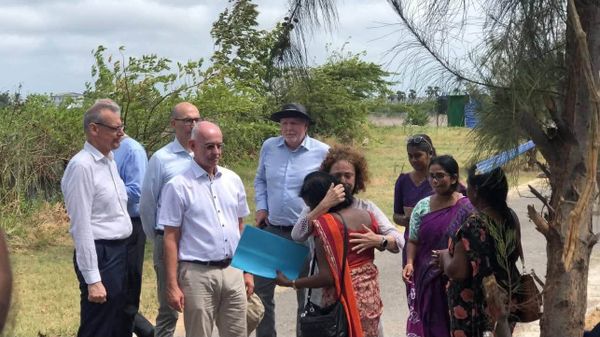
JAFFNA, Sri Lanka — A high-level delegation of European diplomats visited the Chemmani mass grave excavation in Jaffna on Wednesday, meeting relatives of the forcibly disappeared and telling them that a petition they submitted would be treated as more than a symbolic appeal as the families renewed their demand for international intervention.
“The petition you have given us is not merely a piece of paper,” the diplomats told representatives of the families, according to those present at the meeting. “We accept it with our hearts. We cannot make promises, but we know your pain and suffering. As far as we are able, we will raise your concerns at the United Nations and with countries that uphold human rights.”
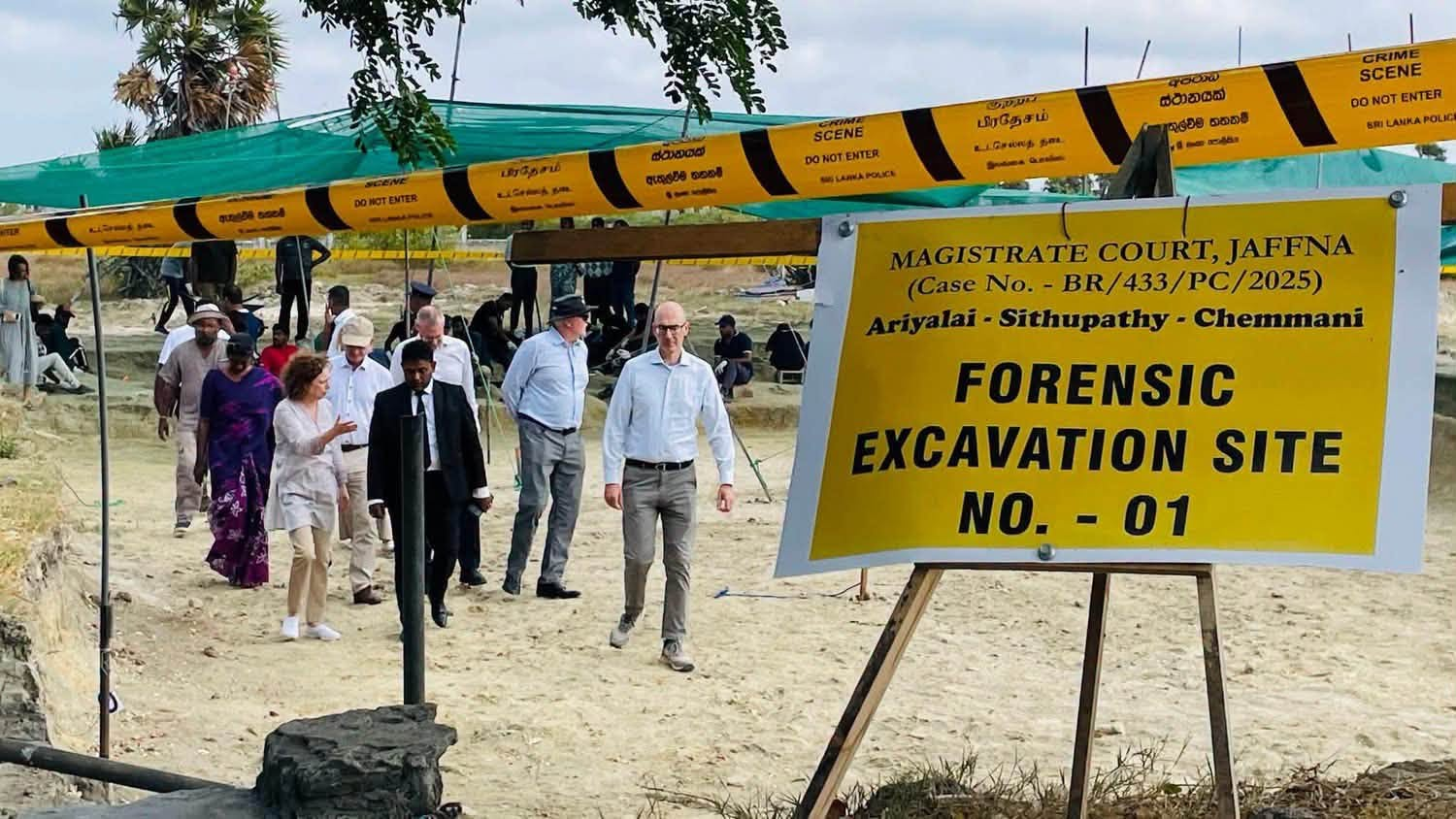
The delegation was led by Carmen Moreno, the European Union ambassador to Sri Lanka, and included the ambassadors of Germany, France, Italy, and the Netherlands. Senior European Union officials also took part in the visit, which came as the continuing excavation at Chemmani draws renewed attention to unresolved allegations of disappearances and extrajudicial killings stemming from Sri Lanka’s decades-long civil conflict.
The diplomats visited the excavation after receiving permission from the Jaffna Magistrate’s Court and were briefed on the progress and procedures of the investigation. They also spoke with judicial and forensic officials and lawyers involved in the court-supervised excavation.
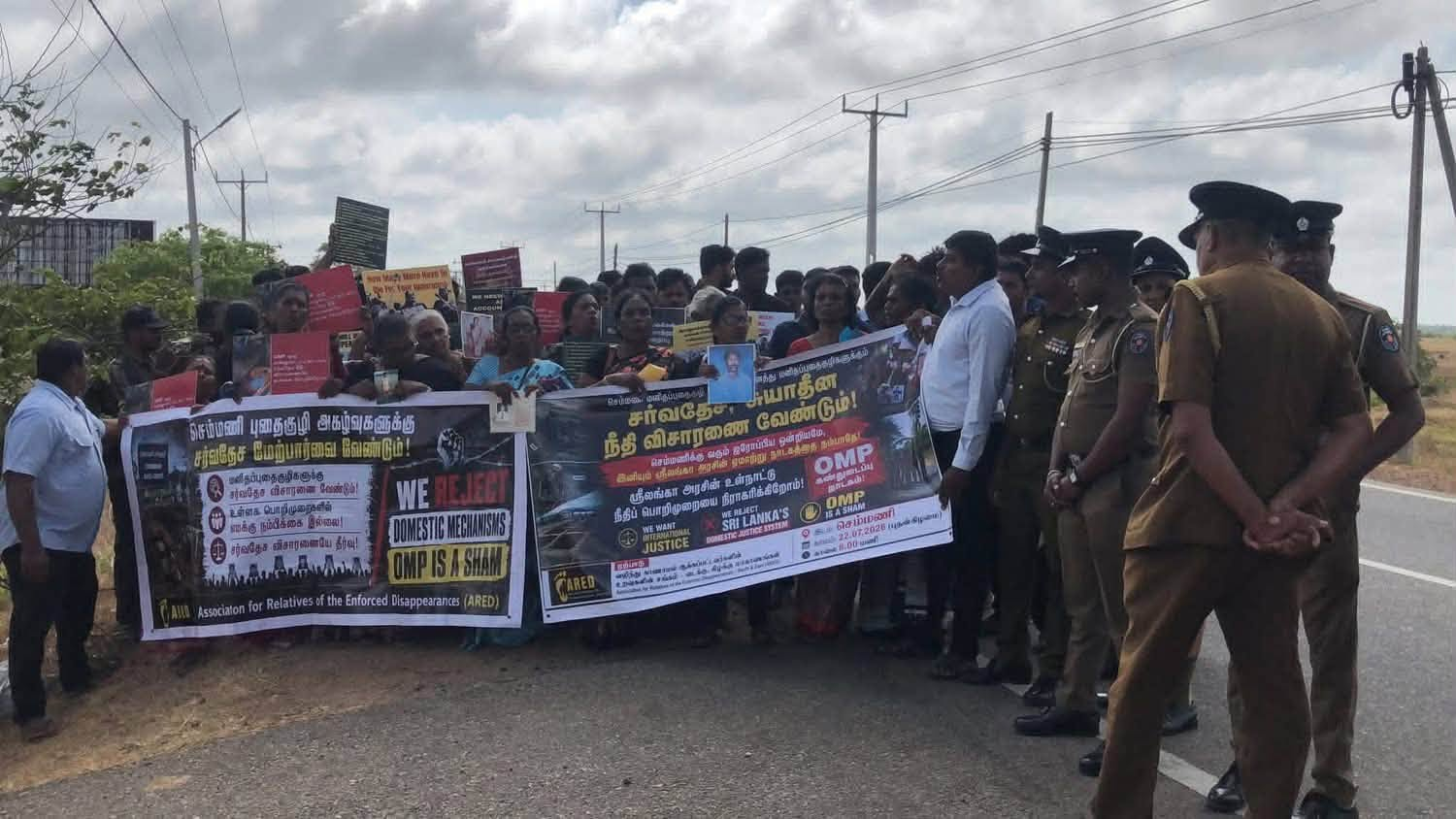
Outside the site, relatives of the disappeared, university students, Tamil political representatives, and other demonstrators gathered along the main Kandy-Jaffna road, calling for an independent international investigation into Chemmani and other mass graves discovered across Sri Lanka.
The protesters also demanded truth, justice, and accountability for enforced disappearances and guarantees that such abuses would not recur. Many of the families have rejected domestic investigative mechanisms, saying decades of commissions, inquiries, and government promises have failed to establish what happened to their missing relatives.
Police and intelligence personnel closely monitored the demonstration, photographing and filming participants, according to people at the scene. Officers also repeatedly asked those gathered near the site to disperse.
The European delegation later met two representatives of the Association of Relatives of the Enforced Disappeared from the Northern and Eastern Provinces, including Kanagaranjini, one of the group’s leaders, on the grounds of the Sithupathi Hindu Cemetery.
The families presented the diplomats with a 12-page petition calling, among other things, for an independent investigation into Sri Lanka’s mass graves.
According to Kanagaranjini, the diplomats said they could not promise a particular outcome but would seek to raise the families’ concerns internationally. They also expressed continued support for efforts to secure justice and accountability for victims.
Speaking afterward, Kanagaranjini said the families had exhausted their faith in Sri Lanka’s domestic institutions.
“We need to know what happened to our relatives,” she said. “We will never accept domestic mechanisms, domestic investigations, or offices established by the Sri Lankan government, such as the Office on Missing Persons.”
She said the families had appeared before numerous commissions and met representatives of successive governments without obtaining answers about the fate of their relatives.
“It is only after all of this that we have come to demand an international investigation,” she said.
The families also want the international community to recognise the violence against Tamils as genocide and pursue accountability through international institutions, including, where legally possible, the International Criminal Court. The Sri Lankan government has rejected allegations that its forces committed genocide during the conflict.
Kanagaranjini said more than 450 relatives who had participated in the long-running campaign for answers about the disappeared had died without learning what happened to their loved ones.
“After the brutal war and genocide, the international community must obtain and reveal information about what happened to those who were handed over,” she said.
The diplomats’ visit came a day after they met Tamil political leaders in Jaffna, where C.V.K. Sivagnanam, acting president of the Ilankai Tamil Arasu Kachchi, or ITAK, urged them to support a separate scientific investigation aimed at establishing the period in which the victims discovered at Chemmani were buried.
Mr. Sivagnanam argued that determining the approximate dates of the burials could help establish who controlled the area at the time and potentially assist investigators in identifying those responsible.
The continuing excavations have uncovered human remains in circumstances that have intensified demands for a credible investigation capable of establishing both the identities of the dead and how they came to be buried there.
The families have made similar appeals to international officials for years, maintaining that they have little faith left in Sri Lanka’s domestic mechanisms to uncover the fate of the disappeared.
Kanagaranjini said they had sought to convey the urgency of their appeal when they handed the petition to the European delegation.
“This is not merely a report,” she said. “We are placing our lives in your hands.”