

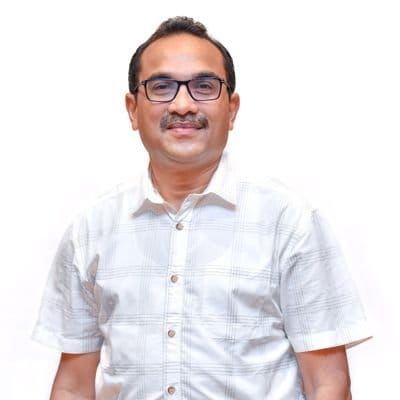
JAFFNA, Sri Lanka — Sri Lanka will decide when and how to develop Jaffna International Airport and Kankesanthurai Port even if India provides financial assistance for the projects, Transport Minister Bimal Rathnayake, a politician increasingly accused by Tamil critics of being hostile to the development of the north, said in Jaffna.
Mr. Rathnayake, the minister of transport and highways and the governing National People’s Power’s chief coordinator for the Northern Province, has been accused by critics of being one of the principal figures obstructing the development of Palaly Airport and Kankesanthurai Port. He made the remarks at a recent news conference in Jaffna, after being asked why the two projects had not advanced despite the availability of Indian funding.
India has provided some money for the airport, Mr. Rathnayake said, but not enough to complete the proposed work, and Sri Lanka would have to borrow the balance. India, by contrast, has said it will bear the full cost of the proposed development of Kankesanthurai harbor.
“As a government, we are concerned about development,” Mr. Rathnayake said. “But it is the government that will decide what development should be undertaken and where.”
The news conference was held at the National People’s Power office in Jaffna. Ramalingam Chandrasekar, the minister of fisheries, aquatic and ocean resources, and Karunainathan Ilankumaran, a member of Parliament, also attended.
Mr. Rathnayake pointed to Mattala Rajapaksa International Airport in southern Sri Lanka as a warning against large infrastructure projects undertaken without adequate planning, saying previous governments had left the state carrying substantial losses there.
The comparison is difficult to sustain on either historical or economic grounds. Mattala was built from scratch at a cost of about $248 million, around projected demand that never materialized. The airport, constructed in Hambantota, the home district and political stronghold of then-President Mahinda Rajapaksa, and later named after him, was controversial from its inception. Critics portrayed it less as an answer to genuine aviation demand than as a prestige project intended to satisfy Mr. Rajapaksa’s political ambitions and his government’s determination to transform his home region into a new economic hub.
They questioned both its remote location and the economic assumptions used to justify such a large investment. Those concerns proved difficult to dismiss: Sri Lanka’s auditor general found that, against an expectation of one million passengers a year, the airport handled only 321,577 passengers over six years and had accumulated net losses of 39.4 billion rupees by the end of 2024.
Palaly is a different proposition. The Palaly airfield dates to the Second World War, decades before Mattala was built and well before Katunayake began operating as Sri Lanka’s principal international civilian airport. India first helped rehabilitate its infrastructure under an agreement dating to 2005, and it already serves a clearly defined regional market, with scheduled Jaffna-Chennai flights operating since 2019, apart from a pandemic interruption.
The same distinction applies to Kankesanthurai and Hambantota. Hambantota was conceived as a new, large-scale international maritime hub, financed substantially through Chinese loans and ultimately placed under a 99-year concession after struggling commercially. Kankesanthurai has operated as a commercial port since 1950, lies 56 nautical miles from India’s coast and already anchors a functioning passenger link with Nagapattinam.
Palaly and Kankesanthurai, in other words, are not speculative attempts to manufacture demand in new locations. They are existing northern gateways being upgraded around established geographic links with southern India, and treating them as northern equivalents of Mattala and Hambantota conflates projects with markedly different histories, scales, financing structures and economic purposes.
The case for developing them rests on geography. Goods originating in India now enter through Colombo and travel hundreds of kilometers north by road along the A9 before reaching Jaffna and the surrounding districts — a penalty paid in freight costs, fuel, travel time and handling. A fully functioning Kankesanthurai port would allow suitable cargo from southern India to enter the north directly, savings that would reach not only consumers but northern farmers, fishermen and businesses importing machinery and raw materials.
Palaly offers the same advantage for passenger traffic. Expanded direct connections with Indian cities would allow tourists, business travelers and members of the large Sri Lankan Tamil diaspora to reach the north without first flying into Colombo and making a six- to eight-hour journey by road. Together, the two gateways could reduce the north’s economic dependence on Colombo and make Jaffna a regional destination in its own right rather than the end of a long domestic journey.
And that, according to one Jaffna-based economist, is precisely what makes the projects politically uncomfortable for some in Colombo.
“The prospect of reducing the north’s economic dependence on Colombo is exactly the problem for people with a racist mindset like Bimal Rathnayake,” the economist said, requesting anonymity because of the sensitivity of the criticism. “A developed KKS and Palaly would give the north direct economic links with India instead of requiring everything to pass through Colombo.”
The history of the Kankesanthurai project also complicates Mr. Rathnayake’s argument about the need for further borrowing. India initially agreed to finance the final stages of the port’s rehabilitation through a $45.27 million line of credit, under an agreement signed in January 2018. When revised estimates pushed the cost beyond that financing, and the project stalled, New Delhi did not ask Colombo to take on a larger loan. It agreed in 2024 to convert the project into a grant of about $65 million — covering rehabilitation of the breakwater and existing pier, construction of a new pier for commercial cargo, and the installation of port infrastructure.
Indian officials have repeatedly presented the work as grant-funded assistance intended to turn Kankesanthurai into a fully functioning commercial port. Indian sources familiar with the project told Jaffna Monitor that New Delhi also remains prepared to accommodate reasonable cost increases arising from delays and revised estimates, meaning that, in their view, cost escalation alone should not prevent the project from proceeding.
Mr. Rathnayake previously oversaw ports and civil aviation before being removed from that portfolio and given other responsibilities. Members of the Janatha Vimukthi Peramuna, the party at the core of the governing coalition, told Jaffna Monitor that the change was linked to what they called his inherently anti-Tamil positions and his resistance to the development of Palaly and Kankesanthurai.
One party member, who said he knew the minister well, went further, describing his outlook as “inherently anti-Tamil and anti-India” and arguing that this, rather than economic considerations, was driving his approach to development projects in the north. Losing the portfolio, his critics say, has done nothing to change it.
“Our government will not undertake development that results in such losses,” Mr. Rathnayake said. “Regardless of who provides the funding for development, the final decision will be taken by the government.” He gave no timetable for further development of either the airport or the port.
In Jaffna, that assertion has prompted a more uncomfortable question.
“If the government is so insistent that it alone decides how development money is spent,” said Vivekanathan, a Jaffna resident, “why does it keep going to India for help whenever it faces financial difficulties?”