

JAFFNA, Sri Lanka: The magistrate hearing the Chemmani mass grave case ruled on Thursday that the court did not have to rely on the lead archaeologist’s latest report in deciding the next steps of the investigation. He said the court had found no reasonable explanation for why the report differed from the archaeologist’s earlier findings.
Magistrate S. Leninkumar issued the order after more than three hours of submissions at the Jaffna Magistrate’s Court. About 20 lawyers for families of the disappeared asked him to reject the report by Prof. Raj Somadeva of the University of Kelaniya. They objected in particular to its suggestion that an epidemic or a natural disaster could explain the burials.
The magistrate stopped short of rejecting it. In his order, he noted that lawyers had shown differences between Prof. Somadeva’s earlier reports and the latest one, and said the court could not find reasonable grounds for them. The court did not need to depend on the report to decide what to do next, he said. “It is his opinion.”
“How the skeletons came to be there, and whose they are, must be determined legally and scientifically,” the order said, according to a Tamil-language account.
The magistrate made no ruling on carbon dating, which the Criminal Investigation Department wants to carry out. He asked the families’ lawyers to recommend other tests and to name four international laboratories that could do radiocarbon dating. He also approved bone sample analysis of the remains thought to be adults. A team led by the Jaffna Judicial Medical Officer, Dr. S. Pranavan, will take the samples, with representatives of the victims present.
The court will return to the scientific questions on Dec. 14.
The report
Prof. Somadeva and his colleague Anusha Wanninayake submitted the report in October under the title “Forensic Archaeological Excavation in Chemmani, Jaffna (2025/2026): A summary report on findings.” Their covering letter to Dr. Pranavan, dated Oct. 15, calls it the third interim report.
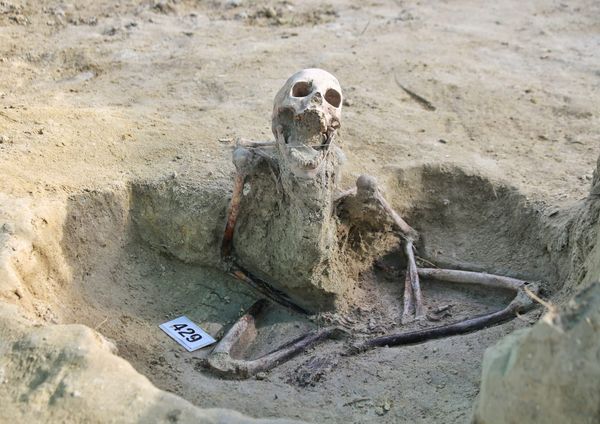
It counts at least 574 people recovered from the trench in the Sinthupathi Hindu cemetery, a few meters from the cemetery’s cremation platform. By the archaeologists’ preliminary estimates, 41 percent were children and 22 percent infants. The remains lay between 0.24 and 1.52 meters below the present ground surface. The team also recorded 51 heaps of loose bone and 170 objects. A ground-penetrating radar survey, the report says, suggests the burials extend beyond the excavated area.
The report says the evidence “is insufficient, in isolation, to support a definitive conclusion.” It also says the site “exhibits greater similarities to contexts characterized by formal burial practices than to clandestine burial sites documented in other parts of the world.” If the burials resulted from “an epidemic or another form of natural catastrophe,” it adds, the small number of objects found with the dead “would not necessarily be unexpected.”
In June 2025, Prof. Somadeva told Al Jazeera that his first report described the site as one that “can be identified as a mass grave and further investigation is needed.” The court recognized it as a mass grave that month. The new report does not use the term.
K.S. Ratnavel, a President’s Counsel, filed a formal objection. He told the court the earlier reports had explained why the site should be treated as a mass grave. They pointed to the shallow graves, the irregular placement of the bones, and the absence of clothing. None of this appeared in the new report, he said, and it gave no reason for the change. He also said it ignored the fact that the area was under military control in the mid-1990s. If an epidemic had caused the deaths, he said, the Health Ministry and other state bodies would have records of it.
“We object to the report in full,” he said.
Coins, carbon and DNA
M.A. Sumanthiran, a President’s Counsel and general secretary of the Ilankai Tamil Arasu Kachchi, spoke for more than an hour. He said Jaffna’s last recorded epidemic was in 1919, yet coins minted after 1920 had been found at the site. “The court must take note of this obvious contradiction,” he said, according to a Tamil-language account of the hearing.
The report lists coins dated from 1920 to 1994. Most were found in a layer of ash near the cremation platform, which the archaeologists believe is left over from an older cremation area that was cleared. The only dated coin found with a skeleton was minted in 1870. The report says a coin’s minting date “does not establish the date of the burial.”
Mr. Sumanthiran and the other lawyers for the families opposed the department’s plan to date the remains by radiocarbon testing. They said carbon dating results had stalled investigations into mass graves in Mannar and Matale. In 2019, tests on remains from the Mannar site gave dates between 1499 and 1719. DNA testing, Mr. Sumanthiran said, could establish both who the dead were and when they died. He said it should be done by international bodies, or under full international supervision if done in Sri Lanka, and that the security forces should have no role.
He filed affidavits from two relatives of people believed to have been disappeared and buried at Chemmani. Both offer their DNA for comparison with the remains. He asked that their names be kept in the court’s safe because they feared threats from the security forces, and the court agreed. Dr. Pranavan told the court their DNA could be collected, recorded, and stored. Mr. Sumanthiran said he expected more families to come forward.
The soldier’s statement
Investigators from the Criminal Investigation Department told the court they had taken a statement from Lance Corporal Somaratne Rajapakse, as the court had permitted last month. Mr. Rajapakse is on death row for the 1996 rape and murder of the schoolgirl Krishanthi Kumaraswamy. In 1998, after his conviction, he told a court that 300 to 400 more bodies were buried at Chemmani. “I can show you where the bodies were buried,” he said at the time.
The investigators said he told them he served at the Chemmani checkpoint in 1996 and that people suspected of being members of the Liberation Tigers of Tamil Eelam were brought there and killed. They said he also told them he could not identify where they were buried.
Mr. Sumanthiran told the court that the Tamil daily Virakesari reported on Nov. 1, citing Mr. Rajapakse’s wife, that he could identify the graves and had sent sketch notes of their location through her. The magistrate asked whether the court could act on a newspaper report alone. Mr. Sumanthiran replied that a report in a national newspaper naming the prisoner’s wife as its source could not be ignored.
The 15 bodies recovered in the 1999 excavation that followed Mr. Rajapakse’s testimony were found at least a kilometer from the present trench.
A priest in Canada
Mariyadas Jude Dinesh, another lawyer for the families, filed an affidavit from the Rev. Alphonsus I. Bernard, a Catholic priest living in Canada. Father Bernard says in it that he has information about the Chemmani grave and is willing to share it. The magistrate said anyone with such information could give it to the Criminal Investigation Department, and that Father Bernard could do so.
Lawyers for the Office on Missing Persons, among them Mirak Raheem and Poorani Mariyanayagam, told the court it did not have to base its decisions on the report. A forensic police officer, relatives of the disappeared, and members of the cemetery’s management also attended.
In September 2025, the Human Rights Commission of Sri Lanka said there was “a reasonable likelihood that the burials were unlawful and pursuant to extrajudicial killings.” On Tuesday, two days before the hearing, relatives of the disappeared marched in Jaffna to demand an international investigation and burned copies of Prof. Somadeva’s report.