

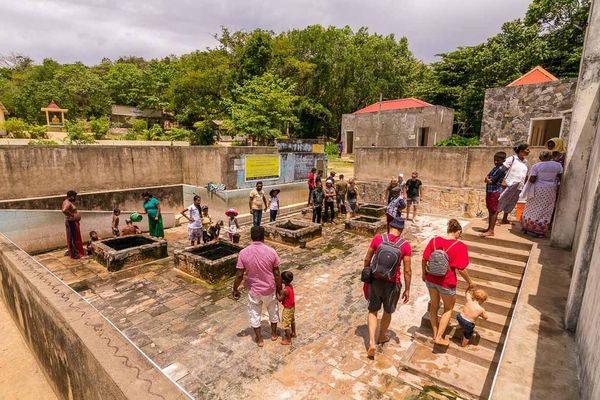
TRINCOMALEE, Sri Lanka — A court in eastern Sri Lanka has ordered the Department of Archaeology to halt construction at a disputed religious site near the Kanniya hot springs, where a Hindu temple once stood and where officials say the remains of an ancient Buddhist stupa lie beneath the ground.
The Trincomalee High Court issued the interim order on Monday, directing that the site be maintained in its present condition and that no further construction take place until the case returns to court on Sept. 22.
The site in question is at Kanniya, near Trincomalee, where a temple dedicated to Pillaiyar, the Hindu deity also known as Ganesha, had previously stood.
According to the case laid out in court, the Department of Archaeology began construction-related work at the site on July 22. The temple property’s owner challenged the work, arguing that it violated an agreement reached before the same court in 2019.
At Monday’s hearing, government counsel Sanjeevan asked for time to obtain information from the Department of Archaeology about precisely what was being built and to submit a written report setting out the department’s position. The court granted the request but ordered that, in the meantime, the site remain exactly as it stood and that no construction work be undertaken.
The dispute stretches back several years. The temple’s owner, identified in the proceedings as Kokilaramani, had sought to demolish the existing structure and build a new one. The Department of Archaeology objected, saying archaeological remains - - including those of an ancient Buddhist stupa - -existed beneath or around the site. The matter reached the Trincomalee High Court, where the parties reached a settlement in 2019.
Under that arrangement, according to the account laid out by lawyers for the landowner, the Pillaiyar temple was to be relocated to another suitable site provided with government approval, while the Department of Archaeology would be permitted only to preserve and protect the archaeological remains at the original location, including the structure identified as an ancient stupa. Arrangements have since been made to build the new temple at the alternative site.
But the landowner’s side returned to court after learning that the department was undertaking new work at the original site, arguing that the activity went beyond preservation and amounted to reconstruction. A motion was filed on the owner’s behalf bringing the matter back before the court.
M.A. Sumanthiran, a President’s Counsel who appeared for the petitioner, said outside the courthouse that the central question was whether the Department of Archaeology was preserving what existed at the site or attempting to rebuild the stupa — a distinction he said was central to the terms of the 2019 settlement.
“The agreement very specifically says preservation and protection only,” Mr. Sumanthiran told reporters after the hearing.
He said that when the landowner learned several months ago that steps were being taken to reconstruct the stupa, Prasanthini Uthayakumar, acting on the owner’s behalf, brought the matter to the court’s attention through a motion. The Department of Archaeology and the local government agent were subsequently summoned.
Mr. Sumanthiran said the government lawyer appearing Monday told the court he needed time to obtain a written report from the department on what work was actually being carried out. The petitioner’s lawyers agreed that time could be granted, he said, but asked that all work at the site be suspended in the meantime — a request the court granted, ordering that the status quo hold until Sept. 22, when the state is expected to explain its position.
Mr. Sumanthiran also pointed to Section 20 of Sri Lanka’s Antiquities Ordinance, which he said allows a landowner and the director general of archaeology to reach a binding agreement over how an archaeological find on private land is treated. He argued that the 2019 settlement recorded before the High Court was such an agreement, and that it limited the department’s role at Kanniya strictly to preserving what was already there.
The Department of Archaeology has not yet placed its full account of the work before the court; its written position is expected when the case resumes on Sept. 22.
The dispute is the latest instance of a recurring friction point in Sri Lanka’s north and east, where archaeological conservation work has periodically drawn accusations that it is being used to expand Buddhist religious sites in areas with Hindu and Tamil populations.