
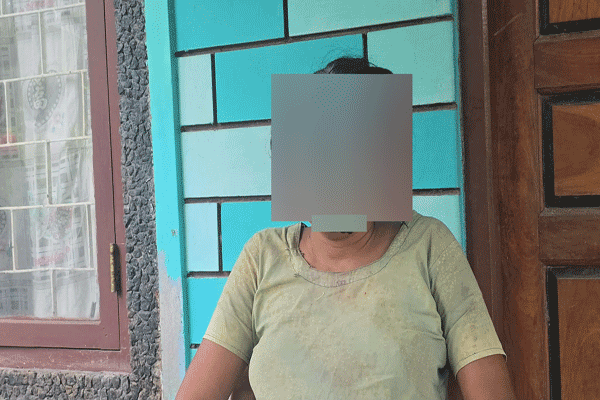
MANNAR, Sri Lanka: The war took her leg. The peace, she says, took her kidney.
Along Sri Lanka's northwestern coast, where lagoons fringed with palmyra palms still hold the quiet residue of a three-decade civil conflict, a former female combatant of the Liberation Tigers of Tamil Eelam says she survived artillery fire and battlefield amputation — only to be driven, years later, into selling one of her kidneys to repay a high-interest loan.
"I survived the war," she said, seated inside her thatched home in Mannar District, her left leg ending where it once continued. She spoke on condition of anonymity, fearing both social stigma and possible legal consequences. "I didn't think I would have to sell my kidney to survive peace."
Her account cannot be independently verified in every detail. Sri Lankan law prohibits the commercial trade of human organs. Health authorities have not publicly commented on her specific allegations. But interviews conducted over several weeks with former combatants, social workers, community organisers, economists, and legal advocates in the North and East reveal that her story — extreme as it is — is the sharpest edge of a broader and largely unaddressed crisis: the systematic economic abandonment of Sri Lanka's postwar Tamil communities, and the predatory lending networks that have rushed to fill the vacuum left behind.
Debt, these sources say, has become the defining struggle of peace.
A LOAN THAT GREW TEETH
When the civil war ended in May 2009 with the military defeat of the LTTE, thousands of former fighters — men and women, some barely adults — attempted to reenter a civilian world they had never properly known. The transition was uneven at best. Jobs were scarce. Trauma was not. Many, like her, also carried permanent physical injuries.
She lost her left leg during the final phase of fighting near Mullivaikkal. After undergoing rehabilitation at a government facility, she returned to Mannar and began preparing savoury snacks for small shops and tea stalls.
"It was not much," she said. "But it was honest work."
Later, seeking to expand her small operation, she borrowed money from an informal lender.
The loan came with what is known locally as "meter interest" — an unregulated system in which interest accrues rapidly, sometimes calculated daily, and compounds without mercy if payments fall short.
"At first, they spoke kindly," she recalled. "They said they were helping me."
Soon, her payments covered only the interest. The principal remained untouched. New charges appeared. The total expanded faster than her earnings could follow. When she missed payments, the lender's tone shifted.
"They said there would be consequences," she said. "I was afraid — not just for myself, but for my family."
Under mounting pressure, she said she travelled to Colombo, where intermediaries — she would not identify them — arranged for her to sell one of her kidneys. The proceeds were used to repay the loan.
It was not enough.
"They told me there was still interest outstanding," she said. "It never ends."
THE ECONOMY OF LOST YEARS
To understand how a former combatant ends up in this position, social workers say, one must understand what war actually took — not just limbs or family members, but time itself.
Many LTTE members joined the movement as teenagers, some voluntarily drawn by ideology or communal solidarity, others coerced under threat. Years were then spent inside a parallel society of training camps, barracks, and battlefronts. Education halted. Vocational pathways vanished. For some, the movement was the only structured institution they had ever known.
"When they surrendered or were released, they were starting from zero," said Kumar, a social worker who has supported former combatants in Mannar since 2009, speaking on condition that only his first name be used. "No qualifications. No savings. No professional networks. And many were also managing trauma or disability. Stable employment was extremely difficult."
Government reintegration programmes existed. They were, by most accounts, insufficient. Some former fighters received short-term vocational training or small grants. Many received nothing. The programmes tapered off as international attention moved elsewhere, leaving communities to absorb thousands of returnees with little sustained institutional support.
A STRUCTURED VULNERABILITY
Over the past decade, microfinance and informal lending practices in Sri Lanka's Northern and Eastern Provinces have drawn consistent criticism from researchers, civil society organisations, and parliamentary voices — yet have received little sustained policy intervention.
The affected population is disproportionately female. War widows, disabled survivors, and women heading households alone — including many former combatants — have been among the most heavily indebted. A 2022 civil society report on livelihoods in the North documented households carrying loans from three, four, or five lenders simultaneously, juggling repayments in a structure one researcher compared to a slow-motion collapse.
"You cannot describe this as individual misfortune," said a development economist based in Jaffna who studies postwar livelihoods and requested anonymity given the political sensitivity of her work. "This is a structured vulnerability. Formal credit has not reached these communities. Sustained livelihood programmes have not reached them. So informal lenders have — and they charge what the market will bear, which in desperation is everything."
Community activists describe aggressive recovery tactics: lenders arriving at homes at dawn, public humiliation in village lanes, threats directed at children and relatives. Some borrowers migrate for work — to Colombo, to the Middle East — and send remittances back not for family needs, but for debt service. Others simply disappear from the community.
Organ sales, if they occur, would represent the extreme end of this spectrum — a final liquidation of the self when all other assets have been exhausted.
Rights advocates say it is impossible to know how frequently they occur. "People do not report these things," said one Mannar-based activist who works with women's groups. "The stigma is immense. The legal risk is real. And there is a profound sense of shame — that it has come to this."
WHAT POLICY COULD DO — AND HASN'T
The questions raised by her story are not unanswerable. Economists and legal advocates point to specific, actionable interventions that successive Sri Lankan governments have failed to implement.
Enforcement against unlicensed moneylenders exists in law but rarely in practice in the North and East, where regulatory institutions were themselves damaged or absent during the war years and have been slow to recover. A stronger enforcement presence — combined with prosecution of illegal usury — would directly reduce the conditions in which predatory lenders operate.
Targeted low-interest credit programmes for war-affected women and disabled survivors have been proposed in various post-conflict development frameworks, but rarely funded at scale. Economists note that microfinance, properly regulated and genuinely concessionary, can be a tool of empowerment — but that the version operating in the North is frequently the opposite: predatory lending dressed in the language of development.
"What prevents stronger enforcement against unlicensed lenders?" asked the Jaffna-based economist. "What prevents targeted credit schemes for disabled women, or former combatants, or war widows? These are policy choices. Not structural impossibilities. Someone has to decide they matter enough."
In the October 2024 general election, voters in the Northern and Eastern Provinces delivered substantial support to the National People's Power coalition — a grouping led by the Janatha Vimukthi Peramuna, which had itself once been an armed insurgent movement before entering democratic politics. The vote was widely interpreted as a demand for economic change rather than ethnic politics.
"Northern people did not vote mainly for political reform or constitutional debates," said Senthan, a former LTTE cadre who now works as a security guard at a private firm in Mannar. "We voted because we believed the NPP would bring economic change. Jobs. Relief from debt. Some stability. Whether that happens — we are still waiting."
THE DIASPORA'S UNCOMFORTABLE QUESTION
During the war, the LTTE operated one of the most effective non-state fundraising networks the world had seen — reaching into Tamil diaspora communities across Canada, the United Kingdom, France, Germany, Australia, and beyond. Estimates of the sums raised vary widely; credible analyses place the annual total in the tens of millions of dollars at the movement's peak.
The money funded weapons, logistics, communications infrastructure, and a parallel administrative apparatus in LTTE-controlled territory.
Today, in towns like Mannar, that history surfaces quietly in conversation — and with it, an uncomfortable question that few raise in public.
"If money could be organised globally for war," said a community organiser who works with war-affected women and asked not to be named, "why cannot it now be organised for livelihoods and dignity?"
He was not the only one to raise it. The question implies another: what became of the sums collected in the LTTE's name — the funds not spent on weapons or operations — and whether any of it could or should find its way to former fighters now living in destitution?
"THE BATTLEFIELD HAS SIMPLY CHANGED"
She does not spend much time on large questions. Her immediate concerns are more pressing: the remaining debt, the management of her prosthetic, and the health of a kidney now working alone. She is not sure if it is managing well. She has not been back to a doctor.
"I thought the hardest days were behind me," she said.
She paused. Outside, a child was calling from somewhere in the lane.
"Instead," she said finally, "the battlefield has simply changed."