
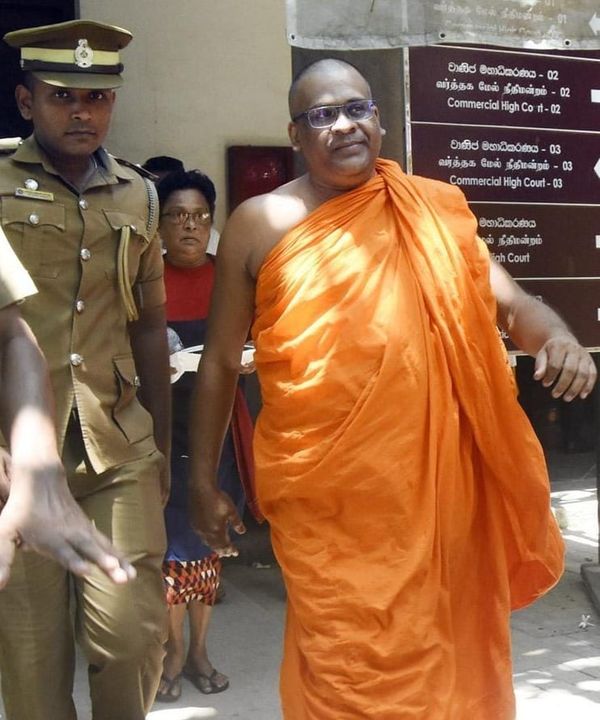
COLOMBO, Sri Lanka — Prison officers went to a temple on Nawala Road in Rajagiriya on Saturday to take Galagoda Aththe Gnanasara Thero back to jail. The monks who were there told them they did not know where he was.
Two days earlier, the Supreme Court had struck down the presidential pardon that released him from Welikada Prison in May 2019, holding that the clemency power had been exercised arbitrarily, in breach of the public trust and beyond the president’s authority.
Gnanasara Thero had served about nine months of a six-year sentence when he was pardoned. With the pardon now void, that sentence remains in force.
But the Supreme Court did not specifically order his arrest or return to prison, nor did it determine how much of the sentence remains to be served. Those questions are now for the relevant authorities to resolve. The absence of a fresh arrest order does not necessarily mean prison officials lack the authority to take him back into custody.
Two sets of applicants filed the petitions in June 2019. The Centre for Policy Alternatives and its executive director, Paikiasothy Saravanamuttu, brought one. Sandhya Ekneligoda, whose husband, the political cartoonist Prageeth Ekneligoda, was abducted in January 2010 and never found, brought the other.
Mrs. Ekneligoda is also the woman Gnanasara Thero was convicted of intimidating. The conduct that put him in prison took place in a courtroom, in front of her.
The Supreme Court granted leave to proceed on October 4, 2023, more than four years after the petitions were filed, and only under Article 12(1), the guarantee of equality before the law. Judgment came seven years and three months after filing.
How the pardon was made
The unanimous judgment was delivered on Thursday by Justices Janak De Silva, Sobhitha Rajakaruna and Sampath B. Abayakoon. Justice De Silva wrote for the court.
A key part of the court’s reasoning concerned a minute found in the Presidential Secretariat files. Prepared by the Additional Secretary (Legal), it recommended a full pardon for Gnanasara Thero. Justice De Silva found that while the minute dealt with the legal issues surrounding a pardon, it gave no reason why the president should have been considering a pardon for the monk in the first place. Mr. Sirisena simply approved the recommendation.
The court found no explanation for the pardon elsewhere in the Presidential Secretariat records, and Mr. Sirisena did not provide one in his affidavit. Justice De Silva concluded that the former president had effectively acted on the recommendation of the Additional Secretary rather than independently exercising the discretion given to him by the Constitution.
The court put two further questions to the former president. Had he known that representations opposing the pardon had been made before he decided? And what accounted for what the judgment calls the “flurry of activity” around the grant of clemency? Mr. Sirisena had the opportunity to answer both in his affidavit once the files were before the court. He did not.
On that record, the court held that he had not exercised the discretion the Constitution gives him. He had submitted to a recommendation. Article 34 confers the power to pardon, the court said, but the power is held in trust for the people, and it remains bounded by the Constitution and open to judicial review. The pardon was arbitrary, in breach of the public trust and the rules of natural justice, and beyond the president’s powers. It therefore violated Article 12(1), and it was void.
The court declined to make any further order against Mr. Sirisena, noting that he had acted on advice from the Additional Secretary (Legal) that was materially wrong in law.
A Pardon Does Not Erase a Conviction
The judgment also clarified what a presidential pardon actually does. It does not overturn a conviction or set aside a sentence imposed by a court. It simply relieves the person from serving the sentence, to the extent stated in the pardon.
With the 2019 pardon now declared void, Gnanasara Thero loses that protection. His conviction and six-year sentence were never overturned and remain in force.
The court also made clear that a future president could pardon him again. But any new pardon would have to be granted according to law and only after proper consideration of all the relevant material.
The courtroom in Homagama
On January 25, 2016, the Homagama Magistrate’s Court was hearing the case against military intelligence officers accused of abducting Prageeth Ekneligoda, whose cartoons had ridiculed President Mahinda Rajapaksa. Gnanasara Thero interrupted the proceedings to speak for the accused officers. He accused the missing cartoonist and his wife of supporting Tamil extremists and of bringing the military into disrepute.
Two prosecutions followed. The Homagama Magistrate’s Court convicted him in May 2018 of criminal intimidation of Mrs. Ekneligoda and sentenced him the next month, ordering him to pay her 50,000 rupees in compensation. His supporters delivered the money in coins and small notes.
Separately, on the application of the then Homagama magistrate, Ranga Dissanayake, the Attorney General brought contempt proceedings in the Court of Appeal. On August 8, 2018, a bench headed by the court’s president, Justice Preethi Padman Surasena, sitting with Justice Shiran Gunaratne, convicted him on four counts and imposed terms of four, four, six and five years, to run concurrently. The Supreme Court affirmed that conviction in October 2018.
Seven months later he walked out of Welikada. Mr. Sirisena’s office gave no reason. The release came a week after Buddhist mobs attacked Muslim-owned homes, shops and mosques in reprisal for the Easter Sunday bombings, and after senior Buddhist clergy had publicly pressed for clemency. The Tamil National Alliance said the decision took majoritarianism to a new level.
Not the First Time He Has Evaded the Authorities
Gnanasara Thero has been hard to find before. Police issued a warrant for him in April 2014 over remarks about the Quran. He went underground in 2018 while wanted over a series of attacks on Muslims, and stayed out of reach for about a month before surrendering.
His exposure has also continued on a separate track. On January 9, 2025, the Colombo Magistrate’s Court sentenced him to nine months’ imprisonment and fined him 1,500 rupees over statements about Islam made at a 2016 news conference in Kirulapone. Bail was refused the same day. The Colombo High Court dismissed his appeal on June 23 of this year, Judge Manjula Thilakaratne holding that the magistrate had not erred.
He is 51. As general secretary of the Bodu Bala Sena, or Buddhist Power Force, he became the loudest voice of militant Sinhala-Buddhist nationalism in the decade after the war. Muslim organisations and human rights groups have accused him repeatedly of inciting religious hatred, which he and his organisation deny. He kept ties with Ashin Wirathu, the Myanmar monk whose speeches inflamed anti-Muslim violence there.
Thursday’s judgment is the third time the Supreme Court has voided a presidential pardon. What followed the first two is worth setting beside it.
On Jan. 17, 2024, the court set aside the pardon Gotabaya Rajapaksa granted on Poson Poya Day in June 2021 to Duminda Silva, the former parliamentarian sentenced to death in 2016 for the murder of Bharatha Lakshman Premachandra. The court had already suspended the pardon by an interim order in May 2022 and directed the police to arrest him. In its final judgment, it directed the Commissioner General of Prisons to carry out the conviction and sentence. Silva remains in prison.
On June 6, 2024, a bench that included Justice Janak De Silva voided the pardon Mr. Sirisena granted to Don Shramantha Jude Anthony Jayamaha, who was convicted over the 2005 killing of 19-year-old Yvonne Jonsson at the Royal Park apartments. That judgment ordered the authorities to implement the sentence and instructed the Attorney General to begin extradition proceedings. It also ordered Mr. Sirisena to pay one million rupees to the petitioner and one million rupees each to Ms. Jonsson’s parents. Jayamaha had left for Singapore a week after his release in November 2019. An Interpol Red Notice was issued last year. He has not returned.
The first two rulings established that presidential clemency is subject to judicial review. Thursday’s goes further, holding that a president must exercise that discretion himself rather than simply approve what an official has placed before him.
Prison officers went to Rajagiriya on Saturday following the judgment. His whereabouts were not publicly known on Sunday, and there was no indication that he had surrendered by the time of publication.