
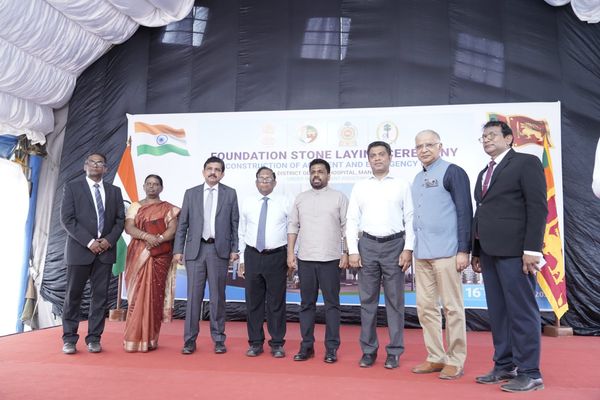
MANNAR, Sri Lanka — President Anura Kumara Dissanayake laid the foundation stones on Wednesday for four new hospital facilities in Sri Lanka's Northern, North Central and Eastern provinces, a roughly 7.15 billion rupee ($21.8 million) construction program financed through Indian grants and Japanese loans that is intended to narrow long-running gaps in emergency and specialist medical care outside Colombo.
The projects include a two-storey accident and emergency unit at the District General Hospital in Mannar, a four-storey medical ward complex at the District General Hospital in Mullaitivu, and eight-storey cardiac treatment complexes at the District General Hospital in Trincomalee and the Teaching Hospital in Anuradhapura.
Indian High Commissioner to Sri Lanka Santosh Jha, Health and Mass Media Minister Nalinda Jayatissa, Japanese Ambassador Akio Isomata and JICA Sri Lanka Chief Representative Shigeo Honzu attended the ceremonies alongside Mr. Dissanayake.
The Mannar and Mullaitivu projects are being financed with a combined 1.2 billion rupees ($3.66 million) in grant assistance from the Government of India, 600 million rupees ($1.83 million) for each facility. The memorandum of understanding for the Mannar emergency unit was signed in September 2025; the Mullaitivu agreement followed in April, between Mr. Jha and Sri Lanka's acting health secretary, Dr. W.K. Wickremasinghe, during a visit by Indian Vice President C.P. Radhakrishnan. Both projects fall under the Indo-Sri Lanka High Impact Community Development Project framework, through which India says it has funded 18 grant projects across 25 districts.
The Mannar unit is expected to be completed in the first quarter of 2028 and will be equipped to provide trauma and emergency care during what Mr. Jha called the “golden hour,” the period after an injury when prompt treatment most improves survival odds. The Mullaitivu ward complex, which will include elevators, backup generators, an uninterruptible power supply, fire protection and a piped medical gas system, is expected to raise the hospital's bed capacity by more than 150 percent, according to health officials; the facility currently has about 195 beds across eight specialized units.
The Trincomalee and Anuradhapura cardiac complexes are being built with loans from the Japan International Cooperation Agency under a health and medical services improvement program that Japan has financed since 2018 and that also covers cardiac facilities at hospitals in Kandy and Kurunegala. The Trincomalee complex is valued at about 2.4 billion rupees ($7.33 million) and the Anuradhapura complex at about 3.5 billion rupees ($10.81 million). Sri Lanka's Cabinet approved construction contracts for both projects last month, worth a combined 5.04 billion rupees ($15.37 million) excluding value-added tax, to Maga Engineering (Pvt) Ltd. Once complete, the complexes will include intensive and coronary care units, catheterization laboratories, wards, clinics, laboratories, libraries, auditoriums, and X-ray and electrocardiogram facilities.
Mr. Jha said India regarded its development assistance to Sri Lanka in the spirit of helping a member of one's own family, attributing the phrase to Prime Minister Narendra Modi. “As neighbours and close partners, we will continue to walk together on this shared path toward the sustainable development and progress of our people,” he said.
Mr. Isomata said Tokyo had placed particular emphasis on the social and economic development of the Northern and Eastern provinces. “Japan has been a longstanding and trusted partner of Sri Lanka,” he said, adding that Japan was prepared to support government efforts to build a sustainable health service.
India has made health a significant part of its development assistance to Sri Lanka in recent years. Past projects include the islandwide 1990 Suwa Seriya ambulance service; a 150-bed multispecialty hospital in Dickoya; a surgical unit at the Batticaloa Teaching Hospital, completed in 2024 at a cost of 302 million rupees ($920,000) and expected to cut surgical waiting times roughly in half for as many as 5,000 patients a year; and upgrades to hospitals in Jaffna, Kilinochchi and Mullaitivu.
For Mannar, the investment addresses what Mr. Jayatissa acknowledged were health services less developed than in many other parts of the country. He said a four-storey doctors' quarters costing 243 million rupees ($741,000) is expected to be completed within about 18 months, and that tenders were underway for a 230 million rupee ($701,000) maternity unit, with construction to begin this year. The government has also begun procuring a scanning machine valued at about 250 million rupees ($762,000), expected to reach the hospital by February, and has allocated 200 million rupees ($610,000) to modernize storage and warehouse facilities. Intern doctors have been assigned to the hospital for the first time, Mr. Jayatissa said, with more expected in October, along with some of the 2,600 nurses and 1,100 public health midwives the government plans to appoint nationally.
Mannar District General Hospital describes itself as a roughly 350-bed tertiary-care institution serving the district and the wider Northern Province, providing emergency, surgical, pediatric, obstetric and critical-care services.
Mr. Jayatissa said the government expected Mannar to play a larger role in the national economy as transport links improve and tourism grows, and that stronger health services would be necessary for both residents and visitors.
The four projects extend a pattern of Indian and Japanese development spending in Sri Lanka's north and east that both governments have described as a long-term partnership. “We will continue to walk together,” Mr. Jha said.