

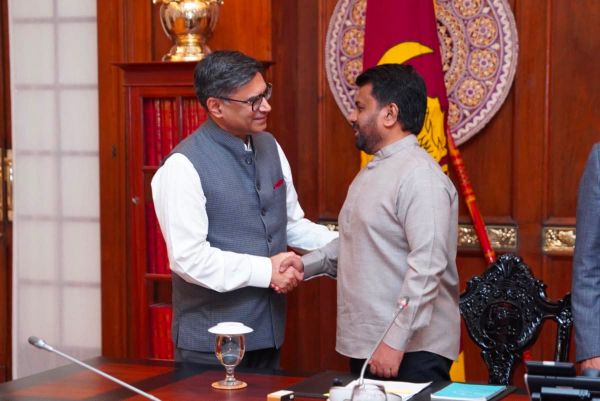
COLOMBO, Sri Lanka — Indian Foreign Secretary Vikram Misri called on Sri Lanka's government Wednesday to hold provincial council elections “at the earliest” and to fully implement the island’s constitutional provisions for the Tamil minority, India’s Ministry of External Affairs said, during his first stand-alone visit to Colombo since taking up the post.
He met President Anura Kumara Dissanayake, Prime Minister Harini Amarasuriya, Foreign Minister Vijitha Herath, and Foreign Secretary Aruni Ranaraja, and held separate talks with Opposition Leader Sajith Premadasa.
He also met Tamil political representatives in two separate sessions: one with parties representing the Northern and Eastern Provinces, and another with leaders of the Indian Origin Tamil community from the central highlands. Most of the parties in a newly formed Tamil-speaking political alliance participated, but they were received separately, split along Sri Lankan Tamil and Indian-origin Tamil lines rather than as a single bloc. The alliance’s Muslim member parties did not participate, and neither the Indian nor the Tamil-speaking side publicly explained why the grouping was not engaged as one.
Indian officials said the discussions were held under the government’s “Neighbourhood First” policy and its “Vision MAHASAGAR” initiative, and that both sides had carried out a comprehensive review of bilateral cooperation.
New Financing, Old Commitments
The two governments finalized two rupee-denominated Lines of Credit, worth $250 million for railway projects and $100 million for livestock and other priority needs. The agreements, concluded between the Export-Import Bank of India and Sri Lanka’s Finance Ministry, were exchanged in President Dissanayake’s presence by Sri Lanka’s Treasury Secretary and India’s High Commissioner.
Reconstruction of houses and bridges damaged by Cyclone Ditwah will begin shortly under a $100 million grant that forms part of a larger $450 million reconstruction package announced after the storm. Officials also reported progress on medical equipment for the relocated Deniyaya Hospital, under a memorandum of understanding signed July 13, along with the supply of medical kiosks, equipment for schools, and an island-wide disaster warning system still being finalized. Rehabilitation of the Northern Railway corridor under a $5 million grant is complete, and train service has resumed.
Both governments agreed to speed up several longer-term projects: an electricity grid interconnection, the Sampur solar power project, development of Trincomalee as an energy hub, and Sri Lanka’s Unique Digital Identity project, for which a tender process is underway. They also directed officials to begin talks on a memorandum of understanding to rehabilitate Kankesanthurai Harbour, to be financed by a proposed $61.5 million grant, and agreed to conclude a separate memorandum expanding the Suwa Seriya ambulance service, a commitment first made during Mr. Modi’s April 2025 visit. More than 1,000 Sri Lankan professionals have completed training under a capacity-building program launched last year, according to the Indian statement.
On plantation housing, Mr. Misri pressed Colombo to speed up construction of the remaining houses under a 2017 Indian commitment to build 10,000 houses for the country’s Indian Origin Tamil workforce, noting recent progress on the fourth phase of the project. The two sides also welcomed initial talks held in June on updating the India-Sri Lanka Free Trade Agreement and the conclusion of negotiations on a bilateral Social Security Agreement, expected to be signed once both governments complete internal procedures.
Tamil Parties Press for Elections
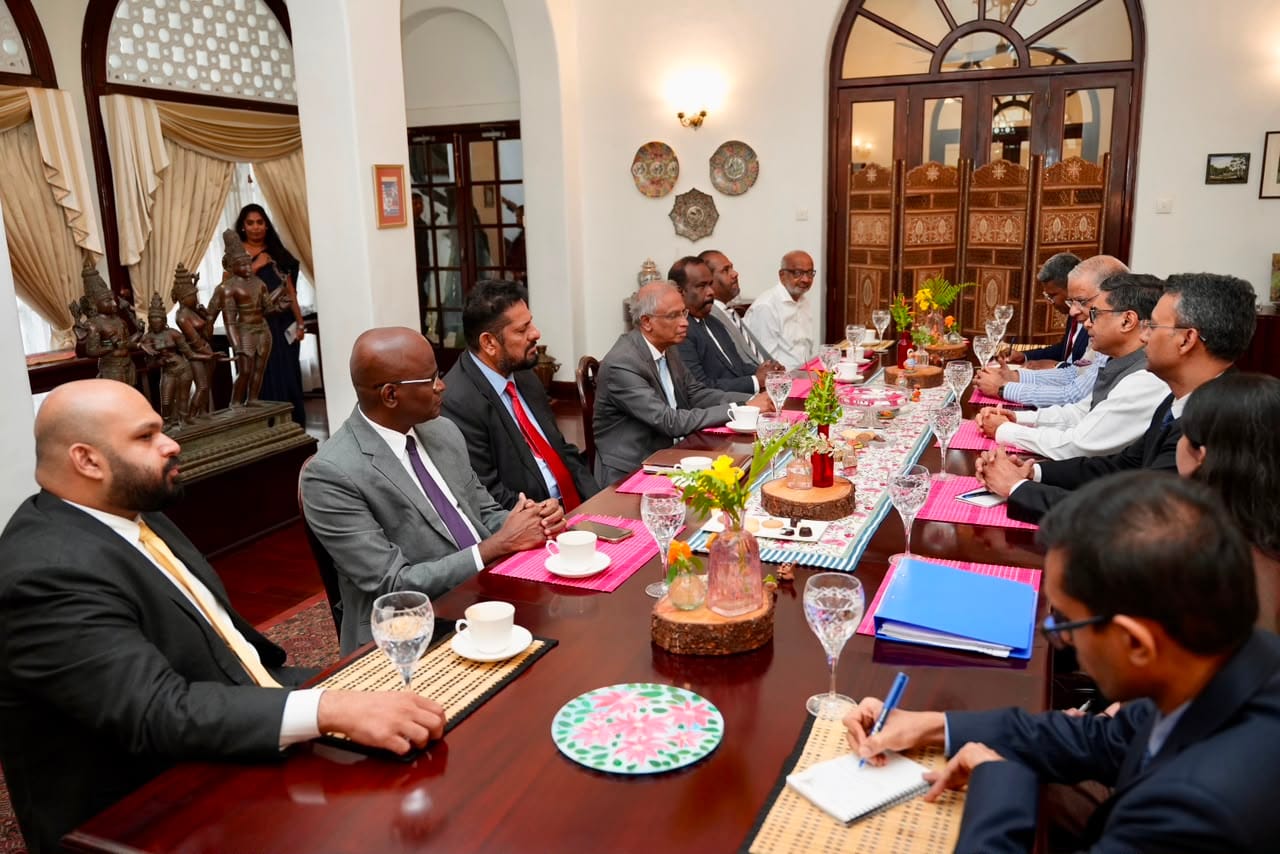
In a roughly 45-minute meeting on Wednesday afternoon, Mr. Misri met representatives of three Tamil parties: the Illankai Tamil Arasu Kachchi, represented by M.A. Sumanthiran, Shanakiyan Rasamanickam, P. Sathiyalingam, and K. Kodeeswaran; the Democratic Tamil National Alliance, represented by Selvam Adaikalanathan and Dharmalingam Siddharthan; and the Tamil National People’s Front, represented by its leader, Gajendrakumar Ponnambalam.
The Tamil representatives told Mr. Misri that President Dissanayake’s government had promised provincial council elections within a year of taking office, a pledge still unmet, and urged India to press Colombo to schedule the vote and ensure it is actually held. Mr. Ponnambalam argued separately that the provincial council system itself is structurally weak, since financial authority remains concentrated in the central government, leaving provincial administrations unable to fully manage responsibilities such as healthcare and education. Mr. Siddharthan acknowledged that divisions among Tamil parties had helped the governing National People’s Power make gains in the North, and Mr. Adaikalanathan said Tamil parties risk repeating that mistake unless they contest future provincial elections as a unified bloc.
On constitutional reform, Mr. Misri said India could not advocate for arrangements benefiting a single ethnic community and instead emphasized equality for all Sri Lankan citizens, a principle Tamil representatives said they welcomed in theory but had yet to see realized in practice. Mr. Misri also asked whether land occupied by the military in the Northern and Eastern Provinces had been abandoned by its owners. The Tamil delegation said the land remained privately owned, and that its owners had been displaced by the civil war and related repression rather than having left voluntarily. They also raised concerns about continuing land acquisitions and the construction of Buddhist temples on disputed sites.
On delays affecting Indian-funded projects, Mr. Misri said India was prepared to move quickly and that no delays originated on its side. He said Sri Lankan officials, when questioned in Parliament, had attributed slow implementation to administrative steps such as appointing a coordinating officer.
Hill Country’s Own Case
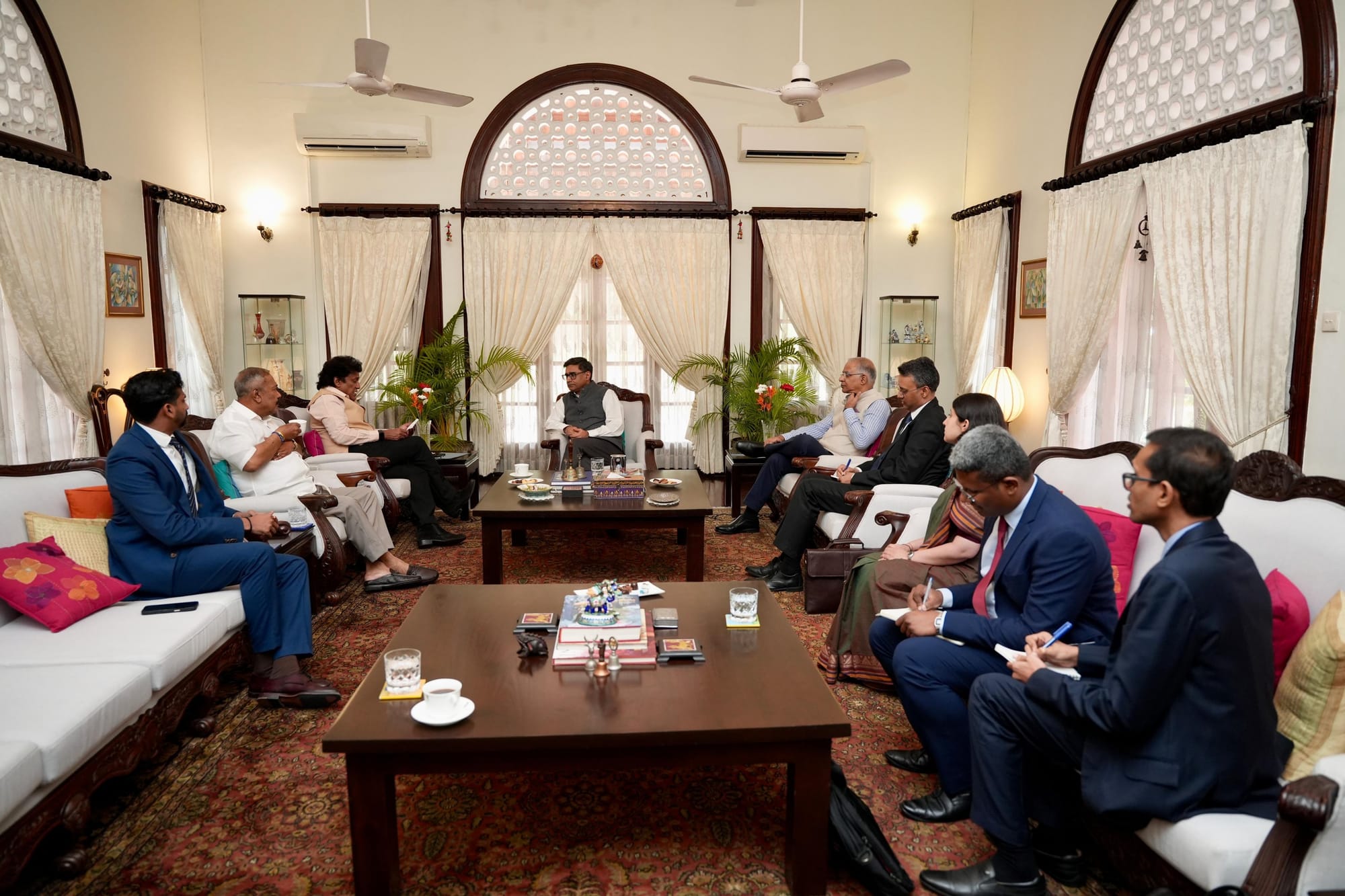
In a separate meeting at India House in Colombo, Mr. Misri met Tamil Progressive Alliance leader Mano Ganesan and a delegation that included the party’s deputy leader and MP, V. Radhakrishnan, and Sri Lanka Workers’ Congress general secretary and MP Jeevan Thondaman. India’s High Commissioner, Santosh Jha, and officials from India’s foreign ministry also attended.
Mr. Ganesan said his delegation focused on Provincial Council elections, constitutional reform, and implementation of the 13th Amendment, while pressing India’s concern that a new constitution might dismantle the provincial council system altogether. He said the delegation told Mr. Misri that President Dissanayake had committed to resuming constitutional talks from the point reached by an interim report drafted between 2015 and 2019, a document meant to strengthen provincial councils rather than replace them, and that the party was confident he would honor that commitment.
Because Indian Origin Tamils are dispersed across roughly a dozen districts without a majority in any single province, Mr. Ganesan said his party intends to propose a “Non-Territorial Community Council” as an alternative form of power-sharing during constitutional negotiations. He said the party continues to support a reformed but reduced executive presidency, accountable to Parliament and elected nationally, arguing that a president who depends on votes from the whole country has more incentive to respond to minority concerns than one who does not.
Mr. Ganesan also said some figures within the governing party had worked to undermine Tamil-inclusive negotiations even as President Dissanayake himself engaged Tamil representatives directly. He warned that responsibility for any breakdown would lie with those government-aligned figures, not with the president or with Tamil parties.
Fishermen and a Security Pledge
Mr. Misri also raised the long-running dispute over fishermen, urging Sri Lanka’s cooperation in releasing detained Indian fishermen and their vessels and calling for a humanitarian approach to continue guiding both governments while they negotiate a permanent solution.
India said it welcomed an assurance President Dissanayake gave during his December 2024 visit to New Delhi that Sri Lankan territory would not be used in any way harmful to India’s security, calling it a foundation for deeper cooperation. Mr. Misri met separately with Opposition Leader Premadasa, where the two discussed regional developments and ways to deepen cooperation in trade, investment, technology, and economic development, according to a readout of that meeting.
The visit closed with both governments reaffirming commitments made during President Dissanayake’s December 2024 trip to New Delhi and Mr. Modi’s April 2025 visit to Colombo, according to the Indian statement.