

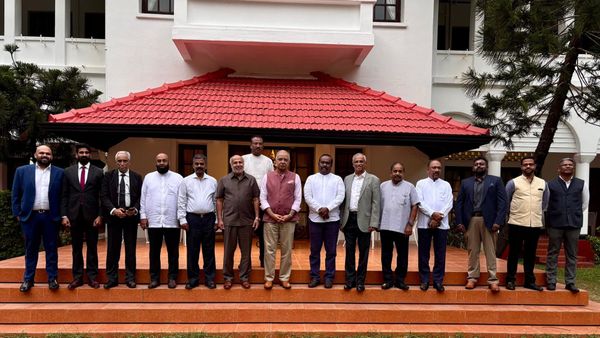
COLOMBO, Sri Lanka — India has privately indicated that Sri Lanka should exercise caution before abandoning its existing constitutional framework in favour of drafting an entirely new Constitution, according to leaders who attended a meeting Tuesday between the country’s newly formed alliance of six Tamil-speaking political parties and Indian High Commissioner Santosh Jha.
Following the discussions, several participants told Jaffna Monitor that constitutional reform featured prominently during the nearly 90-minute meeting at India House in Colombo.
According to participants, Mr. Jha asked whether the alliance intended to discard the existing Constitution entirely and begin drafting a new one from scratch.
The question came a day after the alliance met with President Anura Kumara Dissanayake, during which constitutional reform was one of the principal subjects of discussion.
According to the President’s Media Division, Ilankai Tamil Arasu Kachchi (ITAK) acting General Secretary M.A. Sumanthiran argued during Monday’s meeting that drafting a new Constitution should be approached through a broad national dialogue rather than as a unilateral exercise by any single political party.
Participants at Tuesday’s meeting said they explained to the Indian High Commissioner that they were not proposing to dismantle the existing constitutional framework, which already contains a power-sharing structure through the 13th Amendment and the Provincial Council system. Rather, they said their objective was to build on that foundation and secure stronger devolution within a new constitutional arrangement.
One participant said Mr. Jha responded that abandoning an existing framework after already making significant progress would not be a prudent approach, comparing it to returning to the starting point after travelling halfway towards a destination.
Participants said Mr. Jha's remarks reflected India's longstanding position that the 13th Amendment remains the foundation for political devolution in Sri Lanka under the 1987 Indo-Lanka Accord.
Participants also said Mr. Jha reiterated India’s support for the early conduct of Provincial Council elections and indicated that Indian Foreign Secretary Vikram Misri, who arrived in Sri Lanka on Wednesday, was expected to raise the issue during meetings with senior government leaders.
Leaders Leave Presidential Meeting Frustrated
Several leaders who attended Monday's meeting with President Dissanayake told Jaffna Monitor they were disappointed by the absence of concrete commitments, despite the cordial atmosphere.
One senior participant said the President listened attentively and responded at length, but offered few implementation timelines.
“The discussion was cordial throughout, but we came away without concrete solutions,” the leader said. “His responses were persuasive, much like his public speeches, but when we asked how and when issues would actually be resolved, there were no clear answers.”
According to participants, this was particularly evident when they pressed the President on the release of military-held civilian lands in the Northern and Eastern Provinces.
They said the President replied that he had already instructed the military to address the matter, but did not specify which lands would be released, the process that would be followed, or the timeframe for implementation.
The President’s Media Division said after the meeting that the Government remained committed to constitutional reform, abolishing the Executive Presidency, addressing land issues, and building a broader national consensus before undertaking constitutional change.
Differences Over Constitutional Strategy
The discussions also exposed differing approaches within the Tamil speaking politial alliance, over how constitutional reform should proceed.
One leader who participated in both meetings told Jaffna Monitor that, in his view, Mr. Sumanthiran was the only participant actively pushing for an entirely new Constitution.
"For Sumanthiran, the new Constitution has become an ego issue rather than a practical one," the leader said.
The leader noted that Mr. Sumanthiran had been closely involved in the constitutional reform initiative undertaken during the 2015–2019 Sirisena-Wickremesinghe administration and had played a prominent, if not a leading, role in the Constitutional Assembly process, which ultimately failed to produce a new Constitution.
He argued that, although the JVP, including its leader Anura Kumara Dissanayake, had actively participated in the Constitutional Assembly process during the Sirisena-Wickremesinghe administration, the current political reality made the adoption of a completely new Constitution highly unlikely.
"The NPP has a commanding parliamentary majority, but there is no indication that the Government is preparing to pursue a new Constitution. Given the political realities, continuing to press for an entirely new Constitution is unrealistic. It may become a talking point, but it is unlikely to produce a practical outcome," the leader told Jaffna Monitor.