
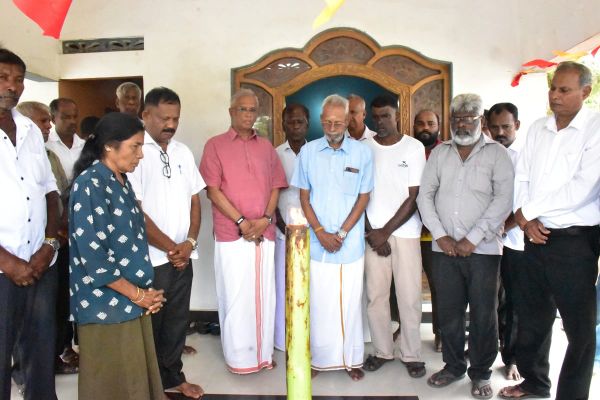
JAFFNA, Sri Lanka — The Ilankai Tamil Arasu Kadchi (ITAK), the largest political party representing Sri Lankan Tamils, said it will stay away from Sunday’s commemorations for the International Day of the Victims of Enforced Disappearances, arguing that competing events had been organized without consulting or inviting the party — even as families of the missing prepare for a large march and international conference in Jaffna.
The decision lays bare divisions over how one of the most enduring grievances of Sri Lanka's civil war should be marked, at a moment when relatives of the disappeared are trying to renew international attention on their decades-long search for answers.
In a statement signed by C.V.K. Sivagnanam, the party's president, and M.A. Sumanthiran, its general secretary, ITAK said several organizations had arranged separate events for Aug. 30 without consulting the party or inviting it to take part.
“Those who have been forcibly disappeared in our country have still not received any form of justice,” the party said. “The government, which bears responsibility in this regard, and the international community must act swiftly.”
The proliferation of separate events, the party said, had led it to withdraw from all of them.
“None of these events was organized in consultation with our party, and we have not been invited to any of them,” the statement said. “Therefore, it has been decided that we will not participate in any event organized by any organization.”
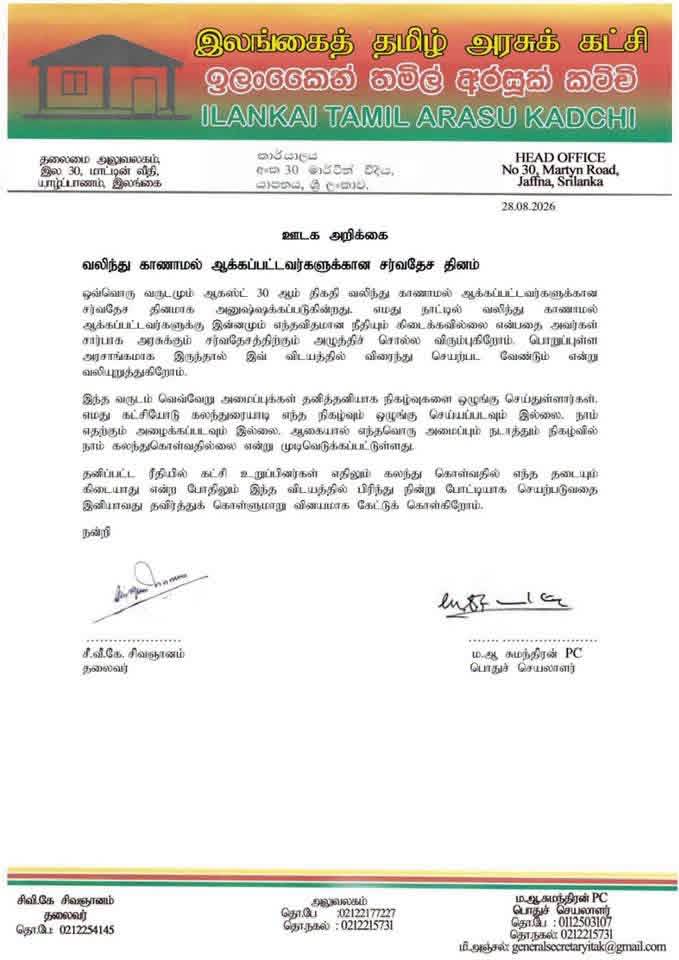
ITAK said individual members remained free to attend in a personal capacity, while also calling for an end to divisions and competing approaches surrounding the issue of enforced disappearances.
The decision comes as groups representing families of the forcibly disappeared across Sri Lanka's north and east prepare for one of the largest commemorations Jaffna has seen in years.
The Association of Relatives of the Enforced Disappeared in the North and East is organizing a march beginning at about 9 a.m. near Veerasingam Hall, at the memorial for those killed during the 1974 World Tamil Research Conference. Marchers are expected to proceed through Jaffna to the Thanthai Chelva Auditorium for a daylong conference titled “The Long Journey for Justice.”
Organizers have called on university students, young people, religious leaders, civil society groups, political representatives and members of the public to join. The Jaffna University Students' Union has announced its support and urged the wider Tamil community to participate.
Representatives of the United Nations and Amnesty International are also expected to attend the conference, organizers said, though their identities have not been publicly disclosed.
The competing commemorations follow a government-backed event held five days earlier, on Tuesday, Aug. 25, at the Jaffna District Secretariat by the Office on Missing Persons, or O.M.P.
That gathering was attended by Justice and National Integration Minister Harshana Nanayakkara, Fisheries Minister Ramalingam Chandrasekar, Northern Province Governor Nagalingam Vedanayagan and government lawmakers. The O.M.P. said hundreds of families of missing people from districts including Jaffna, Kilinochchi, Vavuniya and Mannar had been invited.
But the event also exposed the deep distrust that persists between government institutions and many families of the disappeared.
Relatives protesting outside the District Secretariat rejected compensation payments and death certificates, arguing that neither could substitute for establishing what happened to family members who disappeared or, in some cases, whom they say were surrendered to government forces during the final stages of the war in 2009.
A confrontation followed when police stopped protesters from displaying a banner and physically removed several women from the area. The O.M.P. later disputed the characterization that families seeking justice had been driven away, saying those removed belonged to a politically motivated group attempting to disrupt the event.
The competing commemorations come as enforced disappearances have again moved to the center of public attention in northern Sri Lanka, driven in large part by the continuing excavation of the Chemmani mass grave in Jaffna.