

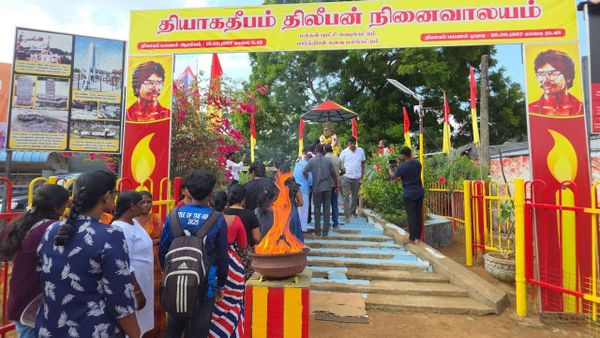
JAFFNA, Sri Lanka — Commemorations for Thileepan, the Liberation Tigers of Tamil Eelam political leader who starved himself to death in 1987, opened at his memorial in Nallur on Tuesday, 39 years to the day since he sat down in front of the Nallur Kandaswamy temple and refused food and water. Observances will be held daily until Sept. 26, the day he died, in towns across the Northern and Eastern Provinces and among Tamil communities abroad.
The ground around the memorial was cleared the day before. The mayor of Jaffna, Mathivathani Vivekanandarajah, inspected the site on Monday at the request of the commemoration’s organising committee and ordered traders to take down stalls left standing from the Nallur festival. Finding refuse dumped near the memorial, she warned the operators and directed the council’s public health division to clean the ground once the stalls came down.
The exhibition
An exhibition of documents and photographs on the fast will open in Nallur at 7 a.m. on Sunday, Sept. 20, and run until Sept. 27. It is the fourth year it has been mounted, on land rented from the Jaffna Municipal Council directly in front of the main memorial site.
Varatharajan Partheepan, a former member of the municipal council speaking for the organisers, said at a briefing at the Jaffna Press Club on Monday that this year’s material had been revised after Thileepan’s family and men who were with him during the twelve days identified errors and gaps in the earlier documentation. Former classmates from Jaffna Hindu College have contributed to the display.
“It has been our great desire that this documentation should be exhibited everywhere,” Mr. Partheepan said. The same panels are to be shown in Croydon, south London, on Sept. 20 and Sept. 27, and in France on Sept. 26. He urged families in the diaspora to bring their children to the overseas events.
The fast
Thileepan was born Rasaiah Parthipan on Nov. 29, 1963, in Urelu, near Urumpirai in the Jaffna district, the youngest of four sons of a Tamil-language teacher. His mother died when he was an infant, and he was raised by his father and brothers. He was educated at Jaffna Hindu College and enrolled at the medical faculty of the University of Jaffna before joining the LTTE in the early 1980s, taking the nom de guerre by which he is now universally known. Wounded in the stomach during the army’s Vadamarachchi offensive in mid-1987, he was appointed the group’s political leader for the Jaffna peninsula.
His fast followed the Indo-Lanka Accord of July 1987, under which Indian troops deployed to the north as a peacekeeping force. On Sept. 13, 1987, the LTTE handed the Indian High Commission a letter setting out five demands: the release of Tamils held under the Prevention of Terrorism Act and emergency regulations; an end to Sinhalese settlement in Tamil areas carried out in the name of rehabilitation; a halt to all such rehabilitation work until an interim administrative council was established; an end to the construction of police stations in the Northern and Eastern Provinces; and the disarming of government-armed home guards, together with the withdrawal of the army and police from schools. The demands were addressed to New Delhi on the reasoning that India alone could compel Colombo to act. No reply came.
Thileepan began his fast on Sept. 15, 1987, on the outer precincts of the Nallur Kandaswamy temple, refusing food and water. Crowds came from across the peninsula. Sympathy fasts were held in towns throughout the north, religious observances were conducted in temples, and kavadi processions were taken up in his name. Citizens’ committees, trade unions and student and teacher associations passed resolutions and petitioned the IPKF commander, Lt. Gen. Depinder Singh, to intervene. J. N. Dixit, then the Indian High Commissioner, flew into Palaly on Sept. 22 and did not visit him. As his condition collapsed, Thileepan stopped speaking. He died on Sept. 26, 1987, on the twelfth day, at 23.
Black flags went up across the peninsula. His body was taken in procession through the villages of Jaffna and then handed to the Faculty of Medicine at the University of Jaffna, in accordance with his last wish.
What happened to the body
What became of it afterwards has never been set down in any public record.
When the LTTE withdrew from Jaffna, it took the body with it. For years it was held at a facility known as the Esther Medical Centre, where the movement’s medical personnel used it in anatomical training, according to people familiar with the arrangement. Those familiar with its movements say the body travelled with the organisation through each subsequent retreat across the Vanni.
By May 2009 it had reached Mullivaikkal, where tens of thousands of civilians and what remained of the LTTE were pinned into a shrinking strip of coast. Between May 10 and May 12, with the shelling at its heaviest and the body impossible to move further, it was buried at Mullivaikkal, the same people said. The location was not marked and is not known.
Why the day is kept
Thileepan is known among Tamils as Thiyaga Deepam, the light of sacrifice. He is the only member of any Tamil armed group to have died by fasting, and the only one whose death is commemorated in the vocabulary of non-violence rather than of arms. The observance centers on fasting, lighting a flame, and retelling the twelve days.
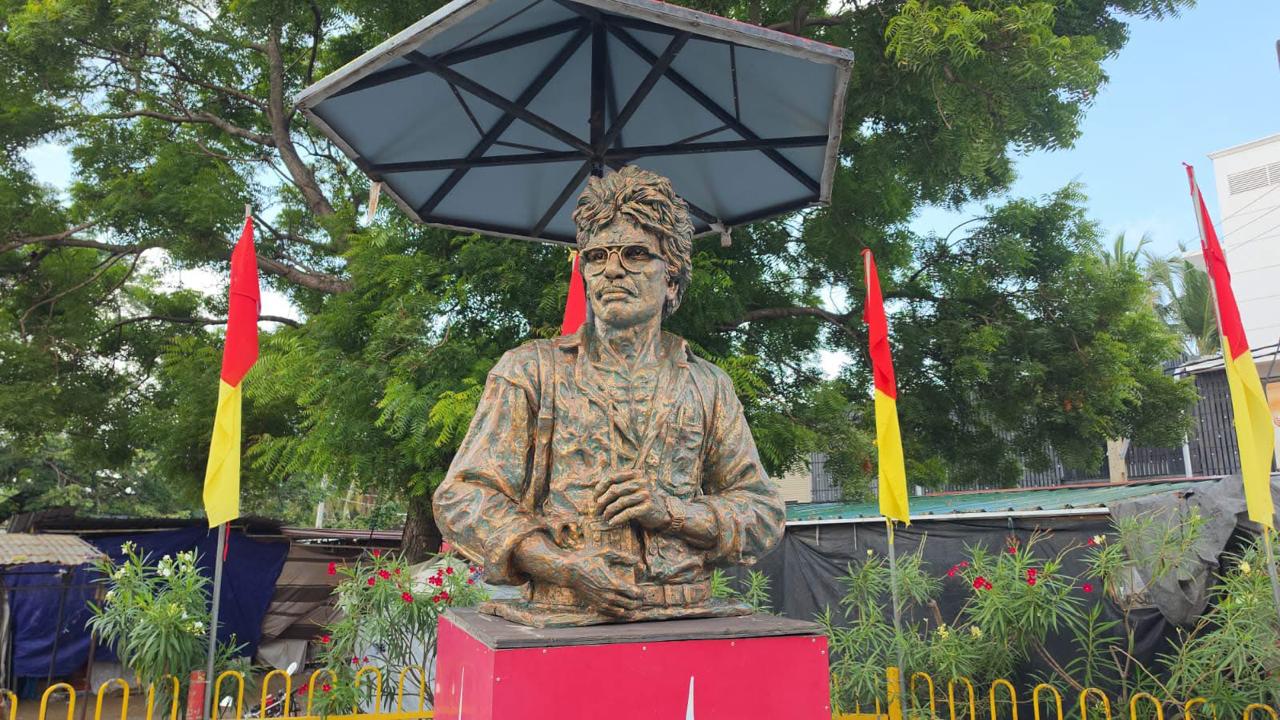
The memorial itself has been destroyed four times. The statue put up behind the temple in 1988 was demolished after the military retook the Valikamam region in 1996. It was rebuilt in 2003 during the Norwegian-brokered ceasefire, damaged in 2006, destroyed by armed men in 2007, and its last pillar brought down in 2010. Police applied to magistrates in 2018 and 2020 to prohibit the annual commemoration and to strip the site of decorations, arguing that it glorified an organisation banned in Sri Lanka, India, the United States, Britain, Canada and the European Union. In 2020 the former provincial councillor M. K. Shivajilingam was arrested while trying to pay tribute at Nallur, and courts in Jaffna and Mullaitivu issued prohibition orders. In other years magistrates refused the applications, holding that the dead may be mourned. In 2023 a memorial float carrying Thileepan’s portrait from Pottuvil to Nallur was attacked by a Sinhala crowd as it travelled north.
A contested record
But there is another account of how Thileepan’s fast began.
K.T. Sivakumar, better known as Anton Master, was an early LTTE member and served on its central committee before the organisation came under the sole leadership of Velupillai Prabhakaran. He later headed the LTTE’s Military Office and, alongside Thilakar, represented the group at both rounds of the Thimphu talks in Bhutan.
Speaking to Jaffna Monitor in 2024, Anton Master recalled being with Prabhakaran on the day Thileepan began his fast.
“Prabhakaran asked Kasi Anandan and me to escort Thileepan to the hunger strike site in Nallur,” he said. “After Thileepan’s death, Prabhakaran directed Kasi Anandan and me to hand over his body to the Faculty of Medicine in Tirunelveli.”
Thileepan, in his account, may genuinely have wished to give his life for something he believed would help Tamils. What he disputes is the use to which that willingness was put. Indian troops had been received in Jaffna that July with garlands and drums, and relations were cordial enough that residents sometimes turned on the LTTE when it attacked Indian soldiers. Prabhakaran, he said, wanted that broken.
Seven days after Thileepan’s death, another event pushed the peninsula closer to confrontation. On Oct. 3, 1987, the Sri Lankan Navy intercepted a boat off Point Pedro carrying 17 LTTE cadres, among them the commanders Kumarappa and Pulendran. They were taken to the military base at Palaly, where Indian forces were then stationed.
Two days later, on Oct. 5, as the Sri Lankan authorities prepared to fly the detainees to Colombo for questioning, the men swallowed cyanide. Twelve died, including Kumarappa and Pulendran. Their deaths triggered an outpouring of anger across the north and helped accelerate the collapse of the already fragile relationship between the LTTE and India. Within days, the LTTE and the Indian Peacekeeping Force were at war.
Anton Master says the capsules reached them on Prabhakaran’s instructions, and calls the deaths an unnecessary loss of life. Several of the seventeen, he said, had gone to look at the boat and nothing more.
“Both Thileepan’s hunger strike and the cyanide incident were orchestrated by Prabhakaran to incite the Tamil population against the Indian army,” he said. “This strategy ultimately proved to be successful.”
He also disputes the premise of the five demands, arguing that an interim administration and the return of the Sri Lankan army to barracks lay within the accord’s framework and needed time rather than a death, and that the LTTE was smuggling weapons into the peninsula in the same weeks that it was making a show of surrendering them. The organisation always denied that.
Thileepan’s conduct in the years before the fast is a separate question, and it has been in print since 1990, when four University of Jaffna academics published The Broken Palmyra, an account of Jaffna in the 1980s. The book records his participation in public executions, including a lamp post killing at Urumpirai in the months before the hunger strike. Accounts from the period place him in the LTTE’s campaign against the Jaffna student movement, which followed the disappearance of Arunagirinathan Vijitharan, a third-year commerce student taken from his boarding house in November 1986, and ran through threats against protesting students to the killing of the student leader Vimaleswaran. He has further been accused of killing captured TELO cadres, among them child soldiers being treated for severe eye disease at the Vattukkottai-Mavadi camp.
Those who hold Thileepan in reverence reject all of it. Tamil diaspora organisations have long accused the authors of The Broken Palmyra and their successor group, University Teachers for Human Rights (Jaffna), of anti-LTTE bias.
The medical faculty at Thirunelvely, where Anton Master says he delivered the body, was also where Rajani Thiranagama taught anatomy. Two years later she was one of the four authors of The Broken Palmyra. On Sept. 21, 1989, weeks after the book appeared, an LTTE gunman shot her dead outside her house in Thirunelvely as she cycled home from work.
The politics of the anniversary
The commemoration is contested inside Tamil politics as well. The Tamil National People's Front has been accused in recent years of taking the Thileepan commemoration for itself, and of turning an occasion of collective grief into a platform for one party.
The objections sharpened when the party routed a commemorative procession through predominantly Sinhala villages, a decision some Tamil commentators called needlessly provocative in an already strained ethnic landscape. Others in Jaffna object more broadly to any party presenting itself as custodian of a grief that is held across the north and east and among Tamils abroad. Whoever controls the platform at Nallur also controls an event that draws money and attention from the diaspora, and people familiar with the organising say that is part of what is at stake in the dispute.
The exhibition opens on Sunday, and the observances at Nallur run daily until Sept. 26.