

By Jaffna Monitor Staff
Kamzy Gunaratnam became Norway’s minister of transport in September. On Tuesday, she wrote to tell Håvard Vederhus.
Mr. Vederhus, one of her closest friends, would have turned 37 that day. He was 21 when a far-right extremist shot him dead on the island of Utøya on July 22, 2011, in a massacre aimed at the Labour Party’s youth wing. Ms. Gunaratnam, then 23, escaped by swimming away from the island.
“Now I am a cabinet minister,” she wrote in Norwegian in a letter posted on Facebook. “It still feels surreal to write those words. And amid all the gratitude, the pride and the gravity, there is also grief. Because I would so much have liked to have you here.”
She wrote that she wished she could hear what he thought, get a phone call from him and be “challenged, contradicted, encouraged.” “And then we could have argued a little, laughed a lot and agreed that we wanted the same thing after all.”
It is not the first time she has written to him in public. She has done it on his birthday and on July 22, in postcards, in Facebook posts and in a speech at his grave.
Ms. Gunaratnam, 38, was born in Jaffna, in northern Sri Lanka, and arrived in Norway with her family in 1991, at age 3, as refugees from the country’s civil war. They lived in the far north of Norway before settling in Oslo. She was deputy mayor of Oslo from 2015 to 2021, the youngest person to hold the post, and was elected to Parliament in 2021. Prime Minister Jonas Gahr Støre named her minister of transport on Sept. 11.
They met in March 2007, at a meeting of the Oslo Labour Party. Both were teenagers. He was 17. Mr. Vederhus sat down beside her, introduced himself, and began holding forth on how distasteful he found homosexuality. She went home furious and complained to her younger brother about the homophobic boy from Oslo Cathedral School. Her brother laughed. Mr. Vederhus was in his class, and he was gay.
“That’s how our friendship began,” she wrote this week. At his grave in 2021, she called the remark typical of his provocative streak.

That summer, both went to their first camp on Utøya, run by the Workers’ Youth League, the Labour Party’s youth organization, known by its Norwegian initials, AUF. Few others wanted to swim with them, so the two swam together from the island’s pump house to a spot on the shore called Bolsjevika. “I wish I had known how precious that memory would one day become,” she wrote.
They fought often. She wrote that they would stand on Youngstorget, the Oslo square where the Labour Party has its headquarters, shouting at each other, and then call each other crying afterward. A year after the attacks, she told the newspaper Dagbladet that they had argued about everything, from how things should be done to whom each of them should date. They were like siblings, she said, although many in the party assumed they were a couple.
In a 2024 post, she listed what they agreed on: that debate moves things forward, that everyone should be lifted up and no one pulled down, and that politics should be based on knowledge rather than tradition. He had a phrase for it, which she still quotes: “Knowledge changes everything.”
In the years after they met, he led Elevorganisasjonen, the union of secondary school students, first in Oslo and then nationally. He sat on a government committee on the education of multilingual children and young people, the youngest person ever appointed by the King in Council to such a panel. In 2009, the newspaper VG named him one of its young talents of the year.
Ms. Gunaratnam was elected leader of Oslo AUF in February 2009. Two months later, she wrote, she ran into Mr. Vederhus at a nightclub, and the two decided that night that he would one day succeed her. He did, in February 2011. “I knew you would be fantastic,” she wrote this week. “And you were.”
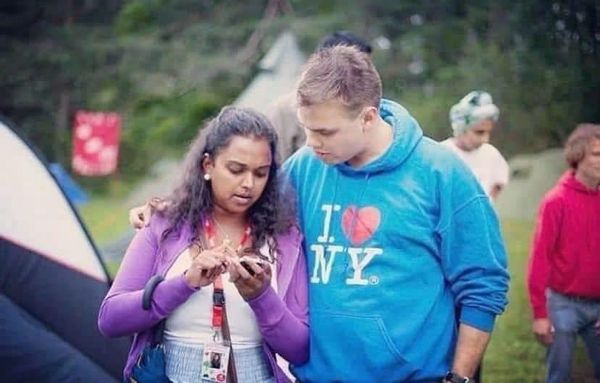
On July 19, 2011, as Oslo AUF was setting up its camp, someone took a picture of the two of them going over the plans. She later posted it with the caption “Life was perfect.”
Three days later, on the afternoon of July 22, a car bomb exploded in the government quarter in Oslo, outside the building that housed the prime minister’s office, killing eight people. Less than two hours later, the bomber, Anders Behring Breivik, reached Utøya dressed as a police officer. He began shooting at 5:21 p.m., when 564 people were on the island, and killed 69 of them, most of them young.
Hours earlier, Mr. Breivik had emailed a manifesto of about 1,500 pages to thousands of people. In it, he named Islam and what he called “cultural Marxism” as his main enemies, and he accused the Labour Party of betraying Norway by allowing Muslim immigration and promoting a multicultural society. Sveinung Sandberg, a criminologist at the University of Oslo who has studied the manifesto, has written that his targets were the government and the party’s future leaders.
Mr. Vederhus was at the pump house, where he and Ms. Gunaratnam had gone swimming in 2007. The 22 July Centre, Norway’s national learning center on the attacks, says the gunman killed 14 young people there.
Ms. Gunaratnam last saw him at an information meeting for the Oslo and Akershus delegations, standing beside Eskil Pedersen, then AUF’s national leader. “Calm, clear and caring,” she wrote. “You took responsibility. You looked after others.”
She ran through the woods to the southern tip of the island, swam out into the lake, and was picked up. She waited for hours at Sundvollen on the mainland and was home before midnight. She was sure he would make it. “Håvard will sort it out,” their friends used to say.
“I came home,” she wrote this week. “You didn’t.”
For years she has asked why he did not swim, and whether she should have waited until he was safe. In 2024, she noted that the gunman reached the pump house while she was already swimming toward the far shore. “Questions that help no one,” she wrote, “but that unfortunately don’t go away on their own either.”

At his grave on the 10th anniversary, in 2021, she said he had not been killed for being gay or a Christian. “Håvard was killed for what he believed in,” she said. “The hatred that killed our dear Håvard is alive and well. And we have not done enough.”
In 2019, a young Norwegian man who said he had been inspired by the mosque massacre in Christchurch, New Zealand, shot dead his 17-year-old stepsister, who had been adopted from China, in what prosecutors called a racist killing. He then opened fire in a mosque outside Oslo. The Christchurch gunman had himself cited Mr. Breivik as an inspiration.
In a 2020 Facebook post calling for a national library of anti-racist literature in Oslo, which quoted Mr. Vederhus, Ms. Gunaratnam wrote that she was a brown woman who had been bullied for the color of her skin and shot at for her political beliefs. She wrote that she had been told she could not lead Oslo’s Constitution Day committee because she was not Norwegian enough. She also recalled Benjamin Hermansen, a 15-year-old boy killed by neo-Nazis in the Oslo district of Holmlia in 2001.
In August 2012, an Oslo court found Mr. Breivik criminally responsible and convicted him of terrorism and murder. It gave him the harshest penalty Norwegian law then allowed: 21 years of preventive detention, with a minimum of 10. Norway abolished life imprisonment in 1971. A 2009 law raising the maximum sentence for terrorism to 30 years had not yet taken effect when he was tried.
Many outside Norway called the sentence mild. But preventive detention can be extended by up to five years at a time, with no limit, for as long as a court finds the prisoner dangerous. The Norwegian government’s own guidance notes that a person serving it can, in principle, spend the rest of his life in prison. Mr. Breivik is still there.
A government commission reported in 2012 that the police could have stopped him sooner on Utøya. Officers did not reach the island until 6:25 p.m., more than an hour after the shooting began. The commission found that the domestic security service could have picked up his trail before the attacks with better methods, though it could not say the attacks would have been prevented. It also said a street beside the government offices should have been closed to traffic and was not.
In 2016, an Oslo court ruled that his near-isolation in prison violated the European ban on inhuman or degrading treatment, a decision that stunned survivors and victims’ families. An appeals court overturned it in 2017, and the European Court of Human Rights dismissed his complaint in 2018. He sued again and lost in 2024, and lost that appeal in 2025. At his first parole hearing, in 2022, he made a Nazi salute and brought signs with far-right slogans into court. His requests for parole were rejected in 2022 and 2024, with courts finding a real risk that he would commit serious violence again.
Mr. Vederhus’s funeral drew more mourners than the church could hold. Prableen Kaur, his deputy at Oslo AUF, said in her eulogy: “Håvard was a fantastic leader, with many visions. We got to blossom under his leadership.” In the local elections that September, his name stayed on Labour’s list in Oslo, and voters who knew he was dead gave him 1,221 personal votes, according to his biographer, the historian Hans Olav Lahlum.
His parents set up an education fund in his name in 2014 that pays for young people in Tanzania to study after secondary school. In 2019, they wrote, it was paying for vocational training for 10 girls. His younger sister, Torunn, wrote for the 2013 launch of Mr. Lahlum’s biography, “Et kvart liv” (“A Quarter of a Life”), that her busy brother was always stopping to send “one very important message.” Once she had his attention, she wrote, “I knew that moment was important to him too.” She ended: “Håvard was, and always will be, a big and beautiful rose.”
Ms. Gunaratnam has gone back to his grave at Grefsen cemetery in Oslo many times. “It’s good to just come up here and talk to him,” she told Dagbladet a year after the attacks. The postcard she left there that day imagined him finding a gay bar in heaven, where there would be dancing when she arrived.
In 2024, less than two years before she joined the cabinet, she wrote that she did not know what she would become, but that whatever she did would serve the dream they had shared of a better world. On his birthday last year, she said she still writes to him as if he were alive. “For me he is.”
She began this week’s letter with a question. “Is it sad? That I still talk to you as if you were still here?”
She wrote that whenever the Labour Party chooses candidates for an election, she thinks of the names that will never appear on a ballot. “Some of the very best among us never got to grow up,” she wrote. “You were one of them, Håvard.”
“My head knows you are never coming back, but my heart refuses to accept it,” she wrote. “I have learned to live with the loss. But I have never learned to stop missing you.”
He was a Christian. She is not religious. She wrote that she hopes all the same that he can see her and is “a little proud of me.” She ended by imagining him waiting at that gay bar in heaven with a bottle of cava, a Spanish sparkling wine, ready to spin her around the dance floor as he did the last time, so that she could tell him everything he had missed and scold him for leaving so early.
“Happy 37th birthday, dear Håvard,” she wrote. “You should have been here.”