

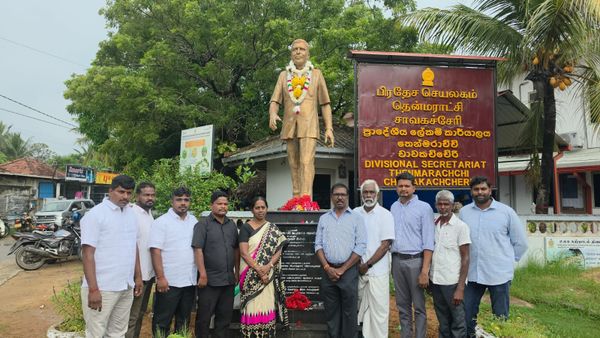
JAFFNA: Family members, politicians and activists gathered in Chavakachcheri on Tuesday to mark 20 years since the assassination of Nadarajah Raviraj, a Tamil member of Parliament who was shot dead in Colombo in 2006. No one has been convicted of the killing.
Mourners garlanded his statue and scattered flowers at the Maamanithar Raviraj Memorial Square, in front of the Chavakachcheri Divisional Secretariat. His widow, Sasikala Raviraj, attended with other family members.
The anniversary comes seven months after the Court of Appeal set aside the 2016 acquittal of five men accused of the murder, three of them Sri Lanka Navy intelligence personnel, and ordered a fresh trial before the Colombo High Court. Tamil politicians and rights groups have for years pointed to the case as an example of how political killings during the war went unpunished.
A lawyer who argued the Tamil case in Sinhala
Mr. Raviraj was a lawyer from Chavakachcheri, in the Thenmarachchi region of Jaffna. He entered politics through the Tamil United Liberation Front and served as mayor of Jaffna. He was elected to Parliament from Jaffna District on the Tamil National Alliance ticket in 2001 and re-elected in 2004.
He spoke out against enforced disappearances, the killing of civilians and abuses by the security forces in the North and East, and he worked with civil rights organisations he helped to establish.
He was fluent in Sinhala as well as Tamil. He appeared often on Sinhala-language television and radio programmes, where he made the case for Tamil political rights and a negotiated settlement directly to audiences in the south.
The killing
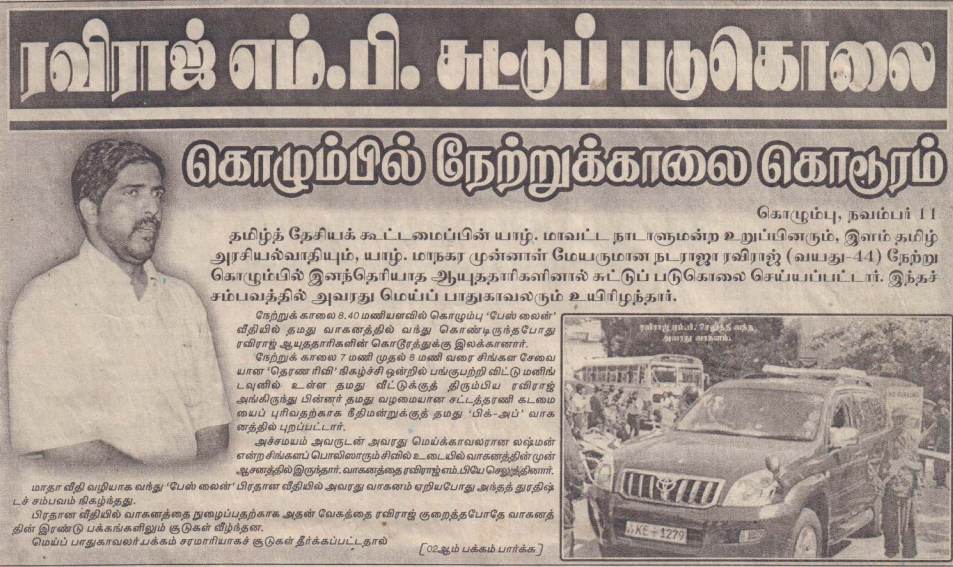
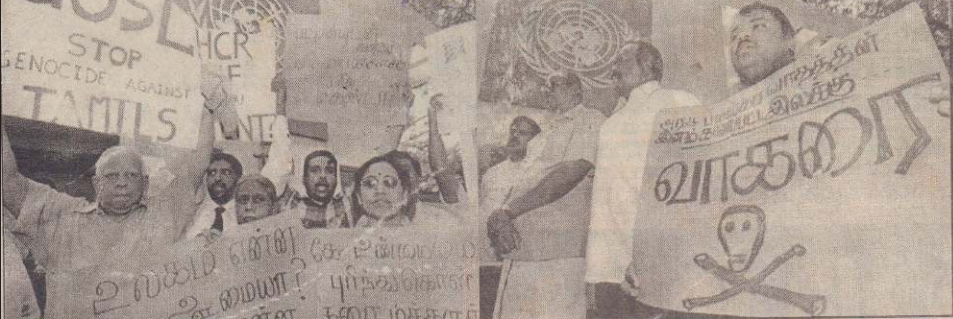
On 9 November 2006, Mr. Raviraj led a protest outside the UNICEF office in Colombo against the shelling of Vaharai, in Batticaloa District, which had killed dozens of displaced civilians days earlier. The next morning, he took part in a live discussion on the Sinhala-language channel TV Derana.
He returned to his home in Manning Town, Narahenpita, and set out again for work shortly afterwards. At about 8:30 a.m., gunmen on a motorcycle opened fire on his vehicle at close range. Mr. Raviraj died in hospital. His police bodyguard, Lakshman Lokuwella, was also killed. The shooting took place in central Colombo, on a stretch of road between police checkpoints.
After his death, the Liberation Tigers of Tamil Eelam conferred on him the title Maamanithar, its highest civilian honour. The title translates roughly as “great human being,” and the memorial square in Chavakachcheri bears it.
Mr. Raviraj was one of several Tamil National Alliance lawmakers killed in the last years of the war. Joseph Pararajasingham, an MP from Batticaloa, was shot dead during Christmas Mass in December 2005. Kiddinan Sivanesan, an MP from Jaffna District, was killed by a roadside bomb in the Vanni in March 2008.
A trial, an acquittal and an appeal
Police arrested suspects within days of the shooting. During the investigation, a former police officer told investigators that the killing had been planned at a navy intelligence office in the Gangaramaya area of Colombo, and that the gunmen fled back to that office after the attack.
The Attorney General indicted five men: three navy intelligence personnel and two members of the Karuna faction, an armed group that had broken away from the Tigers and operated alongside government forces. Over objections from lawyers for the Raviraj family, the High Court allowed a defence request for the case to be heard by a special jury of Sinhala speakers.
The judge began charging the jury late on 23 December 2016. Shortly after midnight, the seven-member jury returned a unanimous verdict acquitting all five men of every charge. M. A. Sumanthiran, who appeared for Ms. Raviraj, said at the time that charges brought under the Prevention of Terrorism Act could not lawfully be decided by a jury.
The Attorney General appealed the verdict. Ms. Raviraj filed a separate appeal, arguing that the evidence had been sufficient to convict and challenging the decision to try the case before a jury.
On 26 March 2026, a Court of Appeal bench of Justices B. Sasi Mahendran and Amal Ranaraja set aside the acquittals. The court found that the trial judge had failed to properly direct the jury on how to assess the evidence of an accomplice who had been granted a conditional pardon in return for his testimony, which was central to the prosecution’s case. The bench also noted the unusual hour at which the verdict was delivered. It held that there was sufficient evidence to proceed and ordered a retrial of all the accused.
One of the accused, Palanisamy Suresh, has since died. Another, the navy officer Hettiarachchi Mudiyanselage Prasad Chandana Kumara, known as Sampath, is also the principal suspect in the separate “Navy 11” case, involving the abduction and disappearance of 11 young men in Colombo.