

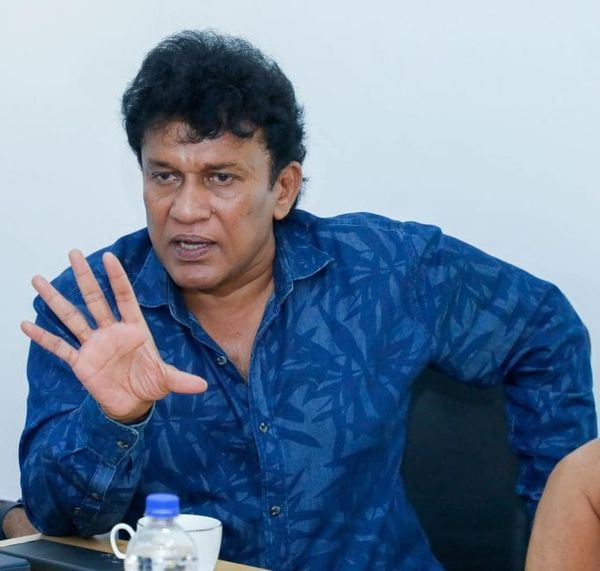
COLOMBO — Mano Ganesan, leader of the Tamil Progressive Alliance, has accused the Sri Lankan government of seeking to use its proposed extension of judges’ retirement ages to facilitate the appointment of preferred candidates to senior judicial positions, adding his voice to growing opposition to the proposed 22nd Amendment to the Constitution, which Justice Minister Harshana Nanayakkara has said will be presented to Parliament on Aug. 18.
Ganesan, an opposition lawmaker, said he did not object in principle to judges serving beyond the current retirement age. Instead, he questioned the government’s stated justification for the change and alleged that the proposal could be used to influence appointments to senior judicial positions.
“The age is not the issue,” Ganesan told reporters after a book launch in Colombo recently. “If they are capable, there is nothing wrong with extending it.”
But he cautioned against interpreting that position as support for the government’s proposal.
The government has argued that retaining experienced judges for longer could help address the large backlog of cases in Sri Lanka’s courts. Ganesan challenged that reasoning, asking why judicial vacancies had not been filled more quickly if reducing delays was the government’s principal concern.
“If the government genuinely has that concern, why did it not promptly fill the judicial vacancies that existed in the past?” he asked.
Ganesan pointed to several experienced judges who had already retired, including Priyantha Fernando, Ilancheliyan, Thurairaja and Kumudini Wickremasinghe. He argued that allowing experienced judges to leave the bench while subsequently seeking changes to retirement rules raised questions about the government’s intentions.
“When such experienced judges were available, the government allowed them to retire,” he said, alleging that the administration was now seeking an opportunity to bring in “people of its own choosing from outside.”
He said his party would not necessarily oppose an even higher retirement age if the policy were applied transparently and without political considerations.
“We have no objection to increasing the retirement age to 70 or even 80,” he said. “What we oppose is this manoeuvre by the government to appoint people it wants.”
Addressing President Anura Kumara Dissanayake directly, Ganesan invoked their years together in the opposition.
“As someone who travelled alongside him in the opposition for many years, I tell my brother Anura Kumara Dissanayake: Do not do this,” he said.
Ganesan also rejected government suggestions that opposition cooperation amounted to an effort to destabilise the administration, saying his alliance sought political change only through elections.
“The government is trying to create a false narrative by claiming that there is a conspiracy to overthrow it,” he said. “We will change governments only through elections.”
He also turned the accusation back on Dissanayake’s political movement, referring to the Janatha Vimukthi Peramuna’s history of insurrection and political violence and arguing that the present opposition should not be portrayed as seeking an unconstitutional change of government.
Ganesan challenged the administration to test public support for its policies at the ballot box.
“If the government is not afraid, let it go before the people and find out whether it has a public mandate for this move,” he said. “The people will then give their answer.”
That challenge comes as the government faces criticism over another unfulfilled electoral commitment. On Page 128 of the NPP’s 2024 presidential election manifesto, A Thriving Nation, A Beautiful Life, the party pledged that Provincial Council and local government elections, which had been repeatedly postponed, would be held “within a year” to allow voters to participate in governance.
Local government elections were subsequently held in 2025, but Provincial Council elections have yet to take place. In May, JVP General Secretary Tilvin Silva said the polls could not be held in 2026 and that the possibility of conducting them would be considered next year.
Political analysts say the government’s reluctance to hold Provincial Council elections is driven by fear of another electoral setback after the NPP’s support fell sharply in the 2025 local elections. The party won about 43 percent of the nationwide vote in May 2025, down from 61.6 percent in the November 2024 parliamentary election.
The decline was evident across the country, including in the Tamil-majority North and East: in Jaffna District, the NPP’s share fell to roughly 20 percent from 25 percent, while in Trincomalee District it dropped to about 24 percent from 42 percent. Analysts say those results have made the government wary of another nationwide electoral test that could further expose the erosion of the commanding mandate it secured in 2024.