
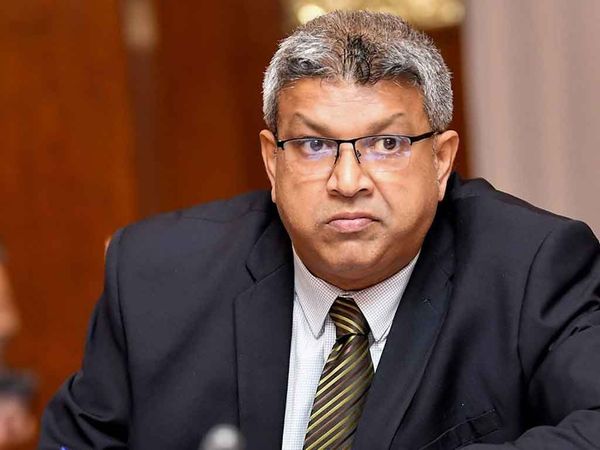
COLOMBO, Sri Lanka — Harshana Nanayakkara, Sri Lanka’s justice minister, said the government would repeal the Prevention of Terrorism Act by the end of this year, calling the 47-year-old law incompatible with fundamental human rights.
But the government is not abandoning special counterterrorism legislation. It plans to replace the law with the Protection of the State from Terrorism Act, or PSTA, an effort that has already faced opposition from rights groups and civil society organizations that say an earlier draft retained many of the sweeping powers they hoped would disappear with the PTA.
“The Prevention of Terrorism Act, which was introduced in 1979 as a temporary measure, remains in force to this day,” Mr. Nanayakkara told reporters. He said the law had contributed to some of the country’s historical conflicts and that its shortcomings on human rights had repeatedly been raised at home and abroad.
The government, he said, remained committed to the promise it made upon taking office to repeal the law.
An earlier draft of the PSTA was released for public consultation late last year. It quickly became clear that changing the law would be more contentious than changing its name.
Critics and legal scholars have raised concerns about the breadth of the proposed definition of terrorism and several powers in the draft. These include provisions allowing arrests by members of the armed forces and Coast Guard, presidential powers relating to organizations and curfews, and the authority to declare certain locations prohibited places.
Amnesty International also raised concerns about the draft and called for any replacement for the PTA to comply with Sri Lanka’s international human-rights obligations.
More than 100 civil society organizations, activists, academics and trade unionists were considerably less restrained. In a joint statement, they called the proposal “PTA+,” arguing that the new legislation risked expanding some of the very powers the government had promised to dismantle.
The government says the bill now being advanced has gone through further drafting.
According to the cabinet, a technical expert committee prepared the preliminary legislation and ministers gave policy approval on Aug. 10 to proceed with the Protection of the State from Terrorism Act. The Legal Draftsman then prepared the bill and obtained the attorney general’s clearance. The cabinet subsequently approved its publication in the Government Gazette and its presentation to Parliament.
Mr. Nanayakkara said the new law was being designed with national and public security in mind. He called for cooperation in enacting it, pointing not only to international terrorism but also to crimes associated with narcotics and underworld groups.
That is likely to add to the debate over what Sri Lanka’s new terrorism law is intended to cover. Drug trafficking and organized crime are serious offenses, but they are ordinarily dealt with under criminal law. Bringing them within the rationale for counterterrorism legislation could widen the reach of a law that the government says is meant to remedy the excesses of its predecessor.
The PTA has outlived the circumstances in which it was introduced. Enacted in 1979 as a temporary measure and later made permanent, it became one of the most powerful instruments of Sri Lanka’s security establishment during decades of insurrection and civil war.
The PTA has left a particularly deep imprint on Tamil communities, where it has long been associated with arrests, prolonged detention and suspects spending years entangled in the legal system without the protections available in ordinary criminal proceedings. Its use has extended beyond the period of the war, drawing repeated criticism from domestic and international human rights organizations.
The debate over the PSTA therefore comes down to more than whether it is an improvement on the law enacted in 1979. What matters is how much of the PTA’s extraordinary power remains.
The government says contentious provisions, including the definition of terrorism, have been reconsidered during the drafting process. The version ultimately gazetted will show how far it has responded to the criticism generated by the earlier proposal.
Much will turn on details that can appear technical but have consequences for anyone caught under the law: what conduct can be called terrorism, who can make an arrest, how long a suspect can be held, when a court must intervene, what role the military can play and whether political activity, protest, journalism and other legitimate expression are clearly protected.
There is also an uncomfortable contradiction for the government.
If, as Mr. Nanayakkara now says, the PTA itself violates fundamental human rights, replacing it with another extraordinary security law requires more than demonstrating that the new statute is an improvement. It requires explaining why the powers that remain are necessary, how they are constrained and why they cannot be exercised under Sri Lanka’s ordinary criminal law.
In Jaffna, there is a familiar expression for changing the presentation without changing much of what is inside: old toddy in a new glass.
The government still has a chance to prove that the PSTA is more than a change of glassware.
When the bill reaches Parliament, the real test will not be whether the letters PTA have disappeared from the statute book. It will be how much of the old toddy remains.