
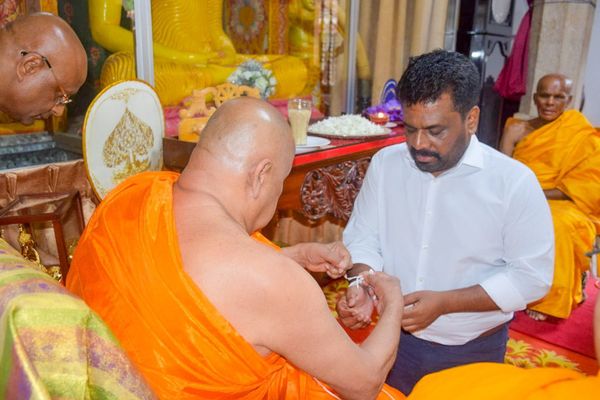
KANDY, Sri Lanka — One of Sri Lanka’s most senior Buddhist prelates said President Anura Kumara Dissanayake has not responded to a letter from the country’s chief Buddhist monks concerning the government’s proposal to extend the retirement age of senior judges.
The Most Venerable Thibbatuwawe Sri Siddhartha Sumangala Thera, the Mahanayake of the Malwatte Chapter, said the chief prelates had not received even an acknowledgment that their letter had reached the President.
“When the Mahanayake Theras send a letter to the President or the rulers of the country, it is customary for us to receive a response acknowledging that the letter has been received,” he said during a meeting in Kandy with representatives of an international human rights organization.
“We have received no response whatsoever to the letter setting out the position of the Mahanayake Theras of the three Chapters on the issue of judges’ retirement age,” he said. “We have not even been informed whether the letter was received.”
The Mahanayake Theras had written to the President setting out their position on the proposed extension of the retirement age of judges. The Malwatte Mahanayake had earlier confirmed that the letter was sent.
The government subsequently confirmed that the President had received the letter. Cabinet spokesman and Health Minister Nalinda Jayatissa said the government had received the communication and considered the concerns raised by the chief prelates.
The proposal would require a constitutional amendment. Under the Constitution, Supreme Court judges retire at 65 and Court of Appeal judges at 63. The government has proposed raising those retirement ages to 67 and 65, respectively.
The proposal has also faced opposition from the Bar Association of Sri Lanka, which has urged the government to reconsider the planned amendment.
The Malwatte Mahanayake said advising the country’s rulers on matters of national importance, both orally and in writing, was a longstanding role of the Maha Sangha.
“Whenever an issue arises in the country, the Maha Sangha has advised the rulers in accordance with the Dhamma,” he said. “This has been the practice since the time when the country was ruled by kings.”
“Providing advice and guidance is something we have traditionally done,” he added. “But what is happening now raises questions even for us.”
He said the chief prelates had seen members of Parliament and ministers make statements suggesting that the President had not received a letter from the Mahanayake Theras.
The Mahanayake Thera also criticized successive governments for failing to establish consistent national policies, saying policies introduced by one administration were frequently abandoned by the next.
“Until now, no one has developed stable policies suitable for the country on important issues,” he said. “Policies are introduced on certain matters, and the next government comes in and abolishes them. That is the situation.”
“The country remains in the same place,” he added. “There are no stable national policies on any issue.”
He said politicians often failed to carry out commitments they had made while in opposition.
“None of them do what they said they would do while they were in opposition,” he said. “Once they come to power, they forget.”
The prelate also raised concerns about Sri Lanka’s education system, particularly the expansion of private tuition classes to increasingly younger students.
“In the past, tuition classes were mainly for Advanced Level and Ordinary Level students,” he said. “Now tuition begins from Grade One. There are tuition classes everywhere.”
He called for greater regulation of private tuition and said Sunday classes were preventing children from attending Dhamma schools.
“Education suited to the modern world is certainly necessary,” he said. “But a country must also teach its future generations good values, discipline and culture, as well as an understanding of our traditions and customs.”
The Mahanayake Thera said concerns about Sunday tuition had been raised with successive governments without producing action.
He also criticized the quality of many goods available in the market, saying repeated representations to the relevant authorities had produced little result.
The prelate pointed to protests taking place around the country and the difficulties facing farmers.
“The country’s farming community is facing very serious difficulties,” he said. “If you speak with them, you can understand the true situation in the country.”
Sources familiar with the government’s thinking said the failure to respond to the letter should not be interpreted as an attempt by the administration to distance itself from the Buddhist clergy or to challenge the traditional influence of the Mahanayake Theras.
They pointed to President Anura Kumara Dissanayake’s repeated meetings with the chief prelates of the Malwatte and Asgiriya Chapters, during which he has sought their blessings and spoken publicly about the importance of protecting Buddhism and the role of the Maha Sangha in society.
The government has also engaged directly with the chief prelates over the proposed changes to judges’ retirement ages. Justice Minister Harshana Nanayakkara and Cabinet spokesman Nalinda Jayatissa recently travelled to Kandy to meet the Malwatte and Asgiriya Mahanayakes and explain the government’s position on the proposed judicial reforms.
Sources said those engagements made it difficult to regard the unanswered letter, by itself, as an act of defiance against the Buddhist hierarchy. Rather, they said, the issue appeared to concern the handling of this particular communication, though the government has yet to publicly explain why the Mahanayakes received no formal response.