

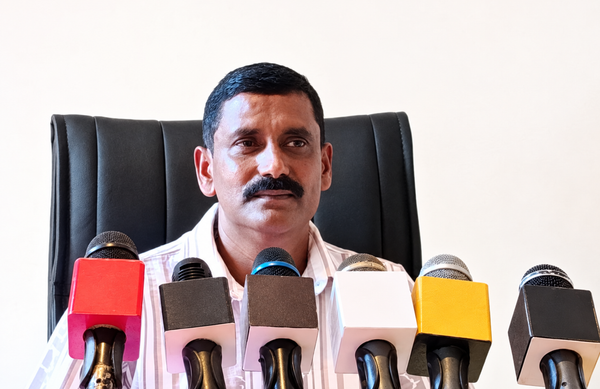
JAFFNA, Sri Lanka: The Ilankai Tamil Arasu Kadchi (ITAK) member whose lawsuit prevented the party’s elected president from taking office said Sunday that he would withdraw the case if ITAK held a new leadership election in accordance with its constitution.
Para Chandrasekaram, an ITAK member from Trincomalee District considered close to M.A. Sumanthiran and often identified within the party with the Sumanthiran camp, made the offer at a news conference.
“Conduct the election according to the law,” Mr. Chandrasekaram said. “Accept the verdict of the members. Provide a permanent democratic solution to the problem.”
ITAK, also known as the Federal Party, is Sri Lanka’s principal Tamil political party. Its General Council met in Trincomalee on Jan. 21, 2024, to choose a successor to its longtime president, Mavai Senathirajah.
In a secret ballot, S. Shritharan defeated Mr. Sumanthiran by 184 votes to 137, a majority of 47. Contemporary accounts recorded 321 votes cast. It was the first time in the party’s nearly 75-year history that its leader had been chosen through a contested ballot.
But Mr. Shritharan was prevented from functioning as president.
Within weeks of the vote, Mr. Chandrasekaram went to the Trincomalee District Court, challenging the legality of the election process on the grounds that the number of people who participated exceeded the number permitted under the party constitution and that prescribed procedures had not been followed.
On Feb. 15, 2024, the court issued two enjoining orders. One restrained ITAK from holding its national convention, then scheduled for Feb. 19. The other prevented party officials from implementing decisions made at the General Council meetings of Jan. 21 and Jan. 27, when the president and other office-bearers had been chosen. The orders effectively prevented Mr. Shritharan and the other newly elected officials from functioning in those positions.
The intervention caused disquiet within sections of ITAK. Some party members questioned how a president chosen by the General Council in a secret ballot could be prevented from taking office through litigation and criticized the party for failing to resolve the dispute through its own mechanisms.
Mr. Chandrasekaram said Sunday that his objective was not to determine who should lead the party.
“Who becomes president, or who holds which position, is not my personal concern,” he said. “What I want is an election conducted according to the law.”
He also said senior ITAK figures had acknowledged defects in the process and had at one stage agreed that the dispute should be resolved by holding a fresh election for president and other party positions.
He named Mr. Shritharan, Mr. Sumanthiran, Mr. Senathirajah, P. Sathiyalingam, S. Kugathasan, S. Yogeswaran and Xavier Kulanayagam. Mr. Chandrasekaram said their position later changed and that they sought in court to preserve the outcome of the 2024 process.
“If it was accepted that a mistake had occurred, why should that mistake not be corrected through a lawful fresh election?” he asked.
The same seven men were named as respondents in Mr. Chandrasekaram’s original action. Contemporary reporting identified him as an ITAK member from Trincomalee District and a resident of Konesapuri, Saambaltheevu.
The timing and circumstances of the lawsuit have long fueled controversy within ITAK. Mr. Chandrasekaram brought the action after Mr. Shritharan defeated Mr. Sumanthiran, and the resulting court orders prevented the winner from assuming the presidency.
Mr. Chandrasekaram is known within party circles to be close to Mr. Sumanthiran and has often been associated with his camp. Photographs seen by Jaffna Monitor also document their association.
Those circumstances have led some supporters of Mr. Shritharan and other ITAK figures to contend that Mr. Chandrasekaram did not act independently and that the legal challenge originated within the Sumanthiran camp. Jaffna Monitor, however, has not seen documentary evidence establishing that Mr. Sumanthiran personally instructed, financed or formally directed the litigation.
Mr. Chandrasekaram said Sunday that the dispute could now be ended by returning the decision to the party membership under procedures laid down in ITAK’s constitution.
“Party positions are not the personal property of individuals,” he said. “They are responsibilities given by the members in accordance with the party constitution and democratic procedures.”
“The rights of the members must be protected,” he added. “The party constitution must be respected. Democratic procedure must be upheld.”