

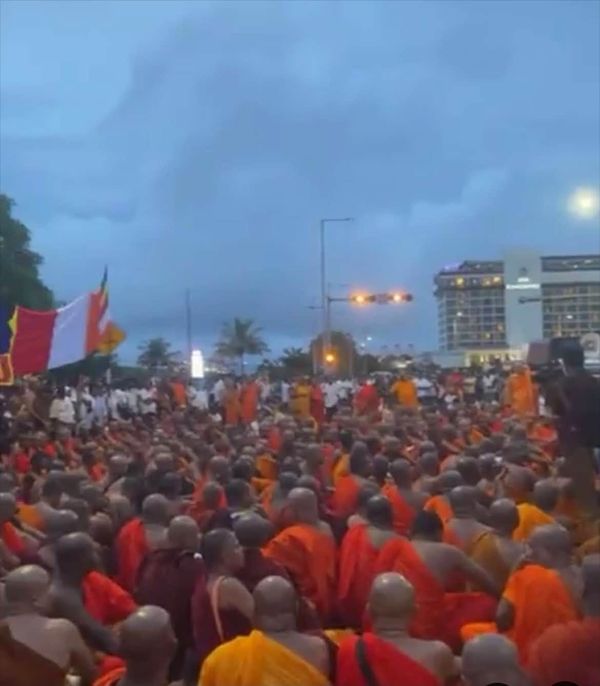
COLOMBO, Sri Lanka: Buddhist monks who ended a six-day march from Kandy with a sit-in outside the Presidential Secretariat in Colombo said on Thursday night that they would not leave until the government agreed to free Galagoda Aththe Gnanasara Thera, the hard-line nationalist monk who was returned to prison this month after the Supreme Court struck down his presidential pardon.
The marchers reached the secretariat on Thursday evening and sat down on the road outside. The president’s secretary, Nandika Sanath Kumanayake, came out to meet them, but the talks ended without agreement. The protesters said officials had told them the government would need at least a month to decide. The monks said they would not wait that long and stayed on the road through heavy rain.
By late Thursday the President’s Office had not commented on the talks. Large numbers of police were deployed around the secretariat, and Galle Road was closed to traffic.
The march, called the Nidahase Pada Yathra, or Freedom March, left the grounds of the Temple of the Sacred Tooth Relic in Kandy on Oct. 10. Its organizers, led by members of the Maha Sangha, the Buddhist clergy, said its aims were to win Gnanasara Thera’s release and to defend the religious rights of monks. The 121-kilometer route ran through Kadugannawa, Kegalle, Warakapola, Nittambuwa and Kadawatha before entering Colombo on Thursday by way of Kiribathgoda, Peliyagoda, Maligawatta and Maradana.
Gnanasara Thera is general secretary of the Bodu Bala Sena, or Buddhist Power Force, which campaigned against Sri Lanka’s Muslim minority in the years after the civil war. Anti-Muslim riots broke out in the town of Aluthgama after a Bodu Bala Sena rally there in June 2014.
In 2018 the Court of Appeal convicted him on four counts of contempt of court and sentenced him to six years of rigorous imprisonment. The charges arose from his conduct at the Homagama Magistrate’s Court, where he berated Sandya Eknaligoda, her lawyers and the presiding magistrate. Ms. Eknaligoda’s husband, the cartoonist and journalist Prageeth Eknaligoda, disappeared in 2010, and the case she has pursued over his disappearance has implicated military intelligence officers. The attorney general brought the contempt case after a complaint from the Homagama magistrate.
He had served about nine months when President Maithripala Sirisena pardoned him on May 23, 2019.
Ms. Eknaligoda and the Centre for Policy Alternatives, a Colombo research group, challenged the pardon in fundamental rights petitions. On Sept. 10, a three-judge bench of the Supreme Court declared it invalid. In a judgment written by Justice Janak De Silva, with Justices Sobhitha Rajakaruna and Sampath Abeykoon concurring, the court found the pardon arbitrary and inconsistent with the Constitution. It also held that a pardon does not erase a conviction or a sentence, and that it relieves an offender only of serving the sentence to the extent the pardon specifies.
It was the third time the Supreme Court has overturned a presidential pardon. In January 2024, it voided former President Gotabaya Rajapaksa’s pardon of Duminda Silva, a former lawmaker sentenced to death for the murder of Bharatha Lakshman Premachandra. It has also struck down Mr. Sirisena’s pardon of Jude Shramantha Jayamaha, who was sentenced to death for the 2005 murder of Yvonne Johnson.
After the ruling, prison officials who went to the monk’s temple in Rajagiriya did not find him there. When the Court of Appeal took up the attorney general’s motion to enforce the sentence on Sept. 29, his lawyer, Anura Meddegoda, told the court that he was resting because of illness. An open warrant was later issued, and the Colombo Crimes Division arrested him on the night of Oct. 3 at a monastery in Thiniyawala, in Kalutara District.
On Oct. 5 the Court of Appeal ordered the commissioner general of prisons to enforce the rest of the sentence. That afternoon prison officials removed his robes, dressed him in inmate clothing and placed him in a ward with ordinary prisoners.
The removal of his robes has drawn a stronger public reaction than the imprisonment itself. The cabinet spokesman, Nalinda Jayatissa, said the Prisons Department had acted under the Prisons Ordinance and had followed the same procedure for all 63 Buddhist monks now serving sentences. A prisons spokesman, Senaka Palletenna, said regulations allow monks serving sentences of simple imprisonment to keep their robes. Gnanasara Thera was sentenced to rigorous imprisonment.
Senior clergy objected. The Kotte Sangha Sabha told the prisons chief that there was no sign the monk had committed a parajika offense, the gravest breach of monastic discipline, which would justify removing his robes. On Oct. 7, representatives of the chief prelates of the three Nikayas, or monastic orders, wrote to the prisons chief asking that he be allowed to appear in court in robes. The Janathawadi Joint Opposition, led by the former minister G. L. Peiris, condemned the decision.
President Anura Kumara Dissanayake met representatives of the chief prelates at the secretariat on Oct. 8. He said a committee would be appointed to propose legal reforms and rules on how monks should be treated in prison and when they are taken outside it.
The march has also led to a dispute with the police. A monk traveling with the procession posted a video claiming that a man injured in a roadside assault was a supporter of the march who had been attacked by people linked to the governing National People’s Power.
Gnanasara Thero also faces a second prison term. In June, the Colombo High Court upheld a nine-month sentence of simple imprisonment that a magistrate imposed in January 2025 over statements he made at a news conference, which the court found had promoted discord between Muslims and Sinhalese. The ruling was read out on Oct. 7 in the Colombo Magistrate’s Court, where he appeared in civilian clothes. His lawyer said a challenge had been filed in the Supreme Court, which is scheduled to hear it on Feb. 23, 2027. The magistrate’s court has set the case for Feb. 25.