

By Jaffna Monitor Staff
Colombo, 13 November 2026
Next year, Sri Lanka’s government will spend more on finishing one section of expressway near Colombo than it has reserved for the whole of the Northern and Eastern provinces, where the civil war was fought.
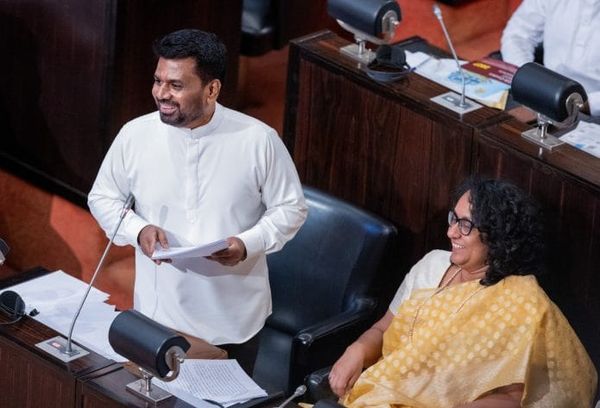
The budget was presented to Parliament on Thursday by President Anura Kumara Dissanayake. It allocates Rs. 53.45 billion to complete the Kadawatha-to-Mirigama section of the Central Expressway in Gampaha District. By Jaffna Monitor’s count, allocations tied only to the eight districts of the North and East total about Rs. 24.1 billion. Those districts are home to 2.9 million people.
The two provinces will also share in national programmes that the budget does not divide by region, such as Aswesuma welfare payments and the fertiliser subsidy. But most of the money set aside for them goes to repairing war damage: houses for displaced families, drinking water, fishing anchorages and bridges. The speech leaves out the projects that the government itself has presented as the way to grow the region’s economy.
It does not mention Jaffna International Airport at Palaly or the harbour at Kankesanthurai, which are the Northern Province’s direct air and sea links to India. It also does not mention the three northern industrial zones announced in the government’s first budget, in February 2025.
What the region gets
The budget does contain large sums for the North and East. The President told Parliament that 13,000 families displaced by the war have still not been resettled, more than 17 years after the fighting ended. He allocated Rs. 10 billion to resettle them within two years.
Another Rs. 5 billion goes to fisheries infrastructure in the Northern Province and to the Pesalai harbour in Mannar. Rs. 1.8 billion will start a Rs. 41 billion water supply scheme in Kilinochchi. Rs. 1 billion is set aside to deal with seawater intrusion and contaminated drinking water in Jaffna and the Vanni.
One national programme favours the region. The District Development Programme gives each of the country’s 25 districts Rs. 2 billion, whatever its population. In Mullaitivu, the least populous district, that comes to about Rs. 16,000 a person. In the Western Province, it is less than Rs. 1,000 a person. The governor of the Northern Province, N. Vethanayahan, said funds channelled through the provincial council rose from Rs. 4 billion in 2024 to about Rs. 10 billion this year.
Not every allocation reserved for the region has local support. Rs. 2 billion for the Kivul Oya reservoir in Vavuniya and Mullaitivu is one of the largest items reserved for the region, and it appears only in an annexure. In February, residents and Tamil political parties protested against the project, saying they feared losing their land.
The missing airport and port
The absence of Palaly and Kankesanthurai stands out because the speech sets out plans for airports at Katunayake, Ratmalana, Mattala, Sigiriya and China Bay, and for ports at Colombo, Galle and Trincomalee.
In 2018, India agreed to lend USD 45.27 million to rebuild Kankesanthurai. It converted the financing into a grant in 2024 and now says it has committed USD 65 million in grant assistance, enough to cover the full cost. In January, speaking near Jaffna, the President said work at the port would begin very soon. As of early this month, the agreement needed to start the work had not been signed.
At Palaly, a new passenger terminal is due to be finished by July 2027.
Both projects are financed largely outside the Treasury, so their absence from the speech does not mean they have no money. But ministers have sent conflicting signals. In August, Bimal Rathnayake, the Leader of the House, told reporters in Jaffna that the government would decide when and how to develop the airport and the port, regardless of who paid for them. He pointed to the losses at Mattala Rajapaksa International Airport. “Our government will not undertake development that results in such losses,” he said.
Another minister later told Parliament that work at Palaly was continuing. Shanakiyan Rasamanickam, the parliamentary group leader of the Ilankai Tamil Arasu Kachchi, asked the government to table the studies behind the comparison with Mattala. “If the government believes that Palaly is not viable, it should produce the evidence,” he said.
The industrial zones
In its 2025 budget, the government allocated Rs. 500 million for five industrial parks, two of them in the North, at Kankesanthurai and Mankulam. It also proposed a chemical manufacturing zone at Paranthan. The Board of Investment said the three northern zones would create about 16,000 direct jobs. When he announced a northern investment summit, held in Jaffna in January, the board’s director general promised enhanced capital allowances “specifically for Northern Sri Lanka.”
The 2027 speech does not mention the three zones. Its new capital allowance applies to any Board of Investment exporter or tourism project anywhere in the country that invests at least USD 3 million. Its Rs. 4 billion for industrial estates covers development at Valachchenai in Batticaloa and further work at Ingiriya, Dambulla, Raigama-Millaniya and Katunayake. For Puliyankulam in Vavuniya, there is only a feasibility study.
The speech does not mention the Paranthan chemical factory, where the government laid a foundation stone in January. Nor does it mention the Kankesanthurai cement factory, whose revival successive governments have announced since 2013. The Board of Investment and state enterprises may pay for some of this work from their own budgets, which the speech does not cover.
The East
The Eastern Province is home to Tamil, Muslim and Sinhalese communities, and its largest prospects are also left to others to finance. The speech presents Trincomalee as a future fuel storage hub for South Asia. The Ceylon Petroleum Corporation will spend Rs. 7.375 billion of its own money on a pipeline from the Upper Tank Farm to the port. Private partners will be invited to develop 29 of the 61 tanks owned by Trinco Petroleum Terminal.
The Treasury’s own money in the East goes mainly to water, bridges and public services. It includes Rs. 1 billion to start the Mundeni Aru river basin project for Batticaloa and Ampara, Rs. 600 million for the Kiran and Pondukalchenai bridges, and a new science faculty building at Eastern University.
Where the big money goes
The budget allocates Rs. 251 billion for highways, expressways and railways. Of that, Rs. 146.5 billion goes to five expressway sections and their link roads in the Western, North Western, Central and Sabaragamuwa provinces, and Rs. 80 billion goes to electrifying three suburban railway lines out of Colombo. Together, these two programmes receive more than nine times the amount reserved for the North and East. None of the expressway money goes beyond Dambulla, and the budget names no work on the Northern railway line.
The gap is still large when measured per resident, even on assumptions that favour the North and East. Eleven allocations of more than Rs. 1 billion each, all for projects entirely inside the Western Province, add up to about Rs. 177 billion. That is roughly Rs. 29,000 for each of the province’s 6.1 million residents. All the allocations reserved for the North and East, down to the smallest, come to about Rs. 8,200 a resident.
There are reasons for some of this. The Kadawatha-to-Mirigama section stalled when the economy collapsed, and next year’s money is meant to finish work already underway. Suburban trains carry commuters from well beyond Colombo, and the Western Province produces 42 percent of national output. The government also faces a legal ceiling on primary spending, and its interest bill of Rs. 2.64 trillion is larger than its entire capital budget.
The North and East start from much further behind. The Central Bank estimates that in 2024 the Northern Province produced 4.4 percent of national output and the Eastern Province 5.0 percent, although together they hold 13.5 percent of the population. In 2019, the latest year for which official district figures are available, 44.5 percent of people in Mullaitivu and 26.4 percent in Kilinochchi lived below the official poverty line. The figure was 14.3 percent nationally and 2.3 percent in Colombo. The speech sets no target for narrowing regional gaps and includes no measure of them.
The figures are consistent with a government that puts fiscal caution first, prefers to finish projects it has already begun and builds where demand is proven. On their own, they do not show that the region was deliberately left out.
Questions about resettlement
The resettlement allocation itself raises questions. Divided among 13,000 families, Rs. 10 billion comes to about Rs. 770,000 each. Earlier this year the National Housing Development Authority allocated Rs. 2.73 billion to build 1,363 resettlement houses in the Northern Province, about Rs. 2 million a house. It said 7,306 houses were needed in that province alone. At that rate, Rs. 10 billion would build about 5,000 houses.
Not every family may need a new house, and costs vary. But the speech does not say how the 13,000 families were counted, where they will be resettled, or whether any of them will return to land still held by the security forces. The budget documents describe the money only as funding for houses.
The pledges left out
The omissions extend to promises that helped the National People’s Power win three of the six seats in the Jaffna electoral district in 2024, the first time a party from the south had topped the poll there. Its manifesto promised to repeal the Prevention of Terrorism Act, to speed up the release of civilian land held by the military and to hold the long-delayed provincial council elections.
The speech mentions none of these, and it does not mention the Office on Missing Persons or the Office for Reparations. It proposes instead to move four district hospitals in the Northern Province under central government control. The Northern Provincial Council, which runs those hospitals, has had no elected members since its term ended in October 2018.
Will the money be spent?
An allocation is not spending, and the speech does not break capital spending down by province. Last month the deputy finance minister, Anil Jayantha Fernando, acknowledged that bureaucratic procedures and resource constraints were delaying public investment projects.
Parliament began debating the budget on Friday. The vote on the second reading is scheduled for 20 November, and the final vote for 14 December.