
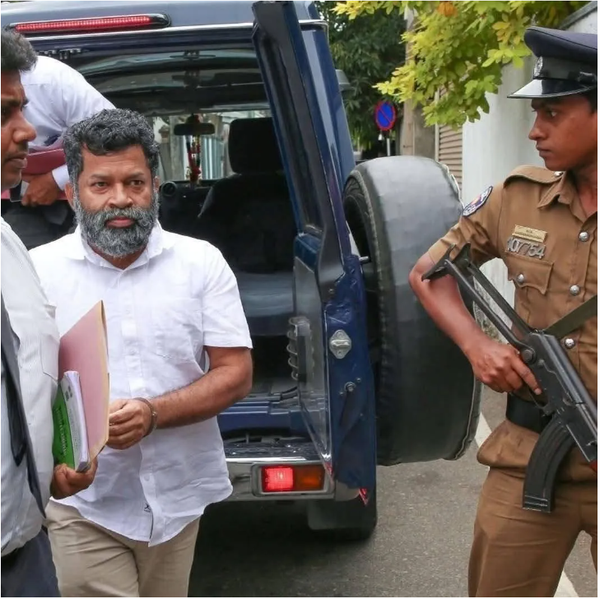
COLOMBO — Sri Lanka’s attorney general has indicted former Eastern Province Chief Minister Sivanesathurai Chandrakanthan and three other men in the abduction and killing of an Eastern University vice-chancellor who disappeared in Colombo nearly two decades ago, bringing one of the country’s most prominent wartime disappearance cases before a criminal court.
The indictments were filed in the Polonnaruwa High Court over the abduction and killing of Prof. Sivasubramaniam Raveendranath, who was vice-chancellor of Eastern University when he disappeared on Dec. 15, 2006.
Mr. Chandrakanthan, widely known as Pillayan, leads the Tamil Makkal Viduthalai Pulikal, or TMVP, a political party that emerged from a breakaway faction of the Liberation Tigers of Tamil Eelam after its eastern commander, Vinayagamoorthy Muralitharan, better known as Karuna Amman, split from the LTTE in 2004.
Mr. Chandrakanthan has denied wrongdoing. The charges against him and the other defendants have yet to be tested at trial.
Prof. Raveendranath, an agricultural scientist and one of the founding academics of Eastern University, was last seen after attending the annual sessions of the Sri Lanka Association for the Advancement of Science in Colombo. His driver had been asked to return for him after the meeting, but Prof. Raveendranath never reappeared. His body has never been recovered.
His disappearance followed months of threats and intimidation at Eastern University. In September 2006, armed men abducted Bala Sugumar, dean of the university’s Faculty of Arts, and demanded Prof. Raveendranath’s resignation as a condition for his release, according to reports at the time. Prof. Raveendranath submitted his resignation, but the University Grants Commission did not accept it, and he continued carrying out his duties from Colombo.
The threats against Prof. Raveendranath came amid a deeper rupture within the Tamil community in the East following Karuna’s split from the LTTE, an episode that sharply aggravated tensions between Tamils from the north and east.
Karuna, the LTTE’s powerful eastern commander, broke with the organisation in March 2004 after accusing its northern-dominated leadership of discriminating against eastern cadres. In the weeks that followed, people of Jaffna origin living in the Batticaloa region came under pressure to leave. Contemporary reports said Jaffna academics and students at Eastern University were driven out or fled, while traders and professionals were intimidated.
The upheaval extended beyond the university. Businesses owned by Jaffna Tamils closed across Batticaloa and surrounding towns after their owners were ordered to leave, and contemporary reports estimated that about 5,000 members of Jaffna-origin families left the area for Colombo, Vavuniya and Jaffna. Some traders reported receiving death threats, while property was reported to have been seized or looted.
Prof. Raveendranath was himself from northern Sri Lanka and held the most senior position at the East’s principal university. Reports after his disappearance said there was a widespread belief that those responsible wanted him removed from Eastern University because of his northern origins. That alleged motive was never established in court.
His case was part of a broader climate of violence and intimidation at the university. Kumaravel Thambaiah, a senior lecturer, was shot dead in May 2004, and by late 2006 lecturers and students were leaving the institution because of threats and insecurity.
For years, Prof. Raveendranath’s disappearance remained unresolved.
The investigation gained new momentum in April 2025, when officers of the Criminal Investigation Department arrested Mr. Chandrakanthan in Batticaloa. Investigators subsequently arrested others as the inquiry developed from an investigation into a disappearance into one alleging abduction and killing.
How the Case Turned on Pillayan
For nearly 19 years, no one was charged in Prof. Raveendranath’s disappearance. The investigation took a decisive turn after witnesses began providing accounts of what they said had happened at a clandestine camp in Sevanapitiya, in Polonnaruwa District.
When the Criminal Investigation Department produced Mr. Chandrakanthan before the Mount Lavinia Magistrate’s Court on April 2, after 359 days in detention, investigators said Prof. Raveendranath had been taken to the Sevanapitiya camp, which they alleged was operated by Mr. Chandrakanthan. They told the court that the vice-chancellor had been detained and tortured there before being killed and his body burned.
Investigators identified Mr. Chandrakanthan as the principal suspect and said four people had been arrested in connection with the case.
The C.I.D. described Sevanapitiya as an illegal detention and torture facility where civilians, government officials and businesspeople had been held. Investigators told the court that Mr. Chandrakanthan had no legal authority to operate such a site.
Investigators also raised questions about weapons issued to Mr. Chandrakanthan during the conflict, telling the court that 362 T-56 assault rifles and 36 9-millimeter firearms remained unaccounted for. The investigation was conducted under provisions of the Prevention of Terrorism Act and the Penal Code.
A central part of the prosecution case rests on witness testimony.
One former worker at the site told investigators that he recognised Prof. Raveendranath after seeing a newspaper report about his disappearance. Two of the suspects arrested in the investigation have also given confidential statements before a magistrate, according to representations made by the state in court.
In June, Deputy Solicitor General Suharshi Herath told the Supreme Court that eyewitness testimony placed Prof. Raveendranath’s killing inside the camp. She made the disclosure while opposing a fundamental rights petition filed by Mr. Chandrakanthan challenging the legality of his arrest and detention.
Mr. Chandrakanthan was represented by President’s Counsel Manohara de Silva and lawyer Udaya Gammanpila. The case was heard by a three-judge bench comprising Justices Mahinda Samayawardena, Arjuna Obeyesekere and Gihan Kulatunga. During those proceedings, the state told the court that prosecutors were preparing an indictment.
Neither the former camp worker nor the two suspects who gave statements before a magistrate has been publicly identified. The authorities have also not publicly said whether they were members of the TMVP or the armed faction from which it emerged.
The allegation that Prof. Raveendranath was taken to a camp in Polonnaruwa District predates the current investigation.
A 2007 United States diplomatic cable recorded that Prof. Raveendranath’s son-in-law had told American officials that he had received information that the vice-chancellor had been taken to a camp in Welikanda and was no longer alive. Welikanda and Sevanapitiya are in the same part of Polonnaruwa District. The account was not established in court.
Mr. Chandrakanthan’s political career grew out of the upheaval that followed the Karuna split. The breakaway eastern faction evolved into the TMVP and entered electoral politics. Mr. Chandrakanthan became the first chief minister of the Eastern Province in 2008, later represented Batticaloa in Parliament and served as a state minister.