
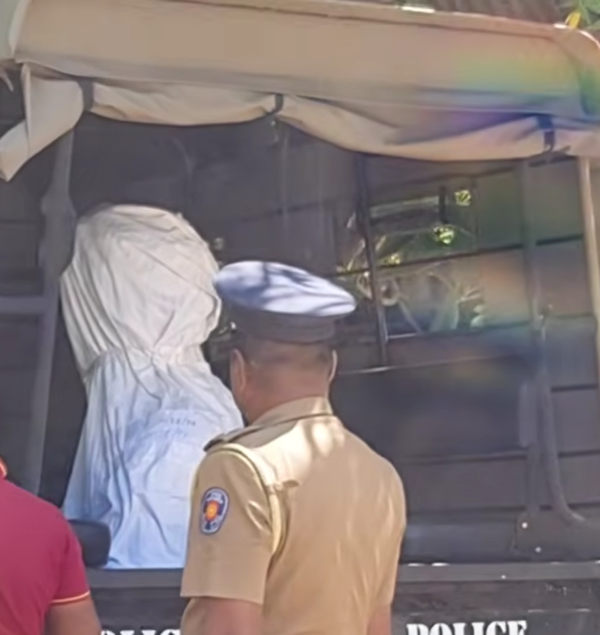
JAFFNA, Sri Lanka — Police on Monday handed over to a Jaffna court a bust of Thileepan, the Tamil Tiger political leader, that officers removed from his memorial eight days earlier, as investigators continued trying to answer a question that has hung over the controversy: Who put it there?
No Tamil political party or group has publicly claimed responsibility for installing the bust at the memorial near the Nallur Kandaswamy Temple.
The Tamil National People’s Front, which controlled the main commemoration site, has fiercely defended the bust and denounced the police for removing it. But amid all its condemnation, the party has conspicuously avoided one simple declaration: “We installed it.” Nor has it identified who did.
The bust, wrapped in white cloth, was taken from the Jaffna Police Station to the Jaffna Magistrate’s Court in a police vehicle on Monday and placed in the court’s custody.
More than 20 police officers removed it before dawn on Sept. 27, hours after the end of 12 days of commemorations marking Thileepan’s death during a hunger strike in 1987. The removal prompted protests across the Tamil-majority north and a round of accusations among rival Tamil political parties and against the government of President Anura Kumara Dissanayake.
Police had previously sought to hand the bust over to the Magistrate’s Court. The court initially declined to accept it after questions arose over why investigators had not established who erected it and on what basis it was being produced before court, according to accounts of the proceedings.
The case was adjourned until January, and the bust remained at the Jaffna Police Station while police said they would seek the advice of the Attorney General.
On Monday, investigators questioned Varatharajan Partheepan and Pathmanathan Mayooran, chairman of the Nallur Pradeshiya Sabha, for about three hours and recorded their statements.
Both men are associated with the Tamil Makkal Kootani, or Tamil People’s Alliance, a political rival of the Tamil National People’s Front.
Police had previously obtained statements from six others, including a member of the Jaffna Municipal Council. Selvarajah Kajendren, general secretary of the Tamil National People’s Front, and a man known as Pon Master have also been summoned in connection with the inquiry.
Mr. Partheepan has denied any involvement in installing the bust. He said his role at the site was limited to an archival exhibition that he has conducted with official permission for four years.
The questioning has unfolded against a longstanding rivalry between Tamil political groups over the organization of the annual Thileepan commemorations, which carry deep significance for many Tamils in northern Sri Lanka and draw financial contributions from supporters in Sri Lanka and abroad.
This year, the Tamil National People’s Front controlled the main memorial site, while figures associated with the Tamil Makkal Kootani operated an exhibition next to it.
The arrangement has produced an unusual outcome: people associated with the exhibition are among those being questioned about a bust that stood at the adjoining memorial controlled by their political rivals, while the party that ran the main site has not publicly said who installed it.
Mr. Kajendren has accused the Ilankai Tamil Arasu Kachchi, or ITAK, which controls the Jaffna Municipal Council, of facilitating the police action and working with the government.
He has also accused C.V.K. Sivagnanam, ITAK’s acting leader, of confronting him over the bust and threatening to have it removed if it remained after Sept. 26.
ITAK officials have rejected those accusations.
Jaffna’s mayor, Mathivathani Vivekanandarajah, an ITAK member, said neither the Municipal Council nor her party’s leadership had been responsible for the removal.
She said a request for permission to keep the bust at the memorial came before the council at its monthly meeting on Sept. 15, the first day of the commemorations. By then, the bust was already in place.
Because the request was for temporary permission, the mayor said she consulted Mr. Sivagnanam, who advised that the council approve it rather than order the bust removed. The council subsequently allowed it to remain until Sept. 26, the final full day of the commemorations.
Police repeatedly asked the council to obtain a written undertaking from the organizers that the bust would be removed after that date, the mayor said. The council declined.
Mr. Sivagnanam “did not oppose the placement of the bust,” she said, describing the accusations against him as unfounded.
The Liberation Tigers of Tamil Eelam remain a proscribed organization in Sri Lanka, giving the dispute a legal dimension beyond the rivalry among Tamil parties. The police inquiry has been linked to the Prevention of Terrorism Act, and investigators have also examined other aspects of the Nallur commemorations, including songs played at the site and the use of sound equipment.
Thileepan, whose birth name was Rasaiah Parthipan, was 23 when he began a hunger strike near the Nallur temple on Sept. 15, 1987, less than two months after India and Sri Lanka signed an accord that brought Indian peacekeeping troops to the island.
Refusing food and water, he pressed five demands, mostly directed at India. He died 12 days later.
His death drew enormous crowds in Jaffna and became a defining moment in the deterioration of relations between the Tamil Tigers and India. Within weeks, the Indian Peace Keeping Force and the Tigers were at war.
The Tigers went on to carry out suicide bombings, assassinations and attacks on civilians during Sri Lanka’s civil war, which ended with their military defeat in 2009.
Many Tamils in the north, however, remember Thileepan primarily for his hunger strike, and thousands attend commemorations marking his death each year. His memorial at Nallur has been destroyed twice in past decades.
Nearly four decades after his death, the bust has now moved from a memorial to a police station and, finally, into the custody of a court — while the identity of the people who installed it remains publicly unclaimed.