

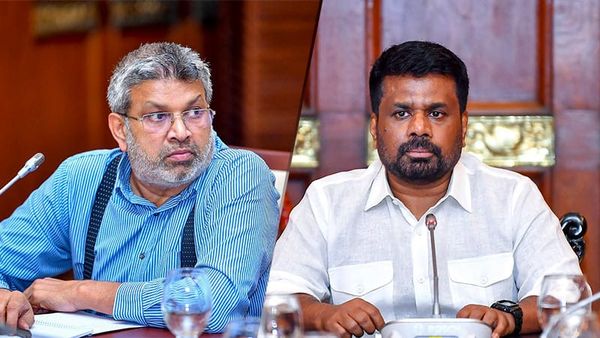
COLOMBO, Sri Lanka — President Anura Kumara Dissanayake had a heated exchange with his justice minister on Thursday morning over the removal of Gnanasara Thero’s robes in prison, according to sources in the President’s Office, hours before he was scheduled to meet senior representatives of the country’s principal Buddhist monastic orders over the same controversy.
The sources told Jaffna Monitor that Justice Minister Harshana Nanayakkara was responsible for the decision that led to Galagoda Aththe Gnanasara Thero being brought to court without his saffron robes. They said Mr. Dissanayake was deeply unhappy with the decision and the controversy it had sparked, particularly as criticism spread among monks who had previously been sympathetic to his government.
But another source familiar with discussions within the administration questioned whether a decision of such religious and political sensitivity could have been taken without the president’s knowledge or approval.
That source suggested that Mr. Nanayakkara was being made to bear responsibility after the decision provoked a backlash, describing the handling of the controversy as a possible attempt to undermine the minister politically. The source did not provide evidence establishing that the president had approved the decision or that anyone had deliberately sought to sabotage Mr. Nanayakkara.
The competing accounts have also drawn attention to the relationship between the Janatha Vimukthi Peramuna (JVP), the political party led by Mr. Dissanayake, and the broader National People’s Power (NPP) coalition through which it governs.
Mr. Nanayakkara is an NPP politician, and the controversy raises questions about how decisions are made and responsibility is shared between the JVP leadership and other figures within the governing coalition. The reported disagreement, however, does not establish that a wider organizational split has emerged between the JVP and NPP.
Jaffna Monitor could not independently verify the account of Thursday morning’s exchange or establish whether Mr. Nanayakkara personally authorized the removal of the monk’s robes. The sources spoke on condition of anonymity because they were not authorized to discuss the matter. Mr. Nanayakkara’s office did not respond to a request for comment.
The dispute has become a test of the government’s relationship with the Buddhist clergy, which wields considerable influence among Sri Lanka’s Sinhala Buddhist majority. According to the President’s Office sources, Mr. Dissanayake is concerned that the controversy could turn significant sections of the Sinhala Buddhist electorate against his governing coalition.
Mr. Dissanayake is scheduled to meet senior monks at the Presidential Secretariat in Colombo at 1 p.m. on Thursday, according to a notice issued to news organizations by the Government Information Department.
The Venerable Medagama Dhammananda Thero, registrar of the Asgiriya Chapter, said representatives of the Malwatta and Asgiriya chapters and the Amarapura and Ramanna orders were expected to attend.
The meeting follows a letter senior Buddhist prelates sent Wednesday to the Commissioner General of Prisons, objecting to the removal of Gnanasara Thero’s robes and his subsequent appearance in court wearing civilian clothing.
Gnanasara Thero, a prominent and frequently controversial Sinhala Buddhist nationalist monk, was taken into custody on Oct. 5 following proceedings before the Court of Appeal. When he later appeared in court in a separate case, he was dressed in civilian prison clothing rather than the saffron robes traditionally worn by Buddhist monks.
His appearance prompted objections from Buddhist religious leaders, who argued that imprisonment does not automatically deprive an ordained monk of his religious status.
In their letter, the prelates said no competent Buddhist monastic authority had determined that Gnanasara Thero had committed a pārājika offense, one of the gravest breaches of Buddhist monastic discipline, which entails the loss of monastic status.
They argued that decisions concerning a monk’s standing within the Buddhist order belonged to the relevant monastic authorities, rather than prison administrators, and warned that removing his robes without such a determination could undermine longstanding religious traditions.
The government, however, has maintained that prison officials acted in accordance with existing regulations. Cabinet spokesman Nalinda Jayatissa said the requirement to wear prison-issued clothing applied to imprisoned Buddhist monks generally, while Prisons Department spokesman Senaka Pallathtenna said no special instructions had been received from higher authorities concerning Gnanasara Thero.
Mr. Pallathtenna said prisoners serving sentences exceeding three years were required to wear prison-issued clothing when appearing in court, including members of the clergy.
Those explanations have introduced another question into the controversy: whether the decision concerning Gnanasara Thero resulted from a specific ministerial instruction, as alleged by the President’s Office sources, or from the routine application of prison regulations, as officials have publicly maintained.
The controversy has become particularly sensitive for the Dissanayake administration because criticism has extended beyond Gnanasara Thero’s established supporters.
Monks who have otherwise expressed support for the NPP government have also raised objections to the decision, according to the President’s Office sources, who said the broader reaction was central to Mr. Dissanayake’s dissatisfaction and the reported disagreement with his justice minister on Thursday morning.
The sources said the president was particularly troubled by the possibility that the controversy could bring together sections of the Buddhist clergy that have otherwise differed in their political loyalties.
Thursday’s meeting will bring the president into direct discussions with representatives of the country’s most influential Buddhist monastic institutions as the government faces questions about the treatment of imprisoned monks and responsibility for the decision.
The government has not publicly identified any ministerial instruction authorizing the removal of Gnanasara Thero’s robes or indicated whether it intends to change the procedures governing monastic clothing in prison.