
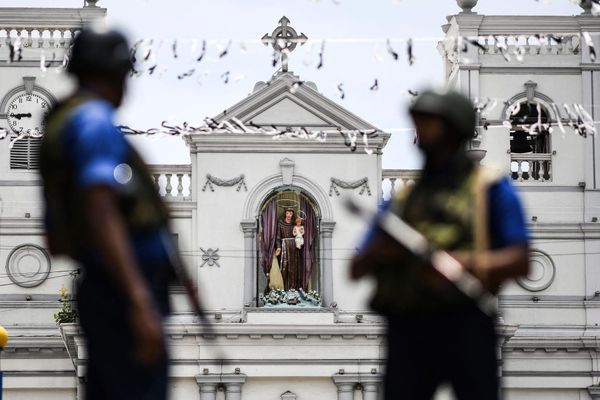
COLOMBO: A special three-judge High Court in Colombo is scheduled to deliver its verdict on Tuesday, September 22, in the main trial over the Easter Sunday bombings of April 21, 2019, when suicide attackers struck three churches, three luxury hotels and a guesthouse, killing about 270 people and wounding more than 500.
The Attorney General has brought more than 23,270 charges against the 24 defendants, including conspiring to carry out and aiding and abetting the attacks. It is the largest number of charges filed in a single case in Sri Lanka’s legal history. Tuesday’s judgment will be the first ruling on the guilt of those accused of taking part in the plot itself. In July, a separate court convicted the country’s former defence secretary and former police chief of failing to prevent the attacks.
The bench
The case is before Presiding High Court Judge Navaratne Marasinghe and High Court Judges Sujeewa Nissanka and Ramanathan Kannan. When the special court was set up in 2021, then Chief Justice Jayantha Jayasuriya appointed a bench chaired by Judge Damith Thotawatte with Judges Amal Ranaraja and Navaratne Marasinghe. Judge Marasinghe is the only member of the original bench still hearing the case.
The charges
The accused have been charged under the Prevention of Terrorism (Temporary Provisions) Act with conspiracy, preparation, aiding and abetting, collecting explosives and weapons, and murder and attempted murder. Prosecutors allege that the defendants conspired with Zahran Hashim, the preacher who led the group, and the other suicide bombers. Each accused faces several hundred counts because the indictment lists a separate charge for every person killed or injured.
The indictment covers the attacks on St. Anthony’s Shrine in Kochchikade, St. Sebastian’s Church in Katuwapitiya, Zion Church in Batticaloa, the Shangri-La, Cinnamon Grand and Kingsbury hotels in Colombo, and the Tropical Inn in Dehiwala.
The accused
The Attorney General originally indicted 25 people. In August 2023, prosecutors told the court they would not proceed against the 17th accused, who had died in custody. The remaining 24 have been held in remand throughout the trial. The court refused every bail application.
The accused, in the order they appear in the indictment, with aliases recorded in court, are:
- Mohamed Ibrahim Mohamed Naufer, alias Naufer Maulavi
- Mohamed Saribu Adam Lebbe (Abu Hadik), named in earlier reports as Adam Lebbe alias Gafoor
- Hayathu Mohamed Milhan (Abu Zillah)
- Mohamed Ibrahim Sadiq Abdullah (Abu Umar)
- Mohamed Ibrahim Abdul Haq (Abu Fala)
- Mohamed Anwar Mohamed Riskan (Abu Tariq)
- Mohamed Mansoor Mohamed Sanasdeen (Abu Misan)
- Abdul Manaf Mohamed Piridavus
- Mohamed Ramish Mohamed Sajith
- Abdul Latif Mohamed Safi (Safi Maulavi, Abu Furqan)
- Husseinul Rizvi Mohamed Khalib Sameer
- Mohamed Zawheer Mohamed Hassan (Abu Dawood)
- Mohamed Iftikhar Mohamed Insaf (Abu Mohamed)
- Rashid Mohamed Ibrahim
- Mohamed Hanifa Zainul Abdeen (Abu Hina)
- Mohamed Mustafa Mohamed Haris (Abu Nanjiar)
- Yassin Bawa Abdul Rauf (died in custody; charges withdrawn)
- Rasik Raza Hussain
- Kachchi Mohamed Jasmine
- Zainul Abdeen Mohamed Jaseen
- Mohamed Mustafa Mohamed Rizwan
- Meera Saheed Mohamed Nafli (Abu Sana)
- Mohamed Amin Ayantullah
- Mohamed Ansar Deen Hilmy
- Mohamed Akram
All the accused face the same broad categories of charges. The specific acts alleged against most of them have not been reported in detail. However, the roles of three were described in a separate case brought in the United States.
In December 2020, federal prosecutors in Los Angeles charged Naufer, Riskan and Milhan with conspiring to provide material support to the Islamic State. According to the FBI complaint, Naufer was the “second emir” of the group that called itself ISIS in Sri Lanka, directed its propaganda, recruited members, and ran military-style training. The complaint alleged that Riskan helped build the explosive devices used in the attacks, and that Milhan executed a police officer to obtain firearms, shot a suspected informant, and scouted a location for a separate attack. The killing attributed to Milhan relates to the murder of two police officers at a checkpoint in Vavunathivu, Batticaloa, in December 2018, which investigators at first wrongly blamed on former LTTE members. All three remain in Sri Lankan custody. US prosecutors said they would keep their charges pending in case the men are ever released.
Sri Lankan officials have described Naufer as the group’s ideological leader. In 2021, Sarath Weerasekera, then the public security minister, said Naufer had introduced Islamic State ideology to Sri Lanka in 2014 and in 2016 steered Zahran Hashim toward extremist activity.
Seven years in court
The indictment, more than 5,000 pages in Sinhala, was served between October and November 2021 and translated into Tamil and English in March 2022. The accused pleaded not guilty after the indictment was amended in February 2023.
The prosecution began leading evidence on October 10, 2022, and closed its case on August 13, 2026. Over about 250 trial days, it called 547 of the 2,309 witnesses on its list and marked 2,076 documents and productions. These included concealed bomb-making materials, chemicals, firearms, swords and explosives, along with DNA reports, Government Analyst findings and reports from judicial medical officers.
Under Section 420 of the Code of Criminal Procedure Act of 1979, the bench accepted defence admissions on the deaths and injuries, so the prosecution did not have to call witnesses to prove each one.
The confessions
Ten confessions were admitted as evidence. In June, after a voir dire inquiry into whether they had been given voluntarily, the court ruled that the confessions of the first, fourth, ninth and 11th accused were admissible. It rejected the confession of the eighth accused, finding it had not been made voluntarily. The court had earlier admitted a statement the 11th accused, Khalib Sameer, made before the Mount Lavinia Magistrate in 2019, which prosecutors say concerns the planning of the attacks.
The Prevention of Terrorism Act allows confessions made to police officers of Assistant Superintendent rank or above to be used as evidence. Under ordinary Sri Lankan law, confessions made to the police are inadmissible. Human rights groups have long objected to the provision.
The defence
The defendants began presenting their case on August 17. Naufer spoke from the dock for nearly two hours and denied any role in the attacks. “I face 940 charges in relation to these alleged activities. I reject all of these charges,” he told the court. He said he was arrested in Dambulla on the evening of the bombings while travelling to his wife’s home in Kattankudy, and was then held by the Criminal Investigation Department under detention orders for about a year and a half. He said he had maintained connections with Zahran Hashim and his group but did not instruct them to carry out the attacks.
Milhan and Zainul Abdeen told the court they had been threatened and forced to sign confessions written in Sinhala, a language they said they could not read, and that they had only attended religious sermons. The defence closed its case on August 24, and both sides filed written submissions in September.
What the court must decide
The judges will rule on each count against each accused, and the outcome may differ from one defendant to another. On the conspiracy and abetment counts, the prosecution must prove beyond reasonable doubt that an accused knowingly agreed to the attacks or helped carry them out. Attending sermons or being associated with Zahran Hashim is not enough to convict. The court must also decide how much weight to give the confessions, particularly where one accused’s statement implicates another, and whether other evidence supports them.
A defendant may be convicted on some counts, such as collecting weapons or explosives, and acquitted on others. Sentencing may follow immediately or be set for a later date. Sri Lankan courts still impose the death penalty, but the country has not carried out an execution since 1976. Convictions by a trial-at-bar can be appealed to the Supreme Court.
The officials
Victims’ families and the Catholic Church, led by Cardinal Malcolm Ranjith, have long argued that the attackers could have been stopped. Indian intelligence warned Sri Lankan authorities of a planned attack before the bombings, and the warnings were not acted on.
In January 2023, the Supreme Court found that former President Maithripala Sirisena and several senior officials had violated fundamental rights by failing to prevent the attacks despite the warnings, and ordered them to pay compensation to victims.
On July 31, a separate three-judge Trial-at-Bar convicted former Defence Secretary Hemasiri Fernando and former Inspector General of Police Pujith Jayasundara of aiding and abetting deaths through dereliction of official duty, and sentenced both to death. Judges Priyantha Liyanage and Thilakarathna Bandara formed the majority, finding each man guilty on 854 of the 855 charges against him. Judge Viraj Weerasuriya dissented, holding that the prosecution had not proved the charges beyond reasonable doubt. The two men had been acquitted in February 2022 without being called on to present a defence. The Supreme Court later held that the acquittals were contrary to law and ordered the trials to continue.
The intelligence chief
Former State Intelligence Service chief Major General (Retd.) Suresh Sallay was arrested in Peliyagoda on February 25 on suspicion of aiding and abetting the attacks. He was appointed to head the service after Gotabaya Rajapaksa became president in November 2019. In 2023, the British broadcaster Channel 4 aired allegations by a whistleblower, Hanzeer Azad Maulana, a former aide to the eastern politician Sivanesathurai Chandrakanthan, known as Pillayan, that Sallay had allowed the attacks to go ahead to help Rajapaksa win power. Sallay has denied the allegations. His supporters have questioned Maulana’s credibility, saying he made the claims to strengthen his bid for asylum in Switzerland. In August, a court ordered Sallay detained for a further 90 days.
On September 15, the CID told the Colombo Fort Magistrate’s Court that sections of the military and state intelligence services had prior information about the attacks but did not share it with other agencies. Prosecutors said an informant who had reported on extremists since 2014 passed on specific warnings in the days before the attacks, including one on April 20. The magistrate has ordered the Director of the Colombo National Hospital to appear on Tuesday, the same day as the verdict, to explain why a report on whether Sallay needs to remain in hospital has not been filed.
The 24 accused are expected to be produced in court for the judgment.