

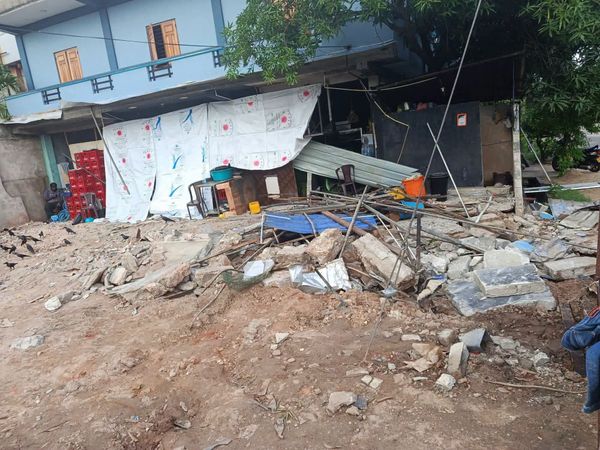
JAFFNA, Sri Lanka: All that is left of the Matara Ambula Hotel on Jaffna’s Main Street is a narrow room at the back. The Ranasinghe family has crammed it with the pots, tables and stoves they managed to pull from the rubble, and still some of it will not fit.
“The restaurant is no longer in a condition in which we can conduct our business,” Tharindu Ranasinghe said on Thursday, a day after workers from the Jaffna Municipal Council tore down the front of the building.
The restaurant belongs to his brother, Isuru Indeewara Ranasinghe, who runs it with their mother, Renuka Ranasinghe. Tharindu Ranasinghe works alongside them. The family comes from Matara in the island’s south.
For nine years, the Ranasinghes fed Tamil office workers, Sinhalese tradesmen, police officers and day laborers at the same tables. A plate of rice and fish curry cost about 350 rupees, among the cheapest full meals in the city. The family employed 23 people, Sinhalese and Tamil. Residents say it was the only eatery in Jaffna owned by ordinary Sinhalese people.
“Twenty-three families depend on the livelihoods provided by this restaurant,” Mr. Ranasinghe said. “Some of them have children attending school. They now have no means of earning the money they need even for their children’s schooling.”
‘They came with the bulldozer without any notice’
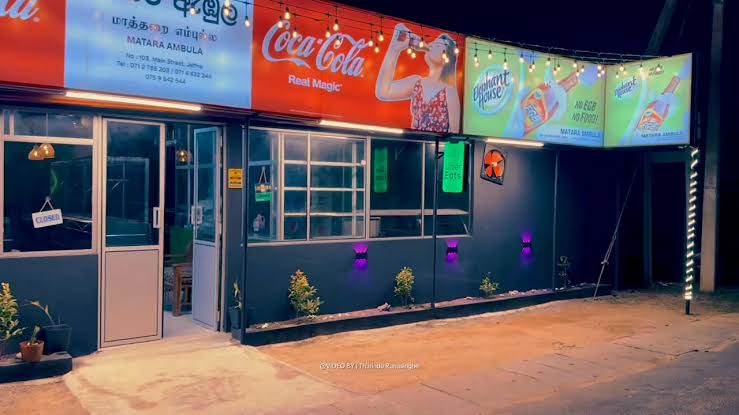
Mr. Ranasinghe said the family was told that part of the building would have to be removed, following a court case over the premises. The court ruled about two months ago, he said, and the matter was then handed to the municipal council.
The family went to the council to ask what they should do. Officials told them they would give them a date to remove the section, he said, and the family understood they could keep operating until then. “So we waited,” he said. “Then they came with the bulldozer without any notice and demolished it.”
He said the family asked for time to move equipment worth several lakhs of rupees and offered to take the section down themselves. They were refused. The council’s workers arrived with a JCB excavator and a tractor. “How could we possibly remove everything from an established restaurant within a single day?” he asked.
The trouble started, he said, after the family put in a glass frontage. A public health inspector had told them the restaurant was in good order but advised them to keep out the dust from the road. “It was a small improvement intended to maintain cleanliness and hygiene inside the restaurant,” he said.
He said the family had asked the municipal council many times to register the business, offering to pay the fees and meet every requirement, and was never given a registration. “If the other establishments can obtain registration and continue operating, why could we not do the same?” he said.
Almost every shop on that stretch, he said, juts toward the road or sits over the roadside drain. The restaurant stood about five feet from the drain. Some of its neighbors are one or two feet from it. “As far as we are aware, no comparable action has been taken against those establishments,” he said. “Our question is why our restaurant alone has been subjected to such action.”
Asked whether he thought the family had been singled out because they are Sinhalese, he took a moment. “Sometimes, I feel that such a possibility exists,” he said. “It is something that naturally comes to mind when I look at what has happened.”
He was quick to add that this was not how the family saw Jaffna. “But my mind also tells me, from our experience, that the overwhelming majority of the Tamils we have dealt with over these nine years have been very good to us,” he said.
Councillors allege racism
Four members of the municipal council told Jaffna Monitor that the action against the restaurant was driven by two councillors who singled it out again and again. Speaking separately and on condition of anonymity, they described the two as holding deeply racist views toward Sinhalese people.
They said both belong to the Democratic National Alliance. According to the councillors, the two raised the restaurant at meeting after meeting, calling it an encroachment, until the council passed a resolution against it. The resolution was approved under the mayor, Vivekanandaraja Mathivathany of the Ilankai Tamil Arasu Kachchi, and sent to the municipal commissioner, who authorized legal proceedings.
The members said they knew at the time that the push was racially motivated. They kept quiet, they said, because they feared being branded anti-Tamil for defending a Sinhalese business.
Jaffna Monitor has not independently established that racial prejudice motivated the council’s actions. The allegation comes from members of the council itself.
One councillor said he had not been able to sleep the night of the demolition. “What wrong did this man commit by coming to an area where we are the majority? Did he come here to rob us?” he said. “He came here with his family to earn a living by preparing food and serving our people.”
He had eaten there himself, he said, and found the food good, the prices fair and the staff attentive. He asked why the council had gone after a small Sinhalese family business while large companies owned by investors from the South operate in Jaffna without trouble. “This is an ordinary family who came all the way from Matara to Jaffna,” he said. “They came here because they trusted the Tamil people.”
Then he reached back to July 1983, when mobs in the South killed Tamils and burned their homes and shops. “If we treat him this way, what moral difference is there between us and those who attacked innocent Tamils in 1983?” he asked. He said he planned to visit the family soon.
None of the councillors objected to enforcing the building rules. “If they want to remove all the encroachments, that is welcome,” one said.
The councillors said there were at least 100 unauthorized structures in the municipal council area alone, and hundreds more across the city. Around Jaffna Teaching Hospital, they said, encroachments have squeezed the back lane so narrow that ambulances cannot reach the rear entrance. Residents and traders point to the shops around the Jaffna Central Bus Stand. The council has taken no comparable action in either place, the councillors said.
Video of the family and their staff weeping as the building came down spread quickly across Jaffna. Muthumalar, 67, a Jaffna resident, told Jaffna Monitor she could not accept what the council had done. “They came here believing they could make a living by cooking and serving food to Tamils,” she said. “The council demolished only their building and left the Tamil-owned buildings that also encroach untouched. That is an injustice. It is an insult to our Tamil identity.”
Questions for the mayor and her party
Councillors also questioned why the mayor went to the site during the demolition and, they said, recorded a video of herself there. Such work is carried out by council engineers, they said. They asked what the mayor was doing there, if not to be seen.
Another council member questioned the timing. The demolition took place on Wednesday, during Maaveerar week, the days leading up to Nov. 27, when Tamils remember fighters who died in the war. Taken together with the mayor’s presence at the site, he said, the timing left him deeply suspicious. He said he had come to believe the demolition was timed to appeal to anti-Sinhalese feeling among some Tamils and win their votes.
“Why this week, of all weeks?” he asked. “ITAK played a dirty game.”
The episode has deepened criticism of Ms. Mathivathany inside the council and beyond it. Several people familiar with the council’s work said she lacked the experience for the post and owed it mainly to her loyalty to the party leadership. Sources also told Jaffna Monitor that foreign diplomats at a council function had been kept waiting 20 to 30 minutes for her to arrive.
The Ilankai Tamil Arasu Kachchi controls the council. Its president, C.V.K. Sivagnanam, declined to comment, saying the demolition was a decision of the council.
Critics say the party cannot wash its hands of it so easily. As the main Tamil party, they say, it carries a duty to support reconciliation, and its council has worked against that duty. Some are asking whether the party will now act on the mayor’s leadership.
Beyond one restaurant
Those who spoke to Jaffna Monitor fear the damage will travel far beyond one family. If the Ranasinghes and their workers go home to Matara believing they were driven out for being Sinhalese, they said, that story will reach their relatives and neighbors, and it could harden into resentment of Tamils.
Matara has Tamil-owned businesses and Hindu temples. It is also the district that elected Saroja Savithri Paulraj, a Tamil, to Parliament.
For decades, Tamils have asked the state for equal treatment and the fair application of the law. Residents said the same must be expected of Tamil-led institutions when they deal with the few Sinhalese families living among them. Critics asked how Tamils can demand equality and protection as a minority in Sri Lanka if a minority family is treated this way where Tamils are the majority. Some warned that Sinhala nationalist groups opposed to devolution and the full implementation of the 13th Amendment could use the episode against Tamils.
The court’s order gave the council the legal power to act. Councillors and residents say the questions lie with the council: why it chose this building out of hundreds, and why it would not give the family the time they asked for.
“We had been conducting business there for nine years,” Mr. Ranasinghe said. “If the other businesses are allowed to operate, why are we not being given the same opportunity? That is the main question I have.”