

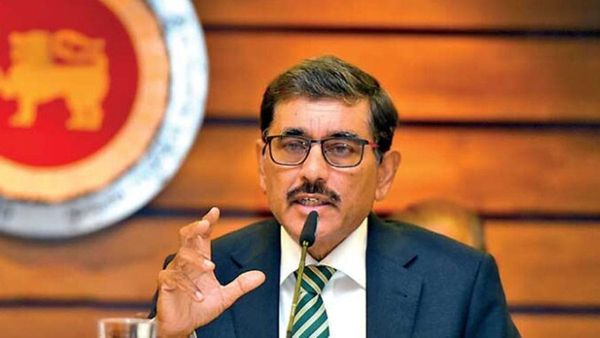
COLOMBO — Sri Lanka can return inflation to its 5 percent target if global oil prices hold near $80 a barrel, the country's central bank governor said, while warning that a fresh energy shock would strain a recovery that remains vulnerable to forces beyond the island's control.
Nandalal Weerasinghe, governor of the Central Bank of Sri Lanka, spoke in an interview with Bloomberg Television in Sydney, where he is leading an investor roadshow intended to draw foreign money into Sri Lanka's stock market.
"If oil prices remain around that level, we can manage the situation," Mr. Weerasinghe said. Further surprises in international energy markets, he added, would be harder to absorb.
The Central Bank's forecasts assume oil at roughly $80 a barrel through the rest of this year and into next. Sri Lanka imports nearly all of its petroleum, leaving it directly exposed to price swings it cannot influence.
Inflation was running at about 2 percent as recently as March. It reached 7.3 percent in July, the fastest pace in three years, after global energy costs climbed and domestic fuel prices followed. Mr. Weerasinghe said he expected those pressures to ease gradually as the Central Bank's tightening worked through the economy.
In May, the bank raised its policy rate by a full percentage point, to 8.75 percent, its first increase in more than three years and a move markets had not expected. Mr. Weerasinghe has called the decision pre-emptive, intended to keep inflation expectations anchored as fuel costs fed into transport, electricity and other prices.
The effects are already visible, he said, in slower credit growth and a steadier rupee. Curbs on vehicle imports and lending, among them loan-to-value limits, have also eased pressure from imports.
Tighter conditions will not derail the recovery, he said, though growth is likely to moderate in the second half of the year.
Sri Lanka's economy expanded by about 5 percent in both 2024 and 2025, after the contraction that followed the 2022 crisis. The Central Bank expects growth of 4 to 5 percent in 2026. The International Monetary Fund is more cautious, forecasting 3 percent on higher energy costs and other external risks.
The gap between the two projections turns largely on oil. Rising prices raise consumer costs and at the same time enlarge the fuel bill Sri Lanka must settle in foreign currency, weighing on the trade balance, the exchange rate and reserves. The I.M.F. warned in May that costlier oil could lift inflation and weaken the current account, and that geopolitical tensions had tilted the risks to the downside.
Mr. Weerasinghe presented the country's recent performance as a reason to invest now. "This is the time," he told Bloomberg's The Asia Trade.
He is in Australia for Invest Sri Lanka, a series of capital-market forums in Sydney and Melbourne organised by the Securities and Exchange Commission of Sri Lanka, the Colombo Stock Exchange and the stockbroking industry. The Sydney forum was held on Aug. 17.
Sri Lanka has been rebuilding under an I.M.F. programme agreed after it defaulted on its foreign debt in 2022, when depleted reserves left the country unable to pay for fuel, medicine and other essential imports. The fund's executive board completed the combined fifth and sixth reviews of the Extended Fund Facility in May, releasing about $695 million. It praised the authorities' implementation of reforms while warning that the Middle East energy shock had significantly worsened the outlook.
Mr. Weerasinghe said the next review was expected in November or December, and that he was confident Sri Lanka would meet its commitments.