

JAFFNA — Almost two years after Anura Kumara Dissanayake won the presidency on a promise to reopen Sri Lanka’s most notorious killings and disappearances, Human Rights Watch has found that his government has pushed a handful of those cases further than any administration before it, and has largely left the rest of the country’s apparatus of impunity untouched.
The report, “Not Genuine with Justice,” comes days before the United Nations high commissioner for human rights updates the Human Rights Council in Geneva. Its title belongs to a woman whose relative is thought to lie in the mass grave at Chemmani, on the edge of Jaffna town.
“There will be no justice for victims in Chemmani,” she told researchers. “The delays show the government is not genuine with justice.”
Human Rights Watch does not claim that nothing has changed since November 2024. Its argument is that nothing has been made irreversible, and that this country has watched credible investigations collapse before—every time a government changed, or a suspect turned out to be someone who mattered.
The cases that moved
The furthest movement has come in the Easter Sunday case.
In February, the Criminal Investigation Department arrested Maj. Gen. Suresh Sallay, the retired officer Gotabaya Rajapaksa installed at the head of the State Intelligence Service, on charges of conspiracy and of aiding and abetting the 2019 bombings that killed 269 people. Sallay denies the allegations. He is held under the Prevention of Terrorism Act and is challenging his detention in the Court of Appeal.
On June 3, the Fort Magistrate’s Court barred Rajapaksa himself from leaving the country, along with Col. Mohamed Ansar and a former intelligence officer, Premananda Udalagama. It was the first time the Sri Lankan state formally tied the former president to the attacks. He has gone to the Court of Appeal to prevent his arrest, and the petition is pending.
On July 31, a Special High Court convicted the former inspector general of police, Pujith Jayasundara, and the former defence secretary, Hemasiri Fernando, of murder and attempted murder in a split decision, for failing to act on intelligence that could have stopped the bombings. Human Rights Watch records the conviction and the gap beside it: several others whom the Supreme Court held liable in 2023 have never been charged with anything.
Father Cyril Gamini, among the most persistent Catholic voices on the case, credits the current investigations, and notes that the previous ones stopped when Gotabaya Rajapaksa became president.
The Navy 11 case has moved too. Between August 2008 and February 2009, eleven men, most of them young, disappeared in Colombo. Their families were asked for ransom, and some paid up to a million rupees. Several of the men got word out on borrowed handsets: they were held first at the Parakrama naval base in Colombo, then at the Gun Site, underground cells inside the Trincomalee Naval Command. The last call came in May 2009.
Fourteen suspects were indicted in 2019, including former navy commander Wasantha Karannagoda, whose own order in an unrelated matter had accidentally exposed the case a decade earlier. The attorney general withdrew the indictment against him in 2021. By then he had been made Admiral of the Fleet, the navy’s highest rank. Washington sanctioned him in 2023, London in 2025.
On June 10, the Colombo Fort Magistrate’s Court ordered that a second former navy commander, Adm. Ravindra Wijegunaratne, be named a suspect. A week later, the Trincomalee magistrate went to the Gun Site and inspected it. The next hearing is on December 9.
Jennifer Jamaldeen Weerasinghe has spent more than a decade in courtrooms looking for her son Dilan, one of the eleven. The mothers have been threatened and watched throughout, she said, and they keep going because the pressure is the only thing that works.
The Prageeth Ekneligoda case has inched. Nine army officers were indicted in 2019 over the cartoonist’s abduction and an alleged conspiracy to murder him, and two trials are now running: one for an earlier abduction in 2009, one for the disappearance itself. Both have been slowed by changes of judge, adjournments, witnesses who revised their statements and repeated allegations of intimidation. The main suspect was detained last year over accusations that he threatened witnesses on 19 separate occasions. The government brought back Shani Abeysekara, the CID director the Gotabaya administration demoted, arrested and retired; he is now a witness. In January it halted the promotion of an accused officer to colonel after protests by Sandya Ekneligoda and human rights groups.
Sixteen years on, there is no verdict and no answer about where Ekneligoda is. His wife’s fear is not that the case will be lost but that it will run out of time.
“My firm belief is that the case must be heard and completed soon because I don’t know what will happen if the political context changes,” she said.
The cases that did not
Against that, Human Rights Watch reports no movement whatever in two cases in the East.
On the evening of January 2, 2006, five Tamil students were shot dead on the Trincomalee beachfront and two more survived with severe injuries. A 2015 investigation by the UN human rights office found reasonable grounds to believe that security personnel, including men from the police Special Task Force, carried out the killings. Thirteen suspects were arrested in 2013 and bailed three months later. In 2019, the Trincomalee chief magistrate dismissed every charge for want of evidence, having declined to hear eight of the 36 witnesses. Two of the eight were the survivors.
Dr. Kasippillai Manoharan, whose son Ragihar was among the dead, testified that government forces were responsible and then left the country with his family after months of death threats. So did the other families, and both survivors. He died last year, still pursuing the case. Balachandran, an auto-rickshaw driver who came forward with information linking the security forces to the shooting, was taken from his home by men in a white van in August 2006 and killed. Subramaniyam Sugirdharajan, the journalist who covered the case, was shot by unidentified gunmen.
Seven months after the beachfront killings, 17 Sri Lankan staff of the Paris-based agency Action Contre la Faim were executed at close range inside their compound in Muttur. Sixteen were Tamil, one was Muslim, and each was wearing a shirt that identified them as an aid worker. The government blamed the Tigers. Field research by University Teachers for Human Rights (Jaffna), and later an ACF investigation and a UN inquiry, pointed instead to the security forces and to a cover-up in which evidence was never collected, was tampered with, or was simply left out of the police file. Twenty years on, no one has been charged.
Two more cases have complete investigation files and nothing else.
Lasantha Wickrematunge, editor of The Sunday Leader and among the sharpest critics of the Mahinda Rajapaksa government, was killed on January 8, 2009, by masked men on motorcycles who forced his car off the road at Mount Lavinia. His notebook and telephone were recovered from the scene and then disappeared; two senior officers later testified that the inspector general of police, Jayantha Wickramaratne, had ordered them destroyed. When detectives followed the trail into military intelligence in 2010, the police chief took the case off the CID and handed it to the Terrorist Investigation Division. The investigation was returned to the CID after 2015 and pursued military intelligence again. In November 2019, weeks after Gotabaya Rajapaksa took office, the officer leading it, Nishantha Silva, fled the country.
Keith Noyahr, deputy editor of The Nation, was abducted in a white van on May 22, 2008, taken to a house, blindfolded, stripped and beaten, and dumped in Dehiwala the next morning. Call logs later produced in court traced what happened after his editor and his chairman telephoned the Rajapaksa brothers for help that night: Gotabaya Rajapaksa, then defence secretary, called the inspector general of police and the intelligence chief, Maj. Gen. Kapila Hendawitharana; Hendawitharana called the director of military intelligence, Brig. Amal Karunasekara; Karunasekara called Maj. Prabath Bulathwatta, who commanded the military intelligence unit at Tripoli Camp. Noyahr told police that during the beating one of his captors took a call and answered “Okay sir, okay sir,” and that the beating then stopped. Nine suspects were arrested in 2017; Karunasekara in 2018. The case stalled once Gotabaya Rajapaksa became president; that February he promoted Bulathwatta to lieutenant colonel.
The attorney general began preparing indictments against 12 former soldiers over the Noyahr abduction in May 2025. That August, the public security minister told Parliament that both investigations were finished and the files had gone to the attorney general. A year later, in neither case has an indictment been filed.
What has not been legislated
The National People’s Power went to the country in 2024 promising to finish the investigations into political killings and the abduction of journalists, to deliver justice for disappearances in every part of the island including the North and East, and to create an independent prosecutor’s office that would answer to no minister. It then took a two-thirds majority in Parliament.
The Prevention of Terrorism Act has not been repealed and is still being used to arrest and detain. Since the report went to press, the government has moved: Cabinet gave in-principle approval on August 10 to a replacement drafted by a technical expert committee, and on August 17 approved its publication in the gazette ahead of presentation to Parliament. The bill has not been tabled. Its text has not been released, and the Cabinet decision gives it a different name from the draft the public was consulted on in December. That draft, which is still the only version anyone outside government has seen, defined terrorism broadly enough to reach political activism and carried wide powers of arrest, search and proscription. Human Rights Watch said in January that it fell short of the benchmarks set by the UN counterterrorism expert and of the commitments Sri Lanka gave the European Union to keep GSP+.
The independent prosecutor’s office promised in the manifesto does not exist. An expert committee was appointed in June to design one.
Enforced disappearance became a crime in Sri Lanka only in 2018, and no case has yet reached court under that law. It is still not a crime against humanity here, and domestic law still contains no provision for command responsibility, the doctrine under which an officer answers for crimes he failed to prevent or punish. Without it, the men who gave orders stay out of reach, and the prosecutions that do proceed reach only the men who carried them out.
Chemmani
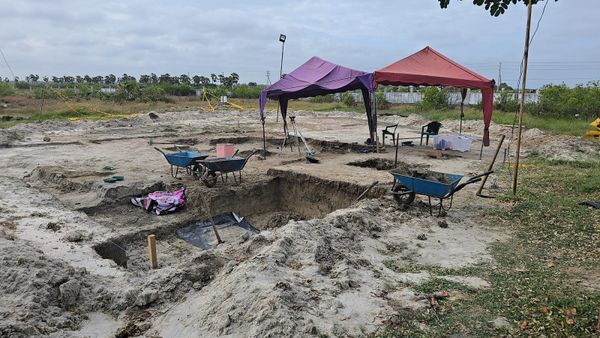
The grave at Chemmani entered the public record in 1998, when a soldier convicted in the rape and murder of the schoolgirl Krishanthi Kumaraswamy told a court that hundreds of bodies had been buried there during the military’s occupation of the peninsula. Nothing followed for 27 years. In 2025, construction workers struck human remains, and digging resumed under the supervision of the Jaffna magistrate.
The report’s summary puts the remains recovered by mid-August at more than 580, which makes Chemmani the largest mass grave in the country; its own chapter on the site gives more than 530 for the same month. Out of the soil have come children’s footwear, school bags, a doll, a baby’s milk bottle and coins.
Almost nothing has been done to work out who the dead were or how they died. The investigators do not have the forensic capacity, and the justice minister, Harshana Nanayakkara, has said DNA analysis will have to go to laboratories abroad. The Code of Criminal Procedure gives a magistrate power to investigate a death but says nothing at all about mass graves; a draft procedure prepared by the College of Forensic Pathologists in 2024 has not been adopted. A committee of the Human Rights Commission named military personnel who were in the Jaffna area during the disappearances of the 1990s. The state has not acted on it.
Families protested at the site in June and again in July, the second time while ambassadors of European Union member states were visiting, and asked for an international investigation.
What lies beneath Chemmani has never been counted nationally. Estimates of enforced disappearances in Sri Lanka since the 1980s range from 60,000 to 100,000. The missing include Tamils who disappeared during the civil war and Sinhalese suspected of left-wing sympathies during the southern insurrection that the state crushed between 1987 and 1989.
The party that led that insurrection, the Janatha Vimukthi Peramuna, is now the principal constituent of the governing National People’s Power. Its own dead from those years lie in graves nobody has opened either.
Human Rights Watch is explicit that the state was not the only offender. Government forces were responsible for arbitrary detention, torture, extrajudicial killings, rape, enforced disappearance and indiscriminate attacks on civilians. The Liberation Tigers of Tamil Eelam carried out suicide bombings and targeted killings of civilians, tortured, took children as soldiers, evicted communities and used civilians as shields.
Geneva
To Colombo, the report recommends an independent prosecutor’s office with investigators of its own, genuine witness protection, forensic and DNA capacity for the graves, enforced disappearance recognised as a crime against humanity, command responsibility written into law, repeal of the Prevention of Terrorism Act, and prosecutions built on evidence that earlier commissions already gathered and no one used.
It also asks the government to work with the Sri Lanka Accountability Project, the UN evidence-preservation mandate the Council renewed last October for two more years, and to revive the special court with international judges, prosecutors and investigators that Sri Lanka itself agreed to in 2015 and never built.
The government has rejected that approach. Foreign Minister Vijitha Herath told Parliament in October that these questions had been internationalised through politicisation and would be settled by domestic institutions.
In Jaffna, that argument is a hard sell. “It is like asking the owner of a chicken shop to investigate the killing of the chickens,” one activist told the Monitor. “You can probably guess what the investigation will find.”
To foreign governments, Human Rights Watch recommends targeted sanctions on individuals credibly implicated in serious abuses, prosecutions under universal jurisdiction where the evidence allows, help with forensics and evidence preservation, and continued linkage between Sri Lanka’s human rights commitments and trade preferences such as the European Union’s GSP+.
Volker Türk, the high commissioner, went to Chemmani in June last year and met a family searching there for someone they had lost. He told the Council in September that Sri Lanka had a historic opportunity to break its cycles of violence and impunity. He reports again this month.
At the edge of the pits, one relative of a disappeared man told the researchers what he thought that opportunity was worth so far.
“Excavations alone will not provide justice.”
Read the Full Report (PDF)
“Not Genuine with Justice” was researched and written by Bhavani Fonseka, a Human Rights Watch consultant, and edited by Meenakshi Ganguly, the organisation’s deputy Asia director.