

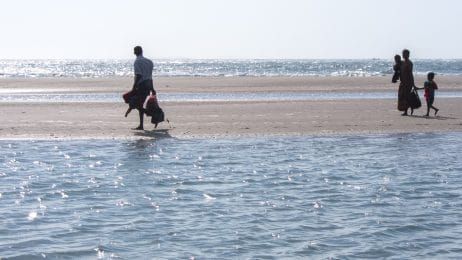
JAFFNA, Sri Lanka — In May 2025, a 75-year-old Sri Lankan Tamil man landed at Palaly airport after decades as a refugee in Tamil Nadu. He had returned with the help of the United Nations refugee agency and carried the clearances his journey required.
Immigration officials arrested him at the airport.
The Criminal Investigation Department produced him before the Mallakam Magistrate's Court, which remanded him after objections to bail. His alleged offense was that he had left Sri Lanka decades earlier without passing through an authorized port.
The court released him within days. The arrest drew attention to a law that had stayed on the books and in use for decades.
Bimal Rathnayake, a government minister and the chief of the governing National People's Power in the Northern Province, said the arrest reflected an outdated law still being enforced rather than a decision by the government. He had raised the case with Public Security Minister Ananda Wijepala, he said, and Mr. Wijepala agreed the law needed changing.
Fourteen months later, the government has acted.
The Cabinet has approved a procedure allowing Sri Lankans who fled to India during the civil war without valid travel documents, and who registered there as refugees, to return through authorized ports without prosecution under immigration law for the manner of their departure.
The decision, taken on the advice of the attorney general and presented by Mr. Wijepala, addresses an unusual legacy of the country's long civil war. Tamils who fled for their safety could be arrested when they tried to come home, because the way they escaped had broken immigration law.
For thousands of refugees in India, that danger is now gone. Other barriers remain.
Under the new arrangement, returnees must first have their Sri Lankan nationality verified through Sri Lankan diplomatic missions in India. They must then obtain security clearance from the State Intelligence Service.
Those who qualify can be issued temporary travel documents and enter Sri Lanka through an authorized port without action under the Immigrants and Emigrants Act of 1948 for their irregular departure. The procedure covers people who left before Aug. 1, 2006, and those who left irregularly between that date and May 19, 2009, when the war ended. People accused of murder, treason, or other serious offenses can still be detained on arrival and handed to the relevant authorities.
The government describes the arrangement as a balance between humanitarian considerations and national security.
For Tamils who fled the former conflict zones, the screening requirement is a delicate one. Security agencies dominated the North and East during the war, and fear of arrest, detention, and military operations was part of why many families left.
The Cabinet announcement sets out what happens to those who receive intelligence clearance. It says little about those who do not. It fixes no deadline for completing the security assessment and no criteria for granting clearance. Nor does it provide any way to challenge an adverse finding.
How that process is run will determine whether the policy lifts voluntary returns or simply swaps one obstacle for another.
A Refugee Population That Outlasted the War
Sri Lankan Tamils began crossing to the southern Indian state of Tamil Nadu in large numbers after the anti-Tamil violence of July 1983. More waves followed as fighting between government forces and the Liberation Tigers of Tamil Eelam intensified. Thousands crossed the Palk Strait in fishing boats, often with little more than the clothes they wore.
The war ended in May 2009 with the military defeat of the Tigers. Many of those who had fled stayed where they were.
Sri Lankan government estimates put the number of Sri Lankan Tamils living in and outside refugee settlements in Tamil Nadu at about 89,000 in early 2026, a substantial share of them born in India.
The second generation shows how long the displacement has lasted. Children of those who fled have grown into adults in India, some with children of their own, and their legal status is still unsettled.
Tamil Nadu has provided Sri Lankan Tamil refugees with shelter, schooling, and financial assistance for more than 4 decades. But on legal status and citizenship, the question that decides whether a refugee can build a permanent life, India's record is far weaker.
India is not a party to the 1951 Refugee Convention or its 1967 Protocol and has no national refugee law. Sri Lankan Tamils have lived instead under a patchwork of administrative rules and executive decisions. Despite decades of residence, and in some cases birth on Indian soil, many have not been offered a straightforward route to Indian citizenship.
The gap is sharpest in Tamil Nadu, where political parties have long treated the plight of Sri Lankan Tamils as a matter of ethnic and cultural kinship. The rhetoric has been strong. The legal protection behind it has not.
It has also produced a divide within the Sri Lankan Tamil diaspora. Those who reached Canada, Britain, Australia, and Europe largely acquired citizenship. They travel to Sri Lanka on Canadian, British, Australian, or European passports and go back to countries where their rights are permanent.
Those who made the far shorter crossing of the Palk Strait have fared differently. After more than 40 years in India, many families are still classified as refugees, holding a temporary status that has outlasted the war itself. Successive Indian governments have given them refuge without offering the durable route to citizenship that would let those who wish to stay belong fully to the country where they have spent most of their lives.
The United Nations High Commissioner for Refugees has facilitated voluntary repatriation from India for more than two decades. Nearly 18,000 refugees returned with the agency's assistance between 2002 and early 2022. Sri Lankan government figures released this year, counted from a different starting point, put the number returning from Tamil Nadu between January 2009 and June 2025 at more than 18,500.
Set against the size of the refugee population and the years that have passed since the war, those numbers are small. The reluctance is not new. When the government set up a committee in 2022 to examine repatriation from India, it estimated that about 58,000 Sri Lankans were living in camps in Tamil Nadu. About 3,800 were said to be willing to return.
By May 2025, according to M.A. Sumanthiran, a former member of Parliament who represented the 75-year-old man arrested at Palaly, about 10,000 people had registered to go back.
Mr. Sumanthiran asked at the time whether the arrest of a man returning through an internationally assisted process would deter others considering the same journey.
Families weigh whether they still have homes or land in Sri Lanka, whether they can find work, whether children raised and schooled in India can build lives in a country they barely know, and whether returning adults can recover documents, property, and livelihoods left behind decades ago.
For some, Tamil Nadu is no longer the place they fled to. It is where they have spent most of their lives.
For others, Sri Lanka is still home.
The Cabinet decision gives that second group a clearer legal route back than they had before, and some assurance that what happened at Palaly should not happen to the next returnee arriving under the new procedure.
The harder test comes earlier, before anyone boards a plane or a ship. Seventeen years after the war, returnees must still be cleared by the State Intelligence Service, part of a security establishment that spent decades fighting the Tigers and that has faced serious allegations of arbitrary detention, torture, and enforced disappearance of Tamils during and after the war. Whether refugees accept the government's invitation may depend on whether they believe that screening will treat them as citizens coming home or as suspects.