

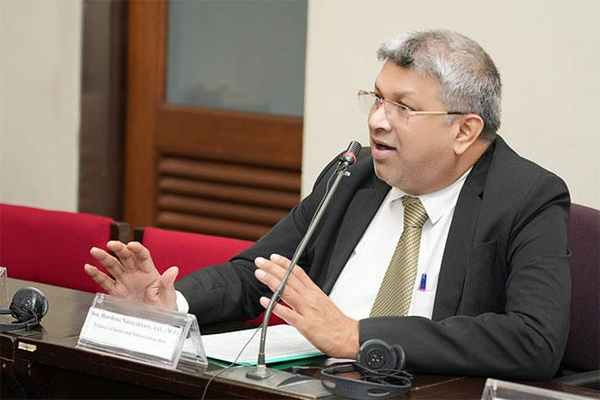
COLOMBO, Sri Lanka — Sri Lanka’s justice minister told Parliament this week that the country holds no prisoners officially classified as “political prisoners,” a legalistic distinction that has reopened one of the most sensitive disputes of the postwar era and raised questions about the government’s commitment to a promise made to Tamil voters by both President Anura Kumara Dissanayake and his party’s election manifesto.
Harshana Nanayakkara, the minister of justice and national integration, said neither the Prisons Ordinance nor prison regulations recognize political prisoners as a separate category.
“No one has been remanded or detained by a court as a political prisoner,” he said. “Accordingly, there are no political prisoners.”
The statement came in response to questioning from Ajith P. Perera, the deputy opposition whip and a lawmaker from the Samagi Jana Balawegaya, who pressed the minister over commitments Mr. Dissanayake made while campaigning in the Tamil-majority North and East.
“If there are no political prisoners in this country, why did the president promise during the election campaign in the North and East to release political prisoners?” Mr. Perera asked.
Mr. Dissanayake’s promise is a matter of public record. At a rally in Vavuniya days before the November 2024 parliamentary election, he said his government would move toward releasing Tamil detainees on the advice of the attorney general, coupling the pledge with a commitment to return military-held land in the North. The National People’s Power manifesto had also promised to release political prisoners, return occupied land, and establish a truth and reconciliation commission.
Mr. Nanayakkara said he had examined the list of prisoners in question several times. Cases had been filed against all of them, he said, and several had been convicted.
“They were arrested for offences involving violations of the law,” he said, while acknowledging the political circumstances in which many of the cases arose.
Legal and political experts interviewed by Jaffna Monitor said the exchange reflected a distinction that has persisted throughout Sri Lanka’s postwar years: While the state does not recognize political prisoners as a separate legal category, Tamil political parties, prisoners’ families and human rights advocates argue that the arrests and prosecutions cannot be divorced from the conflict in which they arose.
Successive governments have taken essentially the same position. In 2021, Ali Sabry, then the justice minister, told Parliament that Sri Lanka had no political prisoners, while acknowledging that some detainees faced no charges or pending cases. In late 2024, weeks after Mr. Dissanayake’s pledge, the former justice minister Wijeyadasa Rajapakshe made a similar assertion.
Tamil groups and rights advocates have long challenged that reasoning. They point to prisoners prosecuted over alleged links to the Liberation Tigers of Tamil Eelam, some of whom have spent decades behind bars in cases arising from Sri Lanka’s nearly three-decade civil war.
In April, a petition signed by 324 organizations and individuals — including two Catholic bishops, 29 priests, seven nuns, and two Buddhist monks — called on Mr. Dissanayake to immediately release 10 Tamil prisoners who had spent at least 15 years in prison. At least two, according to the petition, had been incarcerated for nearly three decades.
Among the cases highlighted by campaigners is that of Vigneswaranathan Parthiban, who has been imprisoned for about three decades. His sister has appealed to successive presidents for his release and handed a letter to Mr. Dissanayake during a visit to Jaffna in January 2025.
Nearly all of the detainees at the center of the dispute were arrested or prosecuted under the draconian Prevention of Terrorism Act, or P.T.A., enacted in 1979 as Sri Lanka’s separatist conflict intensified. The law has long been condemned by international human rights organizations for permitting prolonged detention without trial and allowing confessions made in police custody to be used as evidence.
Sri Lanka committed in 2017 to replacing the law with legislation consistent with international human rights standards after the European Union restored the country’s access to its GSP+ preferential trading arrangement. Successive governments, however, have failed to complete that process.
Even as he rejected the term “political prisoner,” Mr. Nanayakkara indicated that the government was considering relief for some long-serving inmates.
He said particular attention was being given to prisoners who had spent lengthy periods behind bars and that the government would consider measures including reductions in sentences and presidential pardons, based on recommendations submitted by a committee chaired by S. Thurairaja, a retired Supreme Court justice.
The committee, appointed by the Cabinet in June 2025, was tasked with reviewing the exercise of presidential clemency under Article 34 of the Constitution, along with the laws and administrative procedures governing pardons. It submitted its report to Ayesha Jinasena, the secretary to the Justice Ministry, this month. Its mandate covered the pardons system as a whole rather than specifically addressing prisoners whose cases arose from the civil war.
Mr. Nanayakkara emphasized that any measures resulting from that process would not be confined to Tamil prisoners or to cases originating in the former conflict areas.
“This will cover the entire country — the North, East, and South,” he said.
The debate comes as Sri Lanka’s prison system faces a broader crisis of overcrowding. The country’s prisons hold roughly 27,000 to 29,000 people in facilities designed for about 10,000.
The pressure on the system came into stark relief this month after violence at Negombo Prison on July 5 and 6 left at least 28 people dead, including eight prison officers. The opposition has since moved a no-confidence motion against Mr. Nanayakkara.
But the dispute over political prisoners predates the current crisis and touches on a deeper question left unresolved since the civil war ended in 2009: whether people imprisoned for years or decades in cases rooted in the conflict should be treated solely as ordinary criminal defendants, or whether the political circumstances of their detention demand a different response.
The issue now presents the government with a moral as well as a political challenge. Having campaigned on a promise to release political prisoners, it must explain how it intends to fulfill that pledge while insisting that, as a matter of law, no such prisoners exist.