

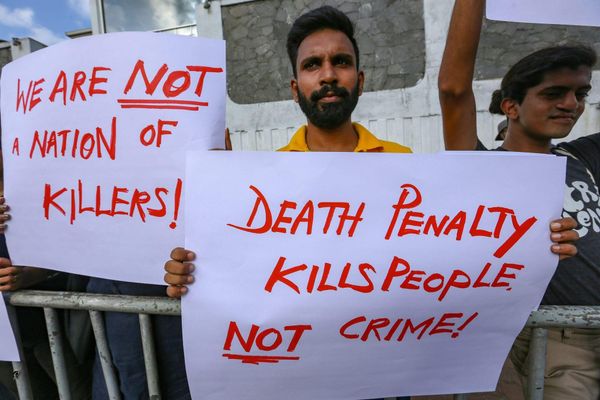
COLOMBO — President Anura Kumara Dissanayake’s anti-narcotics council took up the question of executing drug offenders on Monday, reopening a debate that has surfaced twice in three decades and collapsed both times.
The President’s Media Division said the “Ratama Ekata,” or A Nation United, National Operations Council met at the Presidential Secretariat and concluded that trafficking now threatens the economy, the tourism industry, and the country’s social values, and that harsher laws were needed.
No new law is required to hang a drug offender here. A 1984 amendment to the Poisons, Opium and Dangerous Drugs Ordinance made manufacturing heroin, cocaine, morphine, or opium punishable by death or life imprisonment, along with trafficking or possession above set thresholds. For heroin the threshold is two grams of pure content.
The last execution was in June 1976. Every president since has declined to sign a death warrant, which puts Sri Lanka among the 40-odd countries that keep capital punishment without using it. It has the largest death row of any of them, more than 1,000 prisoners at the end of 2024.
The discussion comes nine months into the largest anti-drug operation the country has run. Since it began on Oct. 30, 2025, police, the military, customs, and the Special Task Force have arrested 230,248 people and seized more than 15,900 kilograms of narcotics, Deputy Inspector General Ashoka Dharmasena of the Police Narcotics Bureau said in July. More than 7,300 of the detained were under 21.
Sri Lanka’s 26 jails were built for 10,000 inmates and hold more than 40,000. Justice Minister Harshana Nanayakkara told Parliament in January that every prison was at 300 percent capacity, with roughly 27,000 of some 38,000 inmates on remand rather than convicted.
On July 5 and 6, a riot at Negombo Prison, built for 650 and holding about 2,600, killed 28 people, eight of them officers, and injured more than 100, the worst prison violence since Welikada in 2012. Officials blamed feuding between inmate groups over drugs. Prisoner-welfare groups blamed the overcrowding the crackdown produced.
What the council decided
Officials said amendments to the drug control and bail laws have been drafted and will be gazetted before reaching Parliament. Neither the Presidential Secretariat nor the Justice Ministry has released the text, so whether they touch capital sentencing is unclear.
Most of the meeting dealt with the Government Analyst’s Department, whose reports establish how much pure narcotic a seizure contains and therefore what a suspect is charged with. Men wait months in remand for a report that may place them below the trafficking threshold. The council was told 6,414 were issued in July.
Mr. Dissanayake ordered seizure data classified by weight, in bands below five and below 10 grams, and told the department, the police and the prisons service to coordinate so suspects reach court as soon as a report arrives.
The argument for
The loudest case for hanging traffickers has come from inside the prison service. Prisons Commissioner Jagath Weerasinghe told a school programme in October that political leaders should press the president to execute large-scale traffickers to “protect future generations.” About 65 percent of inmates are held on drug charges.
Parliament has already moved once. Act No. 7 of 2026, gazetted March 6 after a run of navy interceptions in international waters, made manufacturing those drugs on the high seas aboard Sri Lankan-registered or stateless vessels punishable by death or life imprisonment, for foreigners as well as citizens.
Two presidents have tried before. Chandrika Kumaratunga announced in March 1999 that executions would resume, then retreated. Maithripala Sirisena, back from a Philippines visit where he praised Rodrigo Duterte’s drug war, said in February 2019 he would end the moratorium, advertised for two hangmen, and in June signed warrants for four drug convicts.
The Supreme Court stopped him on July 5, 2019, barring any execution until it heard petitions from the condemned men, the Bar Association of Sri Lanka argued hanging breached Article 11 of the Constitution. In August 2021 the Attorney General’s Department told the court the policy of not executing anyone had not changed.
The argument against
Opposition has crossed party lines. When Mr. Sirisena signed the warrants, his own prime minister, Ranil Wickremesinghe, disowned the decision, and a bill to abolish capital punishment reached Parliament within a fortnight.
The sharper constraint is trade. The European Union restored Sri Lanka’s GSP+ tariff concessions in 2017, subject to conditions including compliance with the International Covenant on Civil and Political Rights. In 2019, Brussels called capital punishment cruel and degrading, said the evidence for deterrence does not hold, and warned that executions would contradict a commitment Colombo had given at the United Nations months earlier. Apparel, the largest export to Europe, rides on those concessions.
Article 6 of that covenant confines the death penalty to the most serious crimes, which the U.N. Human Rights Committee reads as offences involving intentional killing. Drug offences fall outside. Sri Lanka ratified it in 1980 but never the protocol committing states to abolition.
Critics at home say the policy would reach the wrong people. Ambika Satkunanathan, a former commissioner of the Human Rights Commission of Sri Lanka who led the first national study of its prisons, argues that most people convicted of drug offences are poor, caught with small quantities and without competent counsel, and that jailing those who cannot pay bail or a fine amounts to the “criminalisation of poverty.” After the Negombo riot, she told Reuters the government should cut unnecessary imprisonment and treat dependence in the community rather than build cells.