
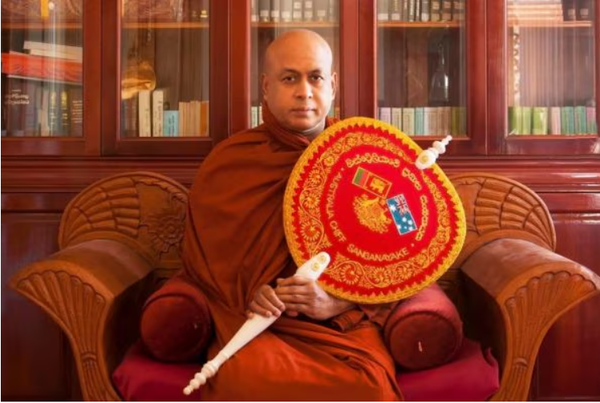
MELBOURNE, Australia — A Sri Lankan-born Buddhist monk who sexually abused six girls at a Melbourne temple over eight years was sentenced on Thursday to 13 years and two months in prison, after a judge condemned his crimes as a profound betrayal of the trust placed in him by families who regarded him as a spiritual leader.
Naotunne Vijitha, 71, the former chief monk of the Dhamma Sarana temple in Melbourne’s southeastern suburbs, was convicted last year of nine counts of sexual penetration of a child and eight counts of committing an indecent act with a child.
Judge Pardeep Tiwana of the County Court of Victoria ordered that Vijitha serve at least nine years and four months before becoming eligible for parole.
The abuse occurred between 1994 and 2002, when the victims were young girls attending the temple in Springvale and Keysborough, suburbs with established Sri Lankan communities.
The court heard that Vijitha repeatedly lured the girls into his private living quarters and sexually abused them, sometimes while their parents were in nearby rooms, unaware of what was happening.
"You preyed on young, innocent girls for your own perverse sexual gratification," Judge Tiwana told him during sentencing.
"You took away their innocence in a place of worship where they were entitled to feel safe, a place where they came to learn and practice their Buddhist teachings."
The judge described Vijitha as a man with "a dark and disturbing side" who had exploited his religious authority and the confidence of parents who entrusted their children to him.
Born in Sri Lanka, Vijitha entered the Buddhist monastic order at 15. He later moved to Sweden, where he obtained citizenship, before relocating to Australia in 1994 to become chief monk of the Dhamma Sarana temple.
Over the years, he became a respected figure among members of Melbourne's Sri Lankan Buddhist community. His standing was such that parents felt comfortable leaving their children alone with him, the court heard.
"You betrayed this immense trust in the most unexpected and egregious manner," Judge Tiwana said.
The victims, now adults, came forward to police decades after the abuse. Prosecutors charged Vijitha in 2023, and their testimony became central to the case.
During his trial, Vijitha denied the allegations. His lawyers argued that the assaults had not occurred and said he could not remember some of the complainants.
The jury rejected his defense.
In sentencing him, Judge Tiwana described the six women who testified as "truthful, intelligent and articulate."
Their victim impact statements revealed the lasting psychological consequences of the abuse, including feelings of shame, fear and an inability to feel safe in religious settings.
"To survive, I had to teach myself not to feel," one woman said in her statement.
Another described how the sight of Buddhist monks wearing saffron robes or the sound of religious chanting continued to trigger distress decades after the assaults.
The judge said one victim feared that she and her family would be accused of lying or attempting to destroy the temple because she had spoken publicly about the abuse.
The sentencing hearing also exposed tensions between the victims and some of the monk's supporters.
According to the Australian Broadcasting Corporation, Vijitha, who appeared in court wearing a gray prison tracksuit rather than his customary saffron robes, smiled and waved toward supporters shortly after receiving his sentence.
Some supporters approached the dock and bowed toward him, prompting an angry reaction from victims who were watching the proceedings.
"This is ridiculous," one victim said aloud.
Court security officers subsequently intervened to prevent further exchanges between Vijitha and those in the courtroom.
Vijitha's lawyers had previously asked the court to consider his deteriorating health, including dementia and other medical conditions, in determining his punishment.
The court also heard that he would probably face deportation after completing his prison sentence. Although born in Sri Lanka, Vijitha holds Swedish citizenship and has indicated that he would be willing to return to Sweden.