


JAFFNA, Sri Lanka — A Sri Lankan Tamil man who spent nearly five years in British custody on Diego Garcia, a remote island in the Indian Ocean, died in Eswatini on Sept. 13 in an apparent suicide, according to local news reports and his family. Britain had sent him there months earlier under an agreement with the Eswatini government that provided for him to live in the country permanently — in what appears to have been the first documented case of a person granted international protection by a British authority being permanently resettled in another country.
The man, 36, is identified by his initials, K.P., under a court order protecting his anonymity. Authorities in the British Indian Ocean Territory granted him international protection in 2024, which barred his return to Sri Lanka. Britain then refused to admit him because of crimes he was convicted of while in detention, and he spent the next two years in custody and in transit without a permanent legal status.
His death was first reported by The New Humanitarian, an independent news organization that has covered the Diego Garcia asylum seekers since they arrived.
K.P. was among 89 Tamils rescued by the Royal Navy in October 2021 after their fishing boat ran into difficulty near Diego Garcia, the site of a joint British-American military base. The passengers had set out from Sri Lanka and India, where tens of thousands of Sri Lankan Tamils who fled the civil war live without citizenship.
More boats arrived in the following months. Most of those passengers eventually returned to Sri Lanka or sailed on to Mauritius or the French island of Réunion. About 60 people remained in British custody in a fenced tent camp inside the base, under strict limits on their movement. Detainees and their lawyers reported rat infestations and declining physical and mental health, and said they had been warned they could be prosecuted or shot if they broke the movement rules.
In November 2024, Britain approved most of the group for entry to the United Kingdom. The following month, the territory’s Supreme Court ruled that their detention on the island had been unlawful.
Three members of the group were excluded because they had been convicted of crimes or were under investigation while detained. One is serving a three-year prison sentence in Montserrat for sexual offenses against a child, the location of another has not been disclosed, and the third was K.P.
According to court records cited by The New Humanitarian, K.P. was convicted of sexually assaulting another asylum seeker on four occasions, of assaulting and injuring a security officer who tried to stop one of his suicide attempts, and of arson connected to another attempt.
His lawyers told the courts that he had been tortured and sexually abused by Sri Lankan military personnel before he fled to India in 2007. He was one of eight people from the Diego Garcia group granted protection after individual assessments.
After the convictions, the territory’s authorities held him apart from the other detainees. He spent about eight months in a laundry room, with supervised access to other parts of the compound, and two weeks alone in a police cell without natural light.
UNHCR, the United Nations refugee agency, visited the camp in late 2023 and said afterward that it was “deeply concerned” about the conditions of his confinement, citing noise, a leaking shower and odors from a nearby toilet. In a 2024 report, its monitors wrote that although they understood the need to separate him from the others, his “right to privacy and to be accommodated in a humane and dignified manner must be upheld.”
He attempted suicide many times during his detention, according to court records, and was flown to Bahrain for medical care in 2024. A psychiatrist who gave evidence in court that year said indefinite isolation was very difficult for him and that ending it “would hugely improve his mental health.”
In 2023, he was one of three asylum seekers sent from Diego Garcia to Rwanda for medical treatment. All three later said they had been harassed or threatened there, including by a hospital worker. After his return to the island, K.P. told The New Humanitarian that the treatment he received had been inadequate, that he could not sleep and that he had been confined to a military area.
In 2025, a British court dismissed his challenge to the decision barring him from the country, ruling that the government was entitled to rely on public safety grounds. With a return to Sri Lanka ruled out and entry to Britain refused, officials looked for a third country that would take him.
His mother, who lives in India, told The New Humanitarian that he was moved from Diego Garcia to the Maldives about six months ago, a transfer she attributed to the war between the United States and Iran. About a month later, she said, he was taken to Eswatini and issued two consecutive three-month visas. The second was due to expire on Sept. 20.
On July 24, Swaziland News, an independent Eswatini outlet, reported that it had seen the agreement governing his transfer. The document was signed by Eswatini’s foreign minister, Pholile Dlamini-Shakantu, and the British high commissioner in Eswatini, Colin Wells, and indicated that K.P. would live in the country permanently. Under its terms, the outlet reported, Britain would pay for his stay for up to three years, after which he would be expected to support himself as a member of Eswatini society.
The arrangement drew criticism in Parliament. During a debate on the performance of the prime minister’s office, Marwick Khumalo, the long-serving member for Lobamba Lomdzala, accused Prime Minister Russell Mmiso Dlamini of bringing “deportees” into the country in place of foreign investment. Mr. Khumalo said the government had allowed Britain to send a Sri Lankan man to Eswatini and had agreed that he would become part of Eswatini society. Swaziland News reported that he accused the prime minister of turning the kingdom into a dumping ground for powerful countries.
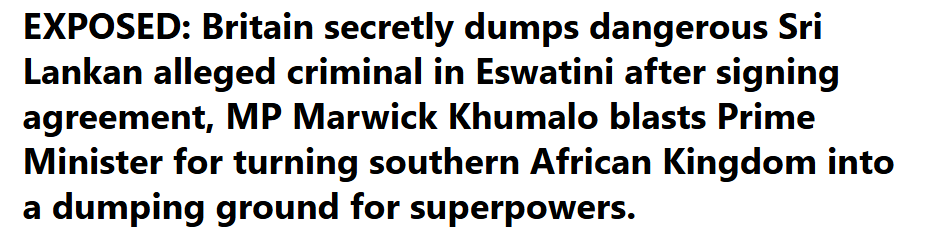
The agreement, which neither government has made public, appears to be the first documented case of a person granted protection by a British authority being permanently resettled in another country. The closest precedent is Britain's 2022 plan to send asylum seekers to Rwanda for processing and possible resettlement. That plan was abandoned in 2024 after legal challenges, before any transfers took place.
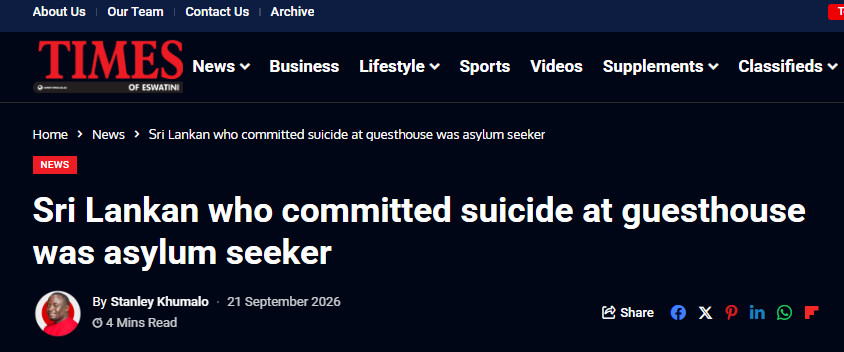
On Sept. 15, The Times of Eswatini reported that police were investigating the death of a Sri Lankan national found dead at a guest house in Mbabane, the capital, the previous weekend.
K.P.'s mother said she spoke with him by phone on Sept. 13, the day he was found. She said he sounded depressed and that she asked him to come back to India. He told her he expected to stay in Eswatini for a few more days before being sent to another country, she said, which suggested he either did not know or did not accept that the move was intended to be permanent.
Asked about his status in Eswatini and the circumstances of his death, a British government spokesperson said officials were working with the Eswatini authorities and that it would be inappropriate to comment further. Duncan Lewis Solicitors, the London firm that represented him in legal cases against the British and territorial governments, said it was not authorized to comment.
If you or someone you know is in distress, in Sri Lanka you can call the National Mental Health Helpline at 1333 or Sumithrayo at 011 2696666.