

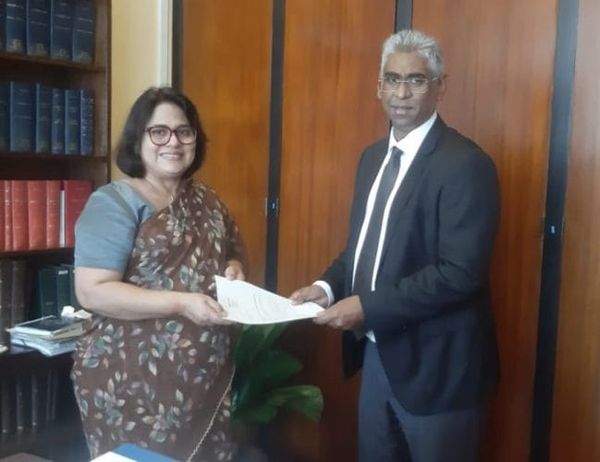
COLOMBO - Sri Lankans who run into serious trouble while working abroad could become entitled to free legal representation and a flight home at the state’s expense, under a Private Member’s Bill submitted to Parliament by Faiszer Musthapha, a President’s Counsel and member of Parliament.
The Sri Lanka Bureau of Foreign Employment (Amendment) Bill would insert a new Section 48A into the Sri Lanka Bureau of Foreign Employment Act, No. 21 of 1985. At present, the state gives this help at its discretion, case by case. Under the bill, it would become a legal obligation owed to every registered worker whose distress has been verified.
The state would have to engage lawyers qualified to practise in the host country and pay the legal costs. It would also have to bring the worker home, providing an economy-class air ticket, transit arrangements and emergency medical clearance.
A worker would qualify in four situations: when contractual wages have gone unpaid for three consecutive months; when there is documented physical, psychological or sexual abuse; when an employment contract has been ended early or illegally; and when the host country is hit by armed conflict, severe political unrest or a natural disaster.
The bill would also make pre-departure training compulsory for all registered migrant workers. The courses would be tailored to each destination’s legal environment and would cover cultural literacy, local cyber laws and the rules on social media use. The minister would be empowered to make regulations and to appoint a committee to review and decide applications for help.
Musthapha submitted the bill weeks after serving on a legal delegation in the case of Anojan Sivarasa, a Tamil worker from Kalmunai. A Saudi court convicted Anojan under the country’s Anti-Cybercrime Law over a Facebook comment about the Prophet Muhammad and sentenced him to five years in prison. On appeal in September, the sentence was raised to death. His family paid for his defence until after that ruling, when the government said it would take over the costs. Saudi Arabia’s Supreme Court quashed the death sentence in October.
If enacted, the bill would widen the legal protection available to Sri Lankans employed abroad by private companies and public corporations, the two kinds of employer the 1985 Act covers. It would also add to the government’s financial and administrative burden. No estimate of the cost has been made public.
The bill could reach a large number of people. In 2025, 310,915 Sri Lankans left the country for jobs abroad, 190,609 men and 120,036 women, according to Arun Hemachandra, the deputy minister of foreign affairs and foreign employment. The year before set a record of 314,672 departures. Bureau data released under the Right to Information Act show that 1,410,995 people left through the bureau between 2020 and 2025, most of them for Kuwait, Qatar, Saudi Arabia and the United Arab Emirates.
The money those workers send home has become a mainstay of the country’s external finances. Remittances reached a record $8.08 billion in 2025, up 22.8 percent from the year before, according to the Central Bank of Sri Lanka. That was about two and a half times the $3.2 billion the country earned from tourism. In 2022, the year of the economic collapse, remittances had fallen to $3.78 billion.
Most of the workforce is in one region. In March, figures from the Foreign Ministry and the bureau put the number of Sri Lankans working in West Asia at between 1,014,437 and 1,050,609. More than 73 percent of workers who registered for foreign employment this year were bound for the Middle East, according to bureau data cited by the International Labour Organization. Bureau figures show 366,918 departures for domestic work between 2021 and July 2025, mostly to Kuwait and Saudi Arabia.
The bureau's own records show the risks. At least 507 Sri Lankan migrant workers died abroad in 2022: 389 of natural causes, 36 in road accidents, 30 by suicide, 29 in other accidents, 20 of COVID-19 and three by murder. That year, the bureau recorded 124 death compensation claims from registered workers' families and paid 109.
Between 2021 and July 11, 2025, the bureau received more than 11,000 requests for repatriation from domestic workers, including more than 4,500 from Kuwait and more than 4,000 from Saudi Arabia. Over the same period, 1,002 domestic workers were repatriated from Kuwait and 1,052 from Saudi Arabia, fewer than one return for every four requests from the two countries. The bureau’s figures do not show what happened to the others.
The bureau received 4,822 complaints from the public in 2025, Hemachandra said in January. It settled 2,914 through inquiries, filed 772 cases in court, recovered Rs. 380 million on behalf of workers and cancelled 15 recruitment licences.
For workers who escape abusive employers, the bureau runs six safe houses in the Gulf. It helped 1,080 workers in the most recent reporting period, up from 871 the year before, according to the U.S. State Department’s 2026 Trafficking in Persons Report. The report said the bureau allocated Rs. 3.3 million, about $10,556, for those facilities and related support. It said the bureau provided legal support, including translation, as needed, and that migrant workers reported insufficient legal assistance.
Most of the bureau’s welfare spending reaches workers or their families after the harm is done. From January to November 2025, it paid Rs. 964.3 million in assistance covering 326,246 migrant workers, including compensation for deaths and illness abroad, and spent Rs. 397 million insuring 318,209 departing workers. Last year it also raised the death compensation paid to the families of registered workers to Rs. 2 million.
The bill’s training requirement bears directly on the kind of offence Anojan was convicted of. A parliamentary inquiry has also found that existing training rules are not always enforced. The Committee on Public Enterprises was told in February 2025 that 28,165 first-time migrant domestic workers had gone abroad without the mandatory residential training. It was also told that 683 underage workers were sent abroad for domestic work between May 2023 and June 2024.
The war in the Middle East this year tested the present system in a crisis. By March 25, only 200 to 250 of the more than one million Sri Lankans in the region had formally asked to be brought home, officials said. Of those, 178 were in Kuwait, where a drone attack had struck the airport. Airspace over Kuwait, Bahrain and Iran was closed, and airfares had risen sharply. Workers who stayed said they feared losing their jobs, and many had taken bank loans to go abroad.
Asked at the time about subsidised tickets, Thushara Rodrigo, director general of the Foreign Ministry’s public diplomacy division, said the matter required careful consideration because public funds were involved. Under the bill, armed conflict in a host country would entitle a registered worker to a state-paid ticket. The Philippines, which provides such help by law, has brought nearly 11,000 workers and family members home from the Middle East since March, according to its Overseas Workers Welfare Administration.
Sri Lankan law already permits the bureau to spend money on this kind of help. The 1985 Act allows payments from its Workers’ Welfare Fund for “all expenses incurred in providing assistance to Sri Lankans employed outside Sri Lanka and their families.” It also makes the bureau’s representatives abroad responsible for settling workers’ disputes with employers. The 2008 National Labour Migration Policy describes repatriation as the responsibility of the state. Neither gives a worker a legal claim to a lawyer or a ticket.
The Philippines wrote such a claim into law in 1995. Its Migrant Workers Act created a Legal Assistance Fund that pays foreign lawyers to represent Filipino workers facing charges abroad, along with bail, court fees and other litigation costs. In 2015, the fund was allotted 148.95 million pesos and assisted 839 workers, according to the Philippine Department of Foreign Affairs. A 2010 amendment requires the government’s welfare agency to repatriate workers in cases of war, epidemic, and disaster. A 2021 law created a further fund for legal, medical, financial, and repatriation assistance.
Gulf governments could also benefit. Domestic workers who run away from abusive employers often lose their legal status. In Kuwait in 2021, domestic workers made up nearly half of the 151,690 people recorded as violating residency rules, according to Kuwaiti officials. In Bahrain, the government opposed a parliamentary proposal that its Labour Market Regulatory Authority cover the cost of sending foreign workers home, saying the expense belonged with employers. For registered Sri Lankans whose distress is verified, the bill would place that cost on Sri Lanka.
If passed, the bill would cover unpaid wages, abuse and breaches of contract, the kinds of complaint that Sri Lankan missions in the Gulf handle.
The bill leaves the details of verification and the handling of applications to regulations made by the minister and to the committee it would create.
As a Private Member’s Bill, the measure will need the government’s support to become law.