

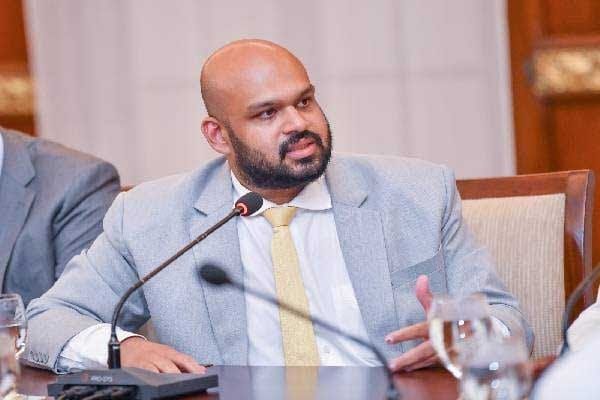
COLOMBO — Sri Lankan police questioned a senior Tamil lawmaker for about four hours over public remarks on power-sharing, federalism and land, in an inquiry examining whether his statements amounted to promoting separatism or stirring hostility between ethnic communities.
R. Shanakiyan, the parliamentary group leader of the Ilankai Tamil Arasu Kachchi, known as ITAK, was summoned after a complaint over comments he made to reporters following a meeting between the party’s lawmakers and President Anura Kumara Dissanayake.
The complaint was filed by Namal Kumara, the director of an organization called the Anti-Corruption Force. It said Mr. Shanakiyan had spoken about power-sharing, about the possibility that Tamils would demand a federal system, and about land rights in the Northern and Eastern Provinces, and alleged that those remarks promoted separatism and could incite antagonism between communities.
Investigators pressed Mr. Shanakiyan on each of those points, according to sources familiar with the questioning. They asked whether demands for greater power-sharing could pave the way for separation, whether his references to federalism could encourage separatism or ethnic conflict, and why he had raised land issues in the North and East.
Mr. Shanakiyan rejected that interpretation of his remarks, the sources said. He told investigators that Tamil political representatives were entitled to seek greater devolution of power to the provincial councils and, if they considered devolution insufficient, to campaign peacefully for a federal system of government.
In support of that position, Mr. Shanakiyan cited a 2017 Supreme Court judgment that rejected an attempt to equate ITAK’s advocacy of federalism with support for a separate state. The court drew a distinction between federalism and secession and found that the party’s objectives did not amount to advocacy for the establishment of a separate state, which is prohibited under Article 157A of the Constitution. Mr. Shanakiyan provided investigators with details of the judgment, according to the sources.
On land, Mr. Shanakiyan told investigators that ITAK represents voters in the North and East and therefore has both a political responsibility and a democratic right to speak about privately owned land in those provinces, as well as areas Tamils regard as their traditional homeland, the sources said.
He also sought to make clear that he was asserting a right arising from political representation rather than an exclusively ethnic claim over the issue. If ITAK were to contest elections elsewhere in Sri Lanka in the future, he told investigators, he would claim the same right to speak publicly about land issues affecting people in those areas, according to the sources.
Devolution, federalism and land have been central to Tamil political demands in Sri Lanka for decades, and successive attempts at constitutional reform have foundered on them. The inquiry places those arguments, long conducted in Parliament and before the courts, in front of criminal investigators.
ITAK has remained politically independent of the government while maintaining working contacts with Mr. Dissanayake, who has presented his administration as an attempt to move the country away from politics organized around ethnicity. The party’s lawmakers met the president at the Presidential Secretariat in December 2024. The complaint that triggered the inquiry came from a private organization, and there is no indication that the government initiated it.
Police recorded Mr. Shanakiyan’s statement and concluded the first round of questioning. It was not immediately clear whether he would be summoned again or whether investigators intended to take further action.